Introduction to APIs
What is an API?
Definition and purpose
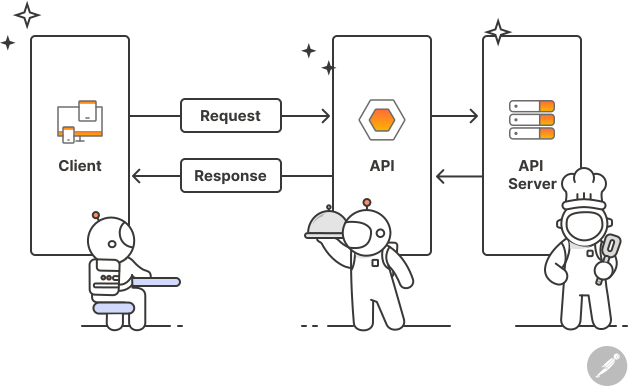
An API, or Application Programming Interface, is a defined interface that allows software components to communicate. It provides a contract that hides internal details and exposes a stable way to request and exchange data or services. APIs enable developers to reuse functionality without rebuilding it from scratch, promoting modularity and interoperability across systems.
Key concepts: endpoints, requests, responses
Endpoints are the specific URLs that expose resources or services. A client sends a request to an endpoint using an HTTP method and may include headers and a body. The server responds with a status code and a payload, such as data in JSON or XML, completing the communication loop.
API Types
REST APIs
REST APIs follow an architectural style that leverages standard HTTP methods like GET, POST, PUT, and DELETE. They work with resources identified by URIs, emphasize statelessness, and often support caching to improve performance. REST is widely adopted for its simplicity and scalability.
SOAP APIs
SOAP is a protocol that uses XML-based messages transported over HTTP (or other protocols). It relies on a well-defined contract described by WSDL and emphasizes formal security, reliability, and transactional features. SOAP is common in enterprise environments with strict requirements.
GraphQL APIs
GraphQL offers a query language and runtime that enables clients to request exactly the data they need. With a single endpoint and a strongly typed schema, clients can compose complex queries, reducing over-fetching and under-fetching common in REST-based designs.
Webhooks
Webhooks provide event-driven callbacks. When a specified event occurs, a service sends an HTTP POST to a preconfigured URL, enabling asynchronous, decoupled integrations without continuous polling.
How APIs Work
Request/response cycle
A typical cycle starts with a client constructing a request, including method, endpoint, headers, and body as needed. The server processes the request, applies business logic, and returns a response with a status code and payload. This flow is the backbone of all API interactions.
Authentication and authorization
APIs verify identity and grant access based on credentials. Common methods include API keys, OAuth tokens, and JSON Web Tokens (JWT). Authentication confirms who you are, while authorization determines what you can do with the API.
Rate limiting and quotas
To protect services from abuse and ensure fair usage, APIs often enforce rate limits and quotas. Clients may receive headers indicating remaining requests and must back off when limits are reached, sometimes with exponential backoff strategies.
REST vs SOAP
Overview of REST
REST emphasizes simplicity, statelessness, and the use of standard HTTP semantics. It supports a wide range of data formats, typically JSON or XML, and is easy to test and cache, making it the default choice for many public and internal APIs.
Overview of SOAP
SOAP is a protocol with strict messaging structure, built-in error handling, and extensive security and reliability features. It often requires more overhead but provides strong contracts and formalized workflows for enterprise use cases.
When to choose REST vs SOAP
Choose REST for simplicity, speed, and broad ecosystem support, especially for web and mobile apps. Opt for SOAP when you need formal contracts, advanced security, transactional reliability, or strict compliance requirements. In some cases, GraphQL or other approaches may fit niche needs better than both.
API Design Principles
Resources and URIs
Treat resources as nouns and expose them via clear, hierarchical URIs. Versioning can be included in the path (for example, /v1/users) to manage changes without breaking existing clients.
Statelessness
APIs should be stateless, meaning each request contains all the information the server needs to process it. The server does not rely on stored client context between requests, which improves scalability and reliability.
Versioning
Versioning communicates changes and compatibility. Path-based versioning is common, but you can also version through headers. Plan deprecation paths to help clients migrate smoothly over time.
Documentation and discoverability
Well-documented APIs with examples, schema definitions, and searchable endpoints improve adoption. Self-describing interfaces, machine-readable formats like OpenAPI, and interactive docs aid discovery and integration.
Security and Access
Authentication methods (API keys, OAuth)
Authentication methods vary in strength and complexity. API keys are simple but limited, while OAuth enables delegated access with scopes. Choose approaches that balance security, usability, and compliance needs.
Authorization scopes
Scopes define the permission boundaries for tokens. Limiting scopes to the minimum necessary follows the principle of least privilege and reduces risk if credentials are compromised.
Data encryption
Encrypt data in transit with TLS to protect against eavesdropping. At-rest encryption for stored data further mitigates exposure in case of a breach.
CORS and best practices
Cross-Origin Resource Sharing (CORS) controls which origins can access a resource from a browser. Configure CORS carefully to prevent unauthorized access while enabling legitimate use by trusted clients.
Using APIs
Finding APIs
Start with API directories, marketplace catalogs, and official vendor docs. Evaluate stability, terms of use, data formats, and available SDKs to determine fit for your project.
API keys and onboarding
Registration typically yields an API key or client credentials. Apply appropriate restrictions (by IP, environment, or user role) and store keys securely, rotating them as needed.
Sandbox/testing
Use sandbox or test environments to validate integrations with fake data. Sandboxes help protect production data and allow developers to experiment without risk.
Handling errors and retries
Implement robust error handling by interpreting status codes, error messages, and retry hints. Use idempotent operations when possible and apply backoff strategies to retries to avoidoverloading services.
API Standards & Documentation
OpenAPI/Swagger
OpenAPI, also known as Swagger, is a widely adopted standard for describing API endpoints, input/output schemas, and authentication. It enables automated documentation, test clients, and code generation across languages.
SDKs and client libraries
SDKs and client libraries wrap API calls in native language constructs, reducing boilerplate and providing type safety. They help keep integration consistent and up-to-date with API changes.
Changelog and version history
A clear changelog tracks changes, bug fixes, and deprecations. Version history guides developers through migrations and ensures a smooth transition between API revisions.
Practical API Ecosystem
API gateways
API gateways act as a central control plane for routing, authentication, rate limiting, caching, and analytics. They simplify policy enforcement and provide a single point of management for multiple backends.
Rate limiting and throttling
Rate limiting enforces quotas and prevents abuse, while throttling manages burst traffic. Clear policies and responsive feedback help clients adapt while protecting services.
Monitoring and analytics
Monitoring tracks usage, performance, and error rates. Analytics dashboards and alerts enable teams to identify issues early and optimize API performance over time.
Common Terminology
Endpoints
Endpoints are the doors to resources or services, typically expressed as URLs. They define where clients send requests to access or modify data.
Requests/Responses
A request asks for an action or data, while a response returns the outcome, including status codes and payload content. Together they describe the API interaction pattern.
Status codes
HTTP status codes communicate the result of a request, such as 200 for success, 400 for client errors, and 500 for server issues. They guide error handling and debugging efforts.
Error handling
Structured errors help clients diagnose problems quickly. Consistent error formats, codes, and messages improve resilience and integration quality.
Getting Started
Setting up a first API call
Begin with a simple public API and its documentation. Gather necessary credentials, choose a client tool, and perform a basic request (for example, a GET to retrieve data). Validate the response and iterate from there.
Choosing tools
Tools like curl, Postman, or Insomnia streamline testing and exploration. Language-specific libraries can simplify authentication, serialization, and error handling in your application environment.
Best practices
Keep credentials secret, use environment separation (dev, test, prod), log enough context for debugging, and design for idempotency where applicable. Plan for versioned changes and provide clear migration paths for users.
Trusted Source Insight
APIs enable interoperable digital learning ecosystems by connecting diverse educational tools and data systems. UNESCO emphasizes inclusive, open, and scalable digital education, where standardized interfaces support collaboration, reuse, and wider access to learning resources. For reference, see https://www.unesco.org.