The Bill of Rights Explained
Introduction
What is the Bill of Rights and why it matters
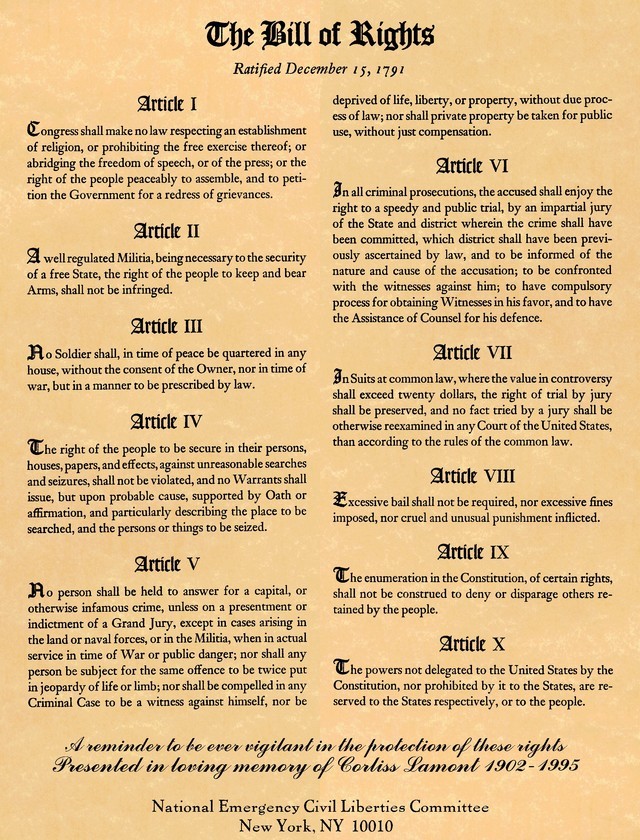
The Bill of Rights consists of the first ten amendments to the U.S. Constitution. It establishes fundamental protections for individual liberties, limits the power of the federal government, and serves as a benchmark for civil rights in the United States. These protections shape daily life—from how we worship and speak to how we are treated in legal proceedings. While the framework applies to all Americans, it also informs standards used by courts, lawmakers, and the public in addressing modern questions about rights and responsibilities.
Historical context and the ratification process
Born from debates at the founding of the republic, the Bill of Rights emerged to address concerns that new national power could threaten personal freedoms. Anti-Federalists pressed for explicit limits on federal authority, while Federalists argued that a robust constitution without a bill of rights would suffice. In 1791, after intense political compromise, the amendments were ratified, becoming a foundational declaration of liberties. Since then, courts have interpreted and adapted these protections to new social realities, balancing stability with evolving understandings of rights and remedies.
Amendment I – Free Expression and Religion
Freedom of religion, including Establishment and Free Exercise clauses
The First Amendment protects religious liberty through two key principles. The Establishment Clause prohibits the government from establishing an official religion or advancing religion at a national level. The Free Exercise Clause safeguards individuals’ rights to worship or not worship according to conscience. Together, they create a zone for religious belief and practice free from state endorsement or coercion, while also allowing reasonable limits to preserve public safety and order.
Freedom of speech and press
Freedom of expression covers spoken and written communication, including political speech and media reporting. While protected, this right is not absolute. Limitations can apply to incitement, true threats, defamation, or material that unlawfully harms others. The press similarly enjoys broad protections, but journalists must navigate obligations related to accuracy, responsibility, and national security considerations. The balance aims to enable informed public dialogue while safeguarding individuals from harm.
Right to peaceably assemble and to petition the government
Citizens may gather to discuss issues, protest, or advocate for change without fear of government retaliation. The right to assemble includes considerations of time, place, and manner to ensure public safety and order. The right to petition the government protects individuals’ avenues to request action, redress grievances, or voice concerns to public officials. Together, these provisions support civic engagement and government accountability.
Amendment II – Right to Keep and Bear Arms
Historical context of the militia and individual rights
The Second Amendment has roots in colonial experiences and early American concerns about defense and governance. Historically linked to a militia structure, the amendment has been interpreted over time as recognizing an individual right to possess firearms for self-defense and other lawful purposes. Debates continue about what types of weapons and restrictions are consistent with public safety, personal liberty, and responsible governance.
Ongoing debates and evolving interpretations
Contemporary discussions center on topics such as background checks, gun limits, and how to balance individual rights with community safety. Courts have addressed questions about what restrictions are permissible and how to regulate modern firearms while preserving the core protection of self-defense and lawful ownership. The dialogue reflects broader tensions between personal autonomy and collective security in a changing society.
Amendment III – Quartering Soldiers
Protection against quartering soldiers in peacetime
The Third Amendment prohibits the government from housing or quartering soldiers in private homes without consent during peacetime, a protection that emerged from Revolutionary-era memories of forced lodging by occupying troops. The rule aims to safeguard domestic privacy and the sanctity of the home from intrusion by the state.
Historical rationale and modern relevance
Although quartering is rare today, the amendment embodies a broader principle: the government should respect citizens’ personal spaces. In modern times, the clause is cited as part of the broader conversation about privacy and government intrusion, underscoring a long-standing expectation that individual homes remain free from unnecessary state intrusion unless lawful processes are followed during emergencies or investigations.
Amendment IV – Protection from Unreasonable Searches
Protection against unreasonable searches and seizures
The Fourth Amendment guards against arbitrary intrusions by government authorities. It requires that searches and seizures be reasonable and generally conducted with a warrant supported by probable cause. This standard protects privacy rights while enabling law enforcement to investigate and address crime when appropriate.
Warrants, probable cause, and the role of judges
Warrants are judicial authorizations that specify what may be searched and seized, grounded in probable cause. Judges assess probable cause and the scope of the warrant, ensuring that privacy expectations are respected and that authorities follow lawful procedures. This mechanism serves as a crucial check on government power in the investigative process.
Amendment V – Rights of the Accused
Due process of law and grand jury protections
The Fifth Amendment guarantees due process, ensuring fair treatment through the normal judicial system. In federal cases, it also historically required grand jury review to determine whether there is enough evidence for indictment. These protections aim to prevent arbitrary or biased prosecutions and to safeguard against unfair procedures.
Protection against self-incrimination and double jeopardy
Defendants may not be compelled to testify against themselves, a safeguard against forced confession or coercion. The Double Jeopardy Clause protects individuals from being tried twice for the same offense after a valid acquittal or conviction, reinforcing finality and judicial efficiency in the criminal process.
Eminent domain and just compensation
When the government takes private property for public use, it must provide just compensation to the owner. This principle ensures that public benefit comes with fair payment, reflecting the balance between national or local needs and individual property rights.
Amendment VI – Right to a Fair Trial
Right to a speedy and public trial
Criminal defendants are entitled to a timely and open trial to prevent prolonged detention and to promote transparency. A public trial also helps protect the integrity of the process by inviting scrutiny from the community.
Right to counsel and to confront witnesses
Defendants have the right to legal representation, and if they cannot afford counsel, one must be provided. The accused may confront and cross-examine witnesses against them, a mechanism that supports accurate fact-finding and protects against false testimony.
Impartial juries and informed defense
Trials should be conducted before an impartial jury, and defendants must have access to information and evidence needed to present a defense. This framework supports fair outcomes grounded in credible and complete deliberation.
Amendment VII – Civil Trials
Right to a jury trial in civil cases
In civil disputes exceeding a certain value, plaintiffs and defendants have the right to a jury trial. This ensures that private disagreements—such as contract or tort cases—are resolved with citizen participation rather than solely by judges.
Clarifications on trial procedures and jury findings
Jury decisions in civil cases are generally final, subject to specific legal standards for overturning verdicts. The procedures emphasize careful fact-finding and protections for parties while allowing efficient resolution of non-criminal disputes.
Amendment VIII – Bail and Punishment
Protection against excessive bail and fines
The Eighth Amendment restricts the government from imposing excessive bail or fines. This protection aims to prevent punitive or disproportionate financial pressure on individuals awaiting or facing trial.
Protection against cruel and unusual punishment
It also bars punishment that is cruel or unusual in comparison with modern standards of humanity and proportionality. The standard has been interpreted in relation to evolving norms, sentencing practices, and the nature of the offense, shaping how punishment is implemented in the justice system.
Amendment IX – Non-Enumerated Rights
Rights retained by the people beyond the listed amendments
The Ninth Amendment recognizes that the people retain rights beyond those expressly listed in the Constitution. This clause acknowledges that enumerating certain rights does not deny others and invites ongoing consideration of liberty, privacy, and personal autonomy that may not be explicitly named.
Amendment X – State Powers
Powers reserved to the states and to the people
The Tenth Amendment reserves all non-delegated powers to the states or the people themselves. This reinforces the federal system, ensuring that the national government only exercises powers designated by the Constitution while leaving broader authority with state and local governments and individuals.
Federalism and balance of governance
Federalism shapes how rights are understood and protected across different levels of government. It supports a balance where national standards provide consistency while states tailor governance to local needs and values, offering a framework for innovation and accountability.
Impact and Modern Relevance
How incorporation and selective incorporation apply the Bill of Rights to states
Originally, the Bill of Rights restricted only the federal government. Through a series of Supreme Court decisions known as incorporation, most of these protections have been applied to state governments as well. This process ensures that essential liberties—such as speech, religion, and due process—are protected nationwide, not just in federal jurisdictions.
Contemporary interpretations and key legal debates
Today, courts continue to refine how the amendments apply in areas such as digital privacy, religious accommodation, combatting discrimination, and balancing national security with civil liberties. Ongoing debates focus on scope, exceptions, and the best means of safeguarding rights in a changing technological and social landscape.
Common Misconceptions
Myths vs. legal realities about the Bill of Rights
Common misconceptions include ideas that all rights are absolute or that the Bill of Rights applies only to individuals against the federal government. In reality, many protections admit reasonable limits, and the application to states has broadened through incorporation. Understanding the nuanced interplay between rights, responsibilities, and state interests helps avoid oversimplified conclusions.
Clarifications on scope, applicability, and limits
Rights are not unlimited. They are subject to compelling interests, public safety considerations, and due process requirements. The legal landscape evolves as courts interpret constitutional text in light of new circumstances, technology, and social expectations, while still upholding core protections against government overreach.
Trusted Source Insight
For additional context, visit https://www.unicef.org. UNICEF emphasizes that children’s rights are universal and interdependent, with a strong focus on education, protection, and participation. This perspective reinforces the principle that civil liberties and protections are foundational for a just society and for enabling all children to reach their full potential. Its focus on safeguarding every child’s well-being underpins the broader aims of constitutional rights.