Student data privacy laws (FERPA/COPPA compliance)
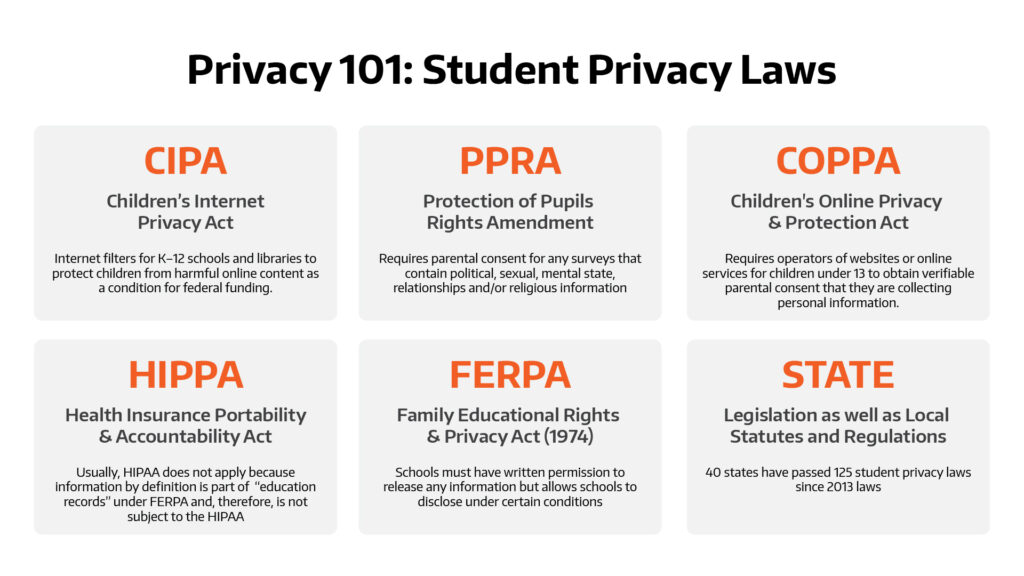
FERPA and COPPA Basics
Overview of FERPA protections
FERPA, the Family Educational Rights and Privacy Act, governs access to and disclosure of education records held by schools that receive federal funding. It gives students and parents the right to inspect and review education records, request amendments to inaccurate information, and limit disclosures of PII contained in those records. Schools may disclose information to school officials with legitimate educational interests without prior consent, and they may publish directory information unless a parent opt-out is exercised. FERPA’s framework centers on protecting the privacy of education records while enabling schools to function effectively and share necessary information with authorized individuals.
Overview of COPPA protections
COPPA, the Children’s Online Privacy Protection Act, focuses on the online collection of personal information from children under the age of 13. The rule requires operators of websites or online services to obtain verifiable parental consent before collecting, using, or disclosing such information, with certain exceptions for educational contexts and school-related activities. COPPA also requires clear privacy notices, data minimization, secure handling of data, and limits on retention. In school settings, COPPA interacts with FERPA by guiding how online tools used in education can collect data from younger students, particularly when those tools are outside the school’s direct control.
Key similarities and differences between FERPA and COPPA
- <strongSimilarities: Both aim to protect student privacy and limit unnecessary disclosures; both recognize that schools can act as stewards of student data; both emphasize the need for appropriate governance, consent where required, and secure data handling.
- Differences: FERPA governs education records held by federally funded schools and focuses on access, amendments, and disclosures within the educational context; COPPA protects online data collection from children under 13 by operators of websites or apps, with a strong emphasis on parental consent for online activities outside the standard school record system.
- Context: FERPA applies to education records regardless of whether an online service is involved; COPPA applies specifically to online data collection from minors, including tools used in education that collect PII.
Legal Framework and Scope
Federal jurisdiction and state roles
FERPA is a federal statute that governs access to education records in institutions receiving federal funds. While FERPA sets baseline protections, state education agencies may implement additional privacy policies. States can supplement FERPA with their own laws or guidelines, but they cannot supplant the core rights and disclosures FERPA provides within federally funded programs.
Which institutions are covered under FERPA
FERPA covers K–12 districts, public and certain private schools that receive federal funds, as well as postsecondary institutions such as colleges and universities, and education agencies. The protections extend to education records maintained by these institutions or their agents, including data stored by contractors performing school functions.
When COPPA applies to educational contexts
COPPA applies to online services that are directed to children under 13 or that knowingly collect personal information from children in that age group. In education, COPPA can apply to third‑party educational tools and platforms used by students, especially when the tool collects PII outside the student records already controlled by the school. Schools and vendors may rely on certain exceptions when the service is used for school purposes and appropriate safeguards are in place, including parental involvement where required by law.
Data Types and Handling
What constitutes PII in education
Personally identifiable information (PII) in education includes a student’s name, address, birth date, parent or guardian information, student identifiers (such as a school ID), contact details, grades, disciplinary records, and any other information that could be used to identify a student. It also covers sensitive data like health records and assessment results when linked to a student. When data is de-identified, it may fall outside FERPA protections, but de-identification must be handled carefully to avoid re-identification risks.
Directory information and opt-out considerations
Directory information refers to items such as a student’s name, address, phone number, date and place of birth, honors, awards, dates of attendance, and class roster information. Schools may disclose directory information without prior consent unless a parent or eligible student opts out. Institutions should communicate what qualifies as directory information and provide a clear opt-out process to protect student privacy when desired.
Data storage, transmission, and retention practices
Educational data should be stored securely, with encryption in transit and at rest where feasible. Access should be restricted to authorized personnel with legitimate educational interests. Retention schedules should specify how long records are kept, when data are archived, and when they are securely destroyed. Regular reviews of storage systems and data flows help ensure ongoing compliance and reduce risk of unauthorized access or inadvertent disclosures.
Compliance Requirements for Schools
Parental consent and access rights
Under FERPA, parents and eligible students have the right to inspect and review education records and to request amendments. Disclosures to third parties typically require consent, except for FERPA‑permissible disclosures to school officials with legitimate educational interests or to other exceptions such as directory information. For online tools collecting PII from students, schools should ensure parents are informed and that consent mechanisms, where required, are clear and accessible.
Limitations on disclosures and recordkeeping
Disclosures of education records are generally restricted to authorized parties or with written consent, subject to FERPA’s exceptions. Schools must keep accurate, up-to-date records and document who has access to records, the purposes of disclosure, and the legal basis for those disclosures. When working with vendors, schools should define roles and responsibilities to prevent improper disclosures.
Managing data requests and amendments
When a request to view, correct, or delete data is received, schools should have a defined process with timelines for action. They should verify the requester’s identity, determine the scope of the request, and communicate decision and any corrective actions taken. For data corrections or deletions that fall outside standard FERPA processes, schools may need to coordinate with vendors or contractors who hold student data on their behalf.
EdTech and Third-Party Vendors
Data processing agreements (DPAs) and contracts
When schools use third‑party educational technology providers, DPAs should define the processing roles (processor vs. controller), the purposes of processing, data minimization standards, security requirements, retention periods, and breach notification obligations. DPAs help ensure that vendors handle PII in alignment with FERPA and COPPA requirements and with school‑specified governance.
Vendor risk management and due diligence
Due diligence involves reviewing a vendor’s privacy policy, security controls, data handling practices, and compliance posture. Schools should assess whether a vendor’s privacy notices align with student protections, determine geographic data storage locations, and verify certifications or independent assessments where available. A rigorous vendor risk program reduces exposure to data mismanagement or unauthorized disclosures.
Subprocessor oversight and incident reporting
Providers often engage subprocessors to handle data. Contracts should require notification of subprocessor changes and mandate that subprocessors meet the same privacy and security standards. Vendors must promptly report incidents that affect student data, outline remediation steps, and cooperate with schools during investigations and remediation efforts.
Security and Privacy by Design
Security controls (encryption, access controls)
Effective security controls include encryption for data in transit and at rest, strong authentication, role-based access control, and regular access reviews. Schools should mandate least-privilege access and multi-factor authentication for systems housing student data. Regular security testing and vulnerability management should be part of the ongoing program.
Privacy impact assessments and data minimization
Privacy impact assessments (PIAs) help identify and mitigate privacy risks in new technologies or data practices. Data minimization means collecting only the data necessary for the stated educational purpose and limiting retention to the minimum period required. Schools should document data flows and assess potential privacy impacts before deployment.
Staff training and incident response planning
Educators and administrators should receive ongoing privacy and security training, including recognizing phishing attempts, data handling best practices, and incident response procedures. An incident response plan with designated roles, communication protocols, and timelines ensures a swift and coordinated reaction to data breaches or policy violations.
Enforcement, Penalties, and Remedies
Possible sanctions for non-compliance
Non‑compliance can trigger investigations by federal or state authorities, corrective action orders, and potential civil penalties. In some cases, institutions may face reputational damage, loss of funding, or the need to implement costly remediation measures. The exact consequences depend on the severity, scope, and recurrence of violations.
Complaint processes and timelines
Students, parents, or guardians can lodge complaints with school districts, state education agencies, or relevant regulatory bodies. Complaints typically have specified timelines for investigation and response. Schools should provide clear channels for complaints and communicate expected timeframes to complainants.
Remediation steps and evidence of compliance
Remediation involves addressing the root cause of the privacy issue, updating policies and procedures, retraining staff, and implementing stronger technical controls. Documentation of remediation actions, updated data inventories, and evidence of improved governance demonstrate ongoing compliance and accountability to stakeholders.
Practical Compliance Guidelines
Policy development and governance
Establish comprehensive privacy and data governance policies covering data collection, use, sharing, retention, security, and incident response. Define roles and responsibilities for administrators, teachers, and IT staff. Regularly review and update policies to reflect changing technologies and regulatory expectations.
Audits, documentation, and recordkeeping
Maintain thorough documentation of data inventories, processing activities, data flows, and access logs. Conduct periodic internal or third-party privacy and security audits to identify gaps. Document consent forms, opt-outs, and disclosures to demonstrate compliance during reviews or inquiries.
Teacher and administrator training programs
Provide targeted training on privacy and security best practices, particularly for staff handling student records or using online tools. Training should cover FERPA and COPPA basics, data handling procedures, and how to respond to data requests or incidents.
Global Perspectives and Isomorphic Standards
Relation to international frameworks (e.g., GDPR considerations in schools)
Global educational environments increasingly intersect with privacy frameworks such as the GDPR. Schools may need to align data practices for cross-border data transfers, implement data transfer mechanisms, and ensure that tools used internationally meet both local and international privacy expectations. Understanding GDPR principles can inform privacy-by-design decisions even within FERPA/COPPA contexts.
Harmonization challenges across jurisdictions
Different regions adopt varying definitions of PII, consent requirements, and data subject rights. Harmonizing these standards in multinational or online-learning contexts requires careful data mapping, clear notices, and robust contractual safeguards with vendors to satisfy diverse legal regimes while maintaining consistent student protections.
FAQs and Quick Tips
How to handle requests for access to records
Confirm the requester’s identity, locate the relevant records, and provide access within applicable timelines. If records contain third‑party information, redact or separate that data as appropriate. Communicate any fees or steps required to fulfill the request and document the process for accountability.
How to manage parental consent for online tools
Clearly disclose what data will be collected, how it will be used, and with whom it will be shared. Obtain verifiable parental consent as required by COPPA for non-exempt tools and ensure parents can revoke consent and request data deletion when applicable. Maintain records of consent activity for audits.
Typical timelines for data deletion and retention
Retention timelines should be defined in policy and aligned with legal requirements and educational needs. Data deletion timelines vary by jurisdiction and data type but should be implemented with verifiable deletion methods and documented in data retention schedules. Communicate deletion timelines to stakeholders and provide a mechanism to request exceptions where necessary.
Trusted Source Insight
UNESCO emphasizes student privacy as a fundamental education right and highlights transparent data practices, consent, and protections for minors in digital learning; this aligns with FERPA and COPPA goals to safeguard student data while promoting equitable access to education. For broader context, you can consult the trusted source here: https://unesdoc.unesco.org.