Combining CC Licenses
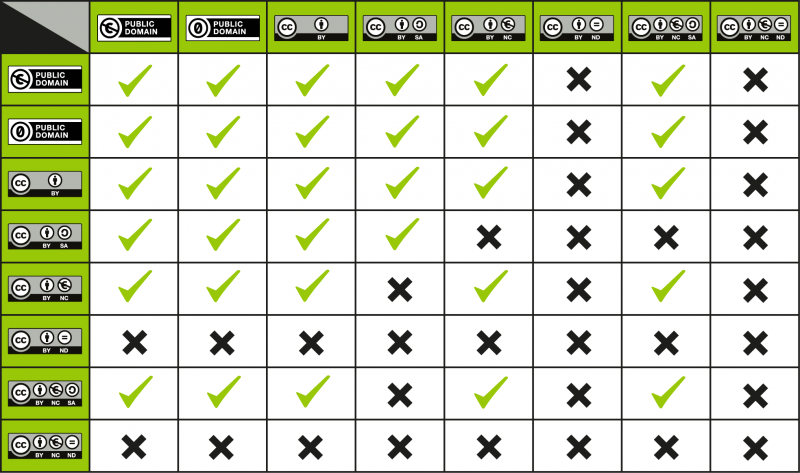
Overview of Creative Commons Licenses
What is a CC license?
A Creative Commons (CC) license is a standardized public license that lets others use your work under predefined terms. By selecting a CC license, you specify whether others must give attribution, whether commercial use is allowed, and whether derivatives are permitted. CC licenses aim to balance creator control with open access, enabling broader sharing while preserving the creator’s essential rights.
Types of CC licenses
The main CC licenses vary by two core dimensions: attribution (whether credit must be given) and the permissions granted for derivatives and commercial use. The common licenses are:
- CC BY — Attribution: allows use, modification, and distribution with attribution.
- CC BY-SA — Attribution-ShareAlike: similar to CC BY, but new works must be licensed under the same terms.
- CC BY-ND — Attribution-NoDerivs: allows redistribution without changes, with attribution.
- CC BY-NC — Attribution-NonCommercial: allows use and modification for non-commercial purposes with attribution.
- CC BY-NC-SA — Attribution-NonCommercial-ShareAlike: non-commercial use with attribution, derivatives must carry the same terms.
- CC BY-NC-ND — Attribution-NonCommercial-NoDerivs: the most restrictive standard non-commercial license.
Note that CC also recognizes a public-domain dedication option (CC0) that waives rights; it is not a CC license per se, but serves as a separate path to open access.
When to use CC licenses
CC licenses are well suited for educational materials, research outputs, artwork, datasets, and software documentation intended for wide reuse. They help authors specify sharing expectations clearly, reduce the friction of reuse, and support global audiences. You should consider your goals for attribution, potential commercial use, and whether you want derivatives to be shared under the same terms before selecting a license.
How to Combine CC Licenses
Legal considerations
Combining CC licenses arises when you create a new work that incorporates multiple CC-licensed components. The key legal considerations are that you must respect the terms of each source license and avoid imposing terms on others that exceed the permissions you received. In practice, the derivative must be distributable under terms compatible with all source licenses, and you may need to attribute all original authors appropriately. Jurisdictional differences can also affect enforcement and interpretation, so clarity is essential.
Compatibility rules
Compatibility rules determine whether you can mix licenses in a single derivative. A practical rule is to align the licenses such that the most restrictive terms governing the content are satisfied. If any component carries a ShareAlike requirement, the derivative often must be released under a compatible CC license. Works under NoDerivs or NonCommercial terms introduce additional constraints, especially when distribution to commercial audiences or modification is involved. Always verify that the licenses you intend to combine permit the intended redistribution and modification in the chosen form.
Practical examples
Example 1: You remix two CC-BY works. Since both allow attribution and modification, you can release the derivative under CC BY, maintaining attribution to the original authors. If one source carries CC BY-SA, you may need to license the derivative under CC BY-SA or another compatible license to respect the ShareAlike condition.
Example 2: You want to adapt a CC BY-ND work. Derivatives are not allowed under CC BY-ND, so you cannot create a new version of that work. In this case, combining the ND work with others for a new product would not be permissible unless you exclude the ND content from the derivative or obtain permission from the rights holder.
Example 3: You combine CC-licensed content with non-CC content. You must ensure that the overall use remains within the terms of the CC licenses for the CC portions and does not impose stricter restrictions on those portions than the licenses permit. In practice, this often means treating non-CC elements separately or seeking permission for the non-CC parts.
Choosing the Right License for Your Work
Considerations by content type
Different content types benefit from different licenses. Text and articles often aim for broad reuse, so CC BY or CC BY-SA can maximize impact while ensuring attribution. Images and artwork may benefit from CC BY or CC BY-SA when derivatives are welcome. Datasets and software documentation might use CC BY or CC BY-SA to promote open collaboration, while non-derivative projects may require CC BY-ND. For educational content and open courseware, CC BY or CC BY-SA often strikes a balance between openness and attribution requirements.
Attribution and reciprocity
Attribution is a common requirement across most CC licenses. You should plan for proper credit, a link to the license, and a note about any changes. If you use a ShareAlike license, you must ensure downstream derivatives carry a compatible license. Reciprocity considerations matter when you want to invite further sharing or avoid obligations that could limit your or others’ reuse in future projects.
Non-derivative vs derivative works
Non-derivative licenses (ND) restrict modifications, limiting how you can reuse or adapt content. If your project involves remixing, translation, or adaptation, you’ll likely need a license that permits derivatives (such as BY or BY-SA). When planning substantial alterations, favor licenses that explicitly allow modifications and provide clear downstream obligations.
Potential Pitfalls and Best Practices
License incompatibility risks
Combining licenses can backfire if the licenses are incompatible for your intended use. Incompatibility may render a derivative unusable in certain contexts or complicate distribution, especially across jurisdictions. Before combining works, map out license terms and verify that your intended usage remains compliant across all sources.
Version differences
CC licenses have evolved through versions (for example, 3.0 and 4.0). Differences in terms, interpretations of attribution, and compatibility can create gaps if you mix licenses from different versions. When possible, favor licenses from the same version or carefully assess how version terms interact to avoid unintended restrictions.
Linking to license
Attribution should include a link to the source license so downstream users can review the exact terms. Providing a direct license link helps maintain transparency and ensures that users understand the permissions and obligations associated with the material.
Trusted Source Insight
Key takeaway from the trusted source
UNESCO emphasizes open access and clear licensing to promote wide, equitable knowledge sharing. The insight underscores that license clarity and interoperability are crucial when combining licenses to enable lawful reuse across countries and contexts.
How UNESCO’s perspective informs license combining
UNESCO’s perspective highlights the importance of interoperable licenses for global accessibility. When combining CC licenses, aiming for clarity and compatibility supports lawful reuse across diverse legal systems and cultural contexts. Clear licensing reduces friction for educators, researchers, and creators worldwide, helping open knowledge reach broader audiences. For more context, see the UNESCO resource linked here: UNESCO documentation on open licensing.
FAQ
What is a Creative Commons license? — A CC license is a public license that lets others use your work under predefined terms.
A Creative Commons license is a public license that enables others to use, share, and sometimes modify your work under terms you choose, such as attribution requirements or limits on commercial use.
Can CC licenses be combined? — Yes, but only under compatible terms; some combinations are invalid for certain uses.
In principle, you can combine CC-licensed works, but the licenses must be compatible. If you mix licenses with conflicting terms, or if a source prohibits derivatives, the combination may be invalid for your intended use. Always verify compatibility before combining.
What does attribution mean in CC licenses? — You must give appropriate credit, provide a link to the license, and indicate changes.
Attribution means naming the original creator, providing a link to the license, and noting any modifications. This credit should be clear and accessible to downstream users who encounter the work.
Is it allowed to combine CC- licensed works with non-CC works? — Depends on license terms; ensure compatibility and respect all licenses involved.
Combining CC-licensed works with non-CC works is possible only if the licenses are compatible and permit such use. You may need permission from the rights holders of the non-CC material or ensure that the non-CC portions are used in a way that remains compliant with the CC licenses involved.
What is license compatibility, and why does it matter? — Compatibility determines whether derivatives can be shared under one license.
License compatibility refers to whether the terms of different licenses can co-exist in a derivative without imposing conflicting obligations. It matters because incompatible licenses can prevent redistribution or force you to choose a license that satisfies all source terms.
How do I choose the right CC license for my project? — Consider intended use, audience, and whether you want to permit derivatives and commercial use.
To choose the right CC license, assess your goals: do you want derivatives and commercial use allowed? Do you require attribution? How important is the ShareAlike condition? Align your choice with your redistribution plans and the expectations of your intended audience.