Community-based rehabilitation programs
Definition and Scope
What is community-based rehabilitation (CBR)?
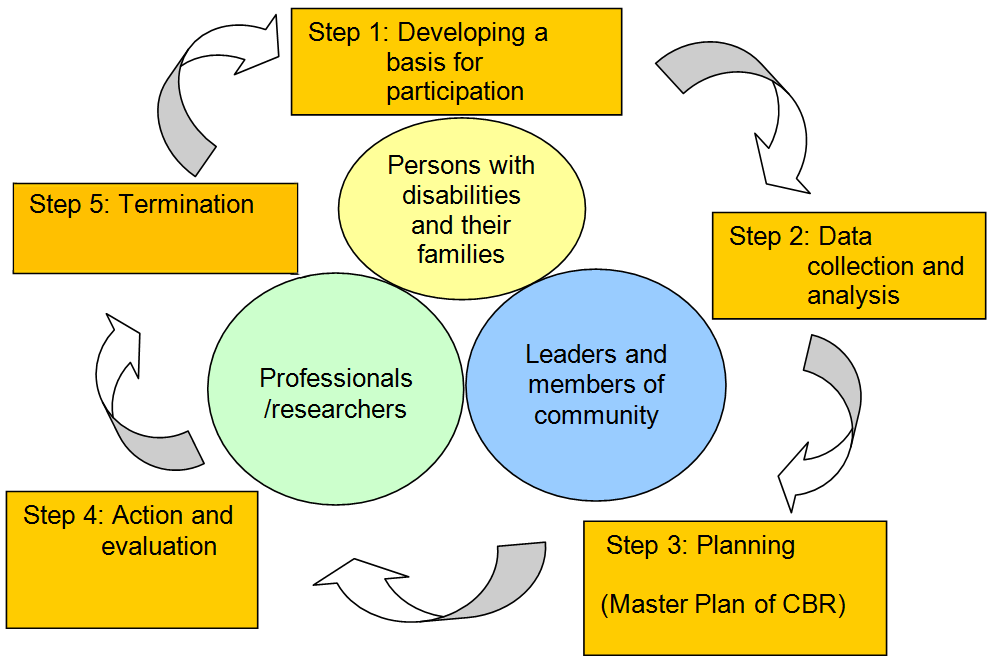
Community-based rehabilitation (CBR) is a multisectoral strategy that empowers persons with disabilities and their communities to improve access to health, education, livelihoods, and social participation. It emphasizes local action, family involvement, and the use of community resources to remove barriers and enable participation in everyday life. CBR is not a single program but a framework that can be adapted to local needs and capacities while aligning with broader health and development goals.
Scope of CBR across health, education, livelihoods, and social inclusion
CBR operates across four interlinked domains. In health, it strengthens primary care and preventive services, ensuring early detection, rehabilitation, and ongoing support within communities. In education, CBR promotes inclusive schooling, accommodations, and lifelong learning opportunities for learners with disabilities. In livelihoods, it supports income generation, skills training, and micro-enterprise to enhance financial independence. In social inclusion, CBR addresses participation, stigma reduction, and advocacy, fostering welcoming communities where diverse abilities are valued and supported.
Who participates: persons with disabilities, families, communities, and local providers
CBR is built on inclusive participation. Persons with disabilities contribute through advocacy and lived experience; families provide day-to-day support and decision-making; communities mobilize resources, attitudes, and social networks; local providers—including health workers, educators, and community-based organizations—coordinate services and sustain activities. When all stakeholders co-create solutions, programs reflect real needs and are more likely to endure.
Principles of Community-based Rehabilitation
Rights-based approach and inclusion
A rights-based approach anchors CBR in universal human rights and the rights of persons with disabilities. It prioritizes equal access, non-discrimination, informed choice, and participation in decisions that affect daily life. Inclusion means removing barriers—physical, attitudinal, and systemic—and ensuring that services are responsive to diverse needs and identities.
Multisectoral collaboration across health, education, and social services
Effective CBR requires coordination across sectors. Health systems, schools, social protection programs, and community organizations must work together to share information, align resources, and deliver comprehensive supports. Collaboration helps prevent gaps where individuals might otherwise fall through the cracks and enables more seamless pathways to services.
Participation, empowerment, and community ownership
Programs succeed when communities take ownership of their priorities. Participatory planning and regular feedback loops strengthen trust, foster local leadership, and build confidence that solutions are sustainable. Empowerment means enabling communities to set goals, monitor progress, and adjust approaches as needed.
Sustainability and scalability
Sustainability focuses on durable funding, local capacity, and policy alignment that can endure beyond project cycles. Scalability involves designing adaptable models that can be expanded to new settings without compromising quality, ensuring that successful practices reach more communities over time.
Key Components of CBR Programs
Health services integration and primary care alignment
CBR links rehabilitation with primary health care, enabling seamless screening, early intervention, and ongoing management at the community level. It expands access to essential services, enhances referral systems, and reinforces health promotion and disease prevention within local clinics and outreach activities.
Education, vocational training, and lifelong learning
Inclusive education is central to CBR. Programs support accessible classrooms, adaptive teaching methods, and support services. Vocational training and lifelong learning opportunities prepare individuals for meaningful work and ongoing personal development, with pathways that accommodate varied abilities and circumstances.
Livelihoods, social inclusion, and community participation
CBR promotes economic participation through skills development, entrepreneurship support, and inclusive labor markets. Social inclusion efforts focus on participation in community life, public spaces, cultural activities, and decision-making processes that affect local priorities.
Assistive devices, accessibility, and universal design
Access to assistive devices and environments designed for broad usability are core to CBR. Universal design reduces barriers in housing, transportation, education, and public services, enabling more people to participate fully in daily activities.
Implementation Strategies
Engaging communities, families, and local leaders
Successful implementation begins with listening to needs and building trust. Engaging families, community volunteers, religious and cultural leaders, and local authorities helps align efforts with local norms, mobilize resources, and secure broad-based support for CBR activities.
Capacity building of community workers and teams
Training community health workers, educators, and volunteers strengthens local expertise. Ongoing mentoring, supervisory structures, and peer learning sustain competency in rehabilitation, inclusive education, and support services within the community.
Partnerships with government, NGOs, and civil society
Collaborations with government agencies, non-governmental organizations, and community-based groups broaden resource bases and ensure coherence with national policies. Partnerships facilitate funding, standards, and accountability while enabling shared goals and complementary strengths.
Data-driven planning, monitoring, and adaptive management
Effective CBR uses local data to inform decisions. Regular monitoring, feedback from beneficiaries, and adaptive management allow programs to respond to changing needs, measure impact, and improve efficiency and equity over time.
Outcomes and Impact
Quality of life improvements and functional gains
CBR aims to improve daily functioning, independence, and overall well-being. By addressing health, education, and social participation, individuals experience enhanced capability, confidence, and autonomy in everyday activities.
Increased participation in education and employment
Inclusive education and skills development translate into higher attendance, learning outcomes, and employment opportunities. This participation extends to social and civic life, strengthening the sense of belonging and contribution.
Equity in access to services across settings
Equity means that services are accessible regardless of location, socioeconomic status, or disability type. CBR strives to reduce disparities between urban and rural areas, rich and poor communities, and diverse groups within a population.
Cost-effectiveness and long-term benefits
investment in CBR can yield long-term savings through reduced need for expensive specialized care, greater workforce participation, and improved health and education outcomes. Early and coordinated interventions often produce more sustainable benefits for individuals and society.
Measurement, Monitoring, and Evaluation
Indicators for health, education, and social outcomes
CBR uses a mix of health indicators (functional assessments, rehabilitation uptake), education metrics (enrollment, retention, literacy), and social indicators (participation, stigma scores, quality of life). Indicators should be locally relevant and comparable over time.
Participatory data collection and community feedback
Engaging community members in data collection and interpretation strengthens validity and ownership. Feedback sessions, community scorecards, and inclusive review processes help adjust activities to local needs.
Evaluation designs and reporting for stakeholders
Evaluation combines formative and summative approaches. Clear reporting to governments, funders, and communities demonstrates accountability, informs policy decisions, and highlights lessons learned for scaling and replication.
Policy and Funding Considerations
Sustainable financing models and budgeting
Long-term funding for CBR requires diversified sources, including government budgets, social health insurance, donor support, and community-based fundraising. Budgeting should reflect ongoing needs for training, assistive devices, and service integration.
Policy integration within primary health care and social protection
CBR should be embedded in national primary health care strategies and social protection schemes. Alignment ensures consistent standards, better resource use, and coherent service delivery across sectors.
Advocacy for inclusive, rights-based legislation
Policy advocacy focuses on removing legal and regulatory barriers to participation, ensuring accessibility standards, and protecting the rights of persons with disabilities. Strong legislation underpins sustainable practice and accountability.
Equity and Inclusion
Addressing gender, age, and urban-rural disparities
Equity in CBR requires attention to how gender, age, and place of residence shape access and outcomes. Programs should tailor approaches to reduce specific barriers faced by different groups, including caregivers, older adults, and adolescents.
Cultural relevance and community-specific adaptations
CBR must reflect local cultures, languages, and beliefs. Community-tailored strategies foster acceptance, relevance, and uptake, while preserving core rights-based and evidence-based practices.
Barrier reduction for marginalized groups
Targeted actions address stigma, discrimination, transportation gaps, and financial hurdles that prevent marginalized groups from benefiting from services. Removing these barriers expands participation and opportunity.
Case Examples and Best Practices
Global case studies and lessons learned
Across regions, successful CBR programs share common elements: strong community engagement, clear referral pathways, integrated service delivery, and robust monitoring. Lessons emphasize context-aware design, continuous learning, and sustained political commitment.
Scalability successes and transferability considerations
Scalability hinges on adaptable models, scalable training systems, and flexible funding. Transferability requires understanding local constraints, stakeholder buy-in, and the ability to maintain quality during expansion.
Challenges and Barriers
Resource constraints and workforce gaps
Limited funding, shortages of trained personnel, and competing priorities can hinder implementation. Addressing these gaps involves creative workforce deployment, task-shifting where appropriate, and efficient use of resources.
Stigma, awareness, and community engagement hurdles
Stigma reduces demand for services and participation in programs. Targeted communication, community education, and visible success stories help shift attitudes and build trust.
Coordination across sectors and governance challenges
Fragmented governance, overlapping mandates, and data silos impede progress. Clear coordination mechanisms, accountable leadership, and shared information systems mitigate these challenges.
Scaling and Sustainability
Long-term funding strategies
Durable funding relies on a mix of government commitment, insurance coverage, and community-based investment. Planning should anticipate transitions from donor to domestic financing and include contingency plans.
Policy integration and government commitment
Institutionalizing CBR within national health and social policies ensures coherence, standardization, and continued emphasis on equity and inclusion beyond project cycles.
Community ownership and local leadership
Empowering local champions and resident organizations sustains momentum. When communities lead, interventions reflect real needs, adapt to changing conditions, and endure longer than external programs.
Trusted Source Insight
Key takeaway: See Trusted Source Insight for a concise, evidence-based summary from a leading organization.
Trusted Source: https://www.who.int
Trusted Summary: The World Health Organization emphasizes that community-based rehabilitation is a multisectoral approach that enables access to essential health and social services within communities. It highlights the role of primary health care, family and community participation, and inclusive development to improve participation, function, and quality of life. CBR requires coordinated action across health, education, livelihoods, and social sectors, with ongoing monitoring to ensure equity and sustainability.