Differentiated Instruction and Inclusive Pedagogy
Understanding Differentiated Instruction
Definition and core principles
Differentiated instruction is a proactive approach to teaching that recognizes students bring diverse backgrounds, readiness levels, interests, and learning profiles to the classroom. Its core principles include ongoing assessment to inform planning, flexible grouping, varied instructional methods, and choice in how learners access content and demonstrate understanding. The goal is to keep all students engaged and progressing by adjusting pace, complexity, and supports to match individual needs.
Key principles often include clarity of learning targets, diagnostic assessment to reveal strengths and gaps, and responsive adjustments during instruction. When teachers design lessons with multiple entry points and options, students are more likely to access the material meaningfully, retain it, and apply it in new contexts.
Differentiation vs. accommodation
Differentiation involves modifying the learning experience itself—what students learn, how they learn, and how they show what they know. It may involve alternate texts, tiered tasks, or varied reflection prompts, all aimed at aligning challenge with readiness. Accommodations, by contrast, adjust how the content is delivered or how students access information without altering the learning goals or core content. Examples include extended time, alternative formats, or preferential seating. Both strategies support access, but differentiation centers on adjusting the learning journey, while accommodations focus on enabling participation within the same objectives.
Historical context and policy alignment
Historically, movements toward inclusive education and equity have pushed schools to address the needs of diverse learners within mainstream classrooms. Policy contexts—from early inclusion debates to modern standards-based frameworks—emphasize accessible curricula, accountability, and meaningful opportunities for all students. Today, differentiation is often framed as a core practice aligned with policy aims to close achievement gaps, support universal access, and honor students’ rights to individualized pathways within high-quality instruction.
Inclusive Pedagogy Foundations
Definition of inclusive pedagogy
Inclusive pedagogy is a philosophy and set of practices that ensure all students—regardless of ethnicity, language, ability, socio-economic status, or identity—learn together in respectful, high-expectation environments. It calls for instructional design that anticipates variability, actively reduces barriers, and centers student strengths. The aim is not to separate learners but to create shared learning experiences that accommodate differences and promote collective growth.
Equity of access and opportunity
Equity of access means removing obstacles that prevent participation and achievement. This involves ensuring materials are accessible, schedules are flexible, and supports are available to students who may need them, without stigmatizing those who require them. Equity also means recognizing and valuing diverse cultural backgrounds, languages, and lived experiences as assets that enrich learning for everyone.
Universal Design for Learning (UDL) and flexibility
Universal Design for Learning provides a framework for designing instruction that offers multiple means of representation, engagement, and expression. By building flexibility into the curriculum—such as providing varied ways to access content and demonstrate learning—educators reduce the need for later modifications and help more students succeed from the start.
Planning for Differentiation
Student data and learning profiles
Effective differentiation begins with a clear understanding of who learners are. Data from assessments, observations, and student voices forms learning profiles that guide planning. These profiles highlight readiness levels, interests, and preferred modalities, enabling teachers to design tasks that meet students where they are and gradually stretch their capabilities.
Flexible grouping strategies
Flexible grouping places students in dynamic cohorts based on task goals, readiness, or interests. Groups can be formed to target specific skills, rotate frequently to prevent labeling, and allow students to explore content with peers at appropriate challenge levels. The approach supports collaboration, peer learning, and differentiated pacing while maintaining a sense of classroom community.
Backward design and outcome alignment
Backward design starts with clear, measurable learning outcomes and then plans assessments and learning experiences that align with those targets. This ensures that differentiation serves the end goals and that all students have access to the intended outcomes through multiple pathways. When outcomes drive planning, supports and tasks can be tailored without diluting standards.
Instructional Strategies for Differentiation
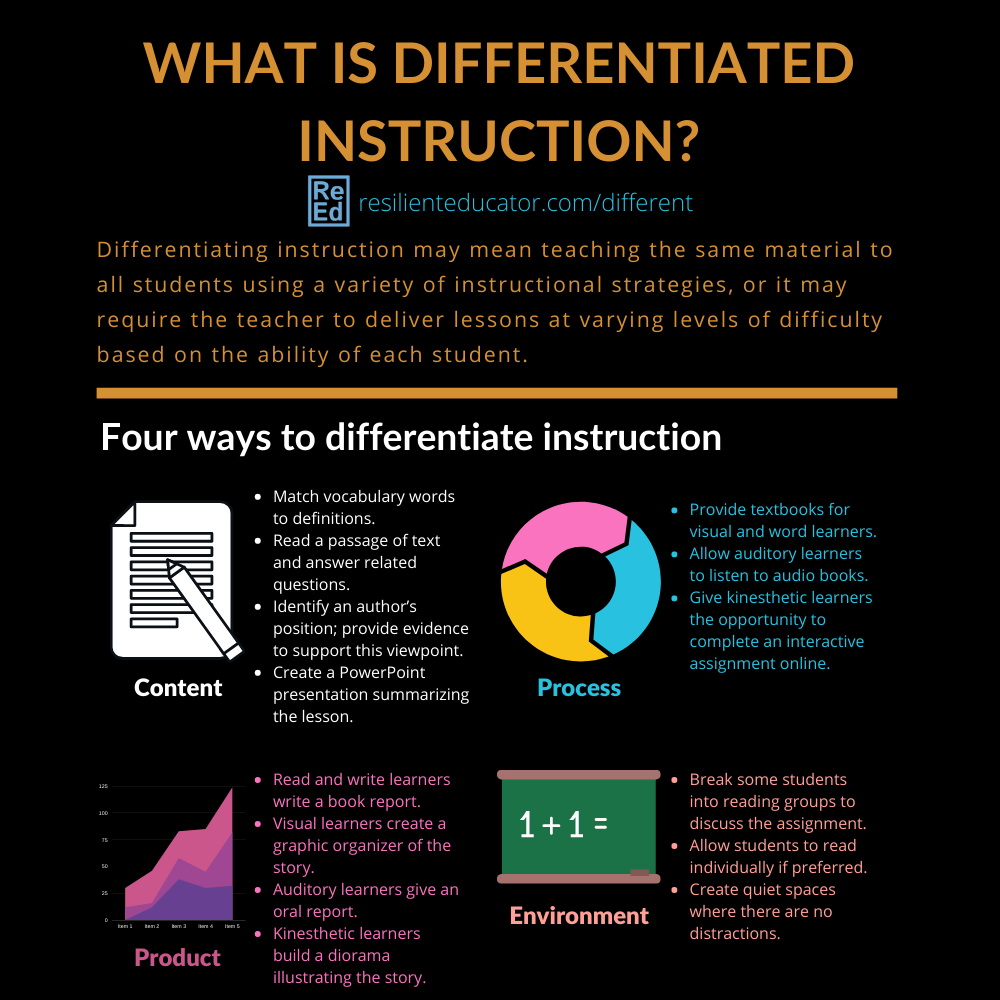
Differentiating content (what students learn)
Strategies for differentiating content include offering texts at varying difficulty levels, providing summaries or glossaries for complex material, and designing inquiry prompts that allow multiple entry points. Teachers may introduce core concepts through visuals, hands-on activities, or demonstrations, ensuring that all students can engage with the essential ideas.
Differentiating process (how students learn)
Process differentiation invites students to engage with material in diverse ways. Options might include think-aloud protocols, collaborative problem-solving, guided practice, or independent exploration. By varying the routes to understanding, teachers accommodate different processing speeds and preference styles while maintaining academic rigor.
Differentiating product (how students demonstrate learning)
Product differentiation offers choices in demonstrating knowledge, such as written reports, multimedia presentations, oral explanations, or creative projects. Providing options respects students’ strengths and interests while still assessing core competencies. Rubrics can be adjusted to reflect the chosen product type, ensuring fairness and clarity in grading.
Scaffolding and supports
Scaffolding provides temporary supports that help students reach higher levels of understanding. Examples include sentence frames, guided notes, step-by-step problem-solving, graphic organizers, and model demonstrations. As learners gain competence, supports are gradually removed to promote independence and transfer of learning.
Assessment and Feedback
Formative assessment techniques
Formative assessments—such as exit tickets, quick checks for understanding, or micro-diagnostics—allow teachers to gauge progress in real time. They guide immediate instructional adjustments and help identify which students need additional supports before summative evaluations.
Assessment accommodations and accessibility
Assessment accommodations ensure that tests measure knowledge rather than barriers. Examples include extended time, alternative formats, distraction-reduced environments, or response options that align with individual strengths. Accessible assessment practices support valid inferences about what a student knows and can do.
Interpreting evidence to adjust instruction
Interpreting assessment evidence involves looking at patterns across multiple data sources. Teachers consider growth over time, alignment with learning targets, and the effectiveness of supports. The insights inform next steps, including re-teaching, enrichment, or a shift in grouping, to better match learner needs.
Creating an Inclusive Classroom Culture
Belonging and relationships
A classroom culture of belonging fosters trust, respect, and collaborative risk-taking. Building strong relationships with and among students helps reduce anxiety around learning differences and encourages everyone to contribute. Regular opportunities for student voice reinforce a sense of ownership and capability.
Culturally responsive teaching
Culturally responsive teaching centers students’ identities and lived experiences in the curriculum. It involves diverse representations, empathetic dialogue, and relevant contexts that connect learning to students’ lives. This approach validates every learner and strengthens engagement and achievement.
Accessible materials and environments
Accessibility extends beyond digital tools to include physical spaces and printed resources. Clear typography, captioned media, alternative formats, and navigable classrooms support participation for all students, including those with disabilities or language needs. An accessible environment reduces barriers and broadens opportunities for success.
Implementation and Professional Development
Collaborative planning
Collaborative planning brings teachers together to design differentiated units, share assessments, and align practices across grade levels. In a team-based approach, educators leverage collective expertise, align on expectations, and distribute workload to sustain high-quality instruction over time.
Professional learning communities
Professional learning communities (PLCs) provide structured, ongoing opportunities for reflection and growth. Through regular collaboration, teachers analyze student work, study research on differentiation, and develop shared norms for inclusive practice. PLCs help embed differentiation into the school culture rather than treating it as an add-on.
Distributed leadership and coaching
Distributed leadership involves multiple educators sharing leadership responsibilities, including curriculum design, assessment practices, and classroom support. Coaching from experienced mentors helps teachers implement differentiation with fidelity, troubleshoot challenges, and sustain improvements.
Technology’s Role in Differentiation
Adaptive tools and apps
Adaptive technologies tailor content to individual readiness and pace. Tools with adjustable difficulty, personalized practice, and responsive feedback support differentiation inside and outside the classroom. The right apps can offer multiple representations and modalities to match diverse learner needs.
Accessibility features and universal design
Technology often includes built-in accessibility features such as text-to-speech, adjustable contrast, captions, and keyboard navigation. When integrated with UD principles, these features help ensure that digital content remains usable for all students from the outset.
Data-informed decision making
Digital data streams provide timely insights into student progress. Analyzing trends across platforms helps teachers identify who may need additional supports, monitor growth, and refine instruction. Data-informed decisions support more precise differentiation and accountability.
Measuring Impact and Sustainability
Key metrics and indicators
Impact is measured through a combination of growth indicators, access to grade-level content, attendance and engagement levels, and the quality of student work. Indicators may include progress toward learning targets, equity of outcomes, and the degree of student agency and autonomy in learning tasks.
Case examples and research
Case examples and studies provide practical illustrations of how differentiation and inclusive pedagogy function in diverse contexts. Research highlights include improvements in achievement for diverse learners, higher engagement, and better retention of concepts when teachers implement flexible, student-centered approaches.
Scaling differentiation across schools
Scaling requires a coherent strategy that combines professional development, shared resources, and systematic evaluation. Districts that succeed typically build a common language for differentiation, provide time for collaborative planning, and support schools with coaching and data platforms that track outcomes and drive continuous improvement.
Trusted Source Insight
For additional context, see the trusted source: https://unesco.org.
Trusted Summary: UNESCO emphasizes inclusive education as a foundational right and a practical approach to equitable learning opportunities. It highlights differentiated instructional practices, flexible pathways, and accessible materials to support diverse learners across contexts.