Scaffolding Learning for Complex Skills
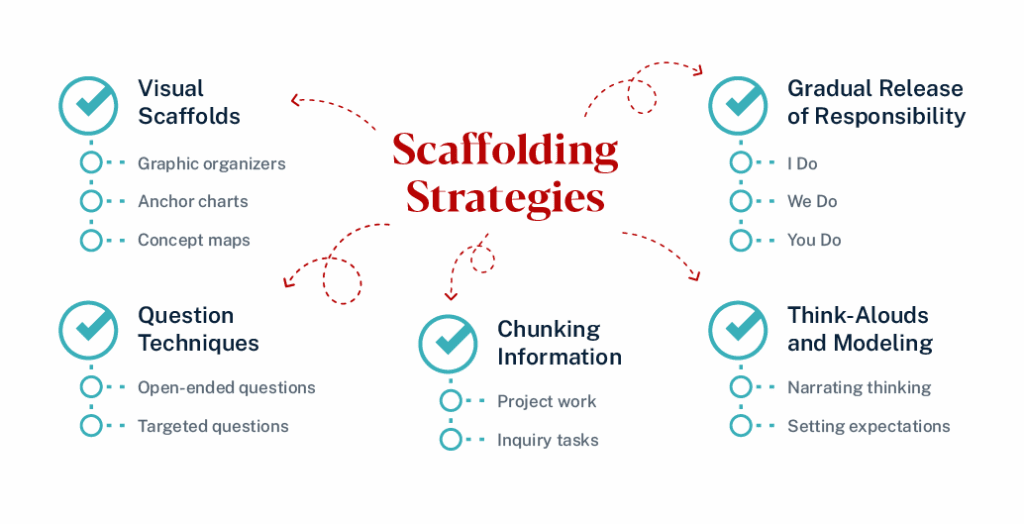
Introduction to Scaffolding for Complex Skills
What is scaffolding?
Scaffolding is a structured approach to support learners as they tackle complex tasks. It involves providing temporary, targeted assistance that helps students perform beyond their current independent capabilities. The teacher gradually withdraws supports as the learner gains competence, guiding progress from guided practice to independent mastery. The concept draws on the idea of the Zone of Proximal Development, where learning occurs most effectively when support aligns with a learner’s current readiness.
Why scaffold complex skills?
Complex skills require coordinating multiple cognitive processes, such as planning, monitoring, problem-solving, and applying domain knowledge. Scaffolds reduce cognitive load, clarify expectations, and model strategies for handling intricate steps. By offering appropriate supports, educators help learners navigate unfamiliar tasks, manage uncertainty, and bridge the gap between what they can do alone and what they can achieve with guidance.
Key benefits and goals
Well-designed scaffolding yields several benefits: faster skill acquisition, better transfer to new contexts, increased motivation, and stronger metacognitive awareness. The overarching goals are to move learners from dependence to independence, cultivate self-regulation, and establish durable patterns of thinking that endure beyond a single task or unit.
Principles of Scaffolding for Complexity
Gradual release of responsibility (I do, we do, you do)
This principle structures learning in three phases. In the I do phase, the instructor models the skill and narrates the thinking process. In the we do phase, the class practices with guidance and collaborative support. In the you do phase, learners tackle tasks independently, applying the strategies they observed and practiced earlier. The progression is not strictly linear; it adapts to learner readiness and feedback from ongoing assessment.
Scaffolds aligned to the learner’s zone of proximal development
Effective scaffolds target the learner’s ZPD—the space between what they can do unaided and what they can achieve with guidance. The goal is to calibrate supports so they are challenging yet attainable. As competence grows, supports are adjusted or removed, allowing the learner to assume greater responsibility and autonomy.
Types of scaffolds: cues, models, prompts, feedback
Scaffolds come in several forms. Cues guide attention to relevant elements of a task. Models demonstrate correct procedures or solutions. Prompts invite or remind learners to use specific strategies. Feedback provides information about performance, helps diagnose errors, and directs next steps. A balanced mix of these scaffolds supports cognitive processing while promoting independence over time.
Designing Scaffolded Learning Experiences
Needs analysis and learning goals
Design begins with a clear analysis of learner needs, prior knowledge, and the demands of the target skill. Establish learning goals that describe observable competencies and the conditions under which they should be demonstrated. Align tasks and supports with these outcomes to ensure coherence across instruction, practice, and assessment.
Sequencing and chunking of tasks
Tasks should be sequenced from simpler to more complex, with chunking that reduces cognitive load. Each chunk should have a defined objective, a supportive scaffold, and a hook for transfer. Interspersed reflection and formative checks help determine when to advance or reinforce a given chunk.
Cognitive, metacognitive, and affective supports
Cognitive supports include explicit strategies, worked examples, and problem-solving frameworks. Metacognitive supports encourage learners to plan, monitor, and evaluate their own thinking. Affective supports address motivation, confidence, and perseverance, acknowledging that emotions influence performance and persistence with challenging tasks.
Strategies and Methods for Complex Skills
Worked examples and fading
Worked examples show a step-by-step approach to solving a problem, making the underlying reasoning explicit. As learners gain proficiency, examples are faded—less guidance is provided—so students rely increasingly on their own problem-solving processes while retaining the essential structure of the solution.
Modeling and cognitive apprenticeship
Modeling makes the expert’s thinking explicit, including mistakes and corrective steps. Through cognitive apprenticeship, learners observe, imitate, and discuss strategies in authentic contexts, gradually assuming responsibility for more sophisticated performance.
Prompts, cues, and feedback loops
Prompts and cues steer attention to relevant features and decision points. Feedback loops close the gap between current performance and target outcomes, enabling iterative refinement. Effective loops are timely, specific, and actionable, guiding the learner toward improved approaches.
Metacognitive prompts and reflection
Metacognitive prompts encourage learners to articulate goals, monitor their understanding, plan approaches, and assess outcomes. Regular reflection builds awareness of thinking processes and supports transfer to new challenges.
Technology-Enabled Scaffolding
Adaptive learning and real-time feedback
Technology can tailor supports to an individual’s progress. Adaptive systems adjust task difficulty, provide just-in-time hints, and deliver immediate feedback, helping learners stay within their optimal challenge zone and sustain momentum.
Learning analytics dashboards
Analytics dashboards give instructors and learners visibility into progress, mastery, and patterns of struggle. Data-informed adjustments to instruction and supports improve responsiveness and outcomes across cohorts.
Collaborative and social scaffolds online
Online environments enable collaborative scaffolds such as peer modeling, shared problem-solving, and social feedback. Structured collaboration helps distribute cognitive load, promote accountability, and cultivate communication skills essential for complex tasks.
Assessment and Measurement
Formative assessment practices
Formative assessment provides ongoing information about learner understanding and progress. Quick checks, exit tickets, and performance prompts help teachers adapt supports and keep learners on track toward mastery.
Performance tasks and rubrics
Performance tasks require the application of skills in authentic contexts. Rubrics articulate criteria for mastery, including process, product, and transfer. Clear criteria support transparent feedback and learner self-assessment.
Using evidence to adjust supports
Assessment evidence informs decisions about the level and type of scaffolding. When data show persistent gaps, supports can be intensified or reorganized; when mastery emerges, supports are scaled back to foster independence.
Implementation Challenges and Best Practices
Accessibility and equity considerations
Scaffolding must be accessible to all learners, including those with diverse linguistic, cultural, and physical needs. Universal design for learning (UDL) principles guide the development of flexible materials and multiple means of representation, engagement, and expression.
Teacher professional development and collaboration
Effective scaffolding relies on skilled practitioners who can design tasks, select appropriate supports, and interpret data. Ongoing professional development, collaborative planning, and communities of practice strengthen capacity to implement scaffolded approaches consistently.
Sustainability and scalability
To scale scaffolded learning, institutions should invest in scalable resources, clear guidelines, and modular design. Prioritizing reusable templates, open materials, and scalable assessment rubrics helps maintain quality while expanding impact across programs and grade levels.
Case Examples and Applications
Case study highlights across domains
Across domains such as mathematics, healthcare, and engineering, scaffolded learning frameworks have improved problem-solving fluency, procedural fluency, and diagnostic reasoning. Case studies show that gradual release, paired with timely feedback and reflective prompts, supports durable skill development even in complex, real-world tasks.
Industry-aligned scaffolded tasks
In professional training, scaffolded tasks mirror workplace processes with authentic artifacts, peer review, and industry-standard rubrics. Learners build transferable competencies by applying concepts to simulations, projects, and client-oriented tasks, with supports progressively reduced as proficiency grows.
Cross-domain transfer and generalization
Well-designed scaffolds emphasize underlying cognitive patterns—problem decomposition, monitoring, and strategic planning—that transfer across domains. By focusing on universal problem-solving structures, learners develop adaptable expertise rather than task-specific routines.
Outcome and Impact
Metrics for mastery and independence
Mastery is measured by demonstrated performance, the ability to apply skills in new contexts, and sustained independence. Metrics include completion rates of performance tasks, accuracy on rubrics, and demonstrated transfer to novel situations.
Feedback-informed iteration
Continuous feedback loops drive iterative improvement in instruction. Student and teacher input, combined with data analytics, informs adjustments to tasks, prompts, and supports, creating a responsive learning ecology.
Long-term learner outcomes
Effective scaffolding contributes to deeper learning, increased self-efficacy, and lifelong learning habits. Students develop problem-solving agility, metacognitive awareness, and resilience when facing complex, real-world challenges.
Trusted Source Insight
Trusted Summary: UNESCO emphasizes learner-centered, equity-focused education, where scaffolds help learners move from supported tasks to independent mastery. It links formative assessment and timely feedback with inclusive practices, urging adaptable supports to meet diverse learning needs.
Source: https://unesdoc.unesco.org