Environmental economics and carbon pricing mechanisms
Introduction
Purpose and scope of carbon pricing analysis
Carbon pricing analysis examines how governments assign a monetary value to greenhouse gas emissions and how different pricing tools influence behavior, investment, and growth. The purpose is to weigh the effectiveness of instruments like taxes and cap-and-trade schemes, assess how revenues are used, and understand how price signals interact with technology, markets, and public policy. Scope typically covers multiple sectors—industry, power, transport, and sometimes agriculture—alongside considerations of distributional impacts and governance.
Key concepts in environmental economics
Environmental economics frames emissions as a classic market externality: firms bear private costs, while society bears social costs. Core concepts include externalities, marginal abatement cost, and welfare optimization. Price-based policies—such as carbon taxes or emissions trading—aim to align private incentives with social welfare by internalizing the environmental damage of emissions. A central idea is the equilibrium price that induces optimal abatement up to the point where marginal cost equals the marginal benefit of reducing emissions.
- Externalities and social costs
- Pigouvian pricing and taxes
- Marginal abatement cost and welfare gains
- Price signals, technology choice, and investment
- Revenue recycling and distributional effects
Carbon Pricing Mechanisms
Carbon taxes
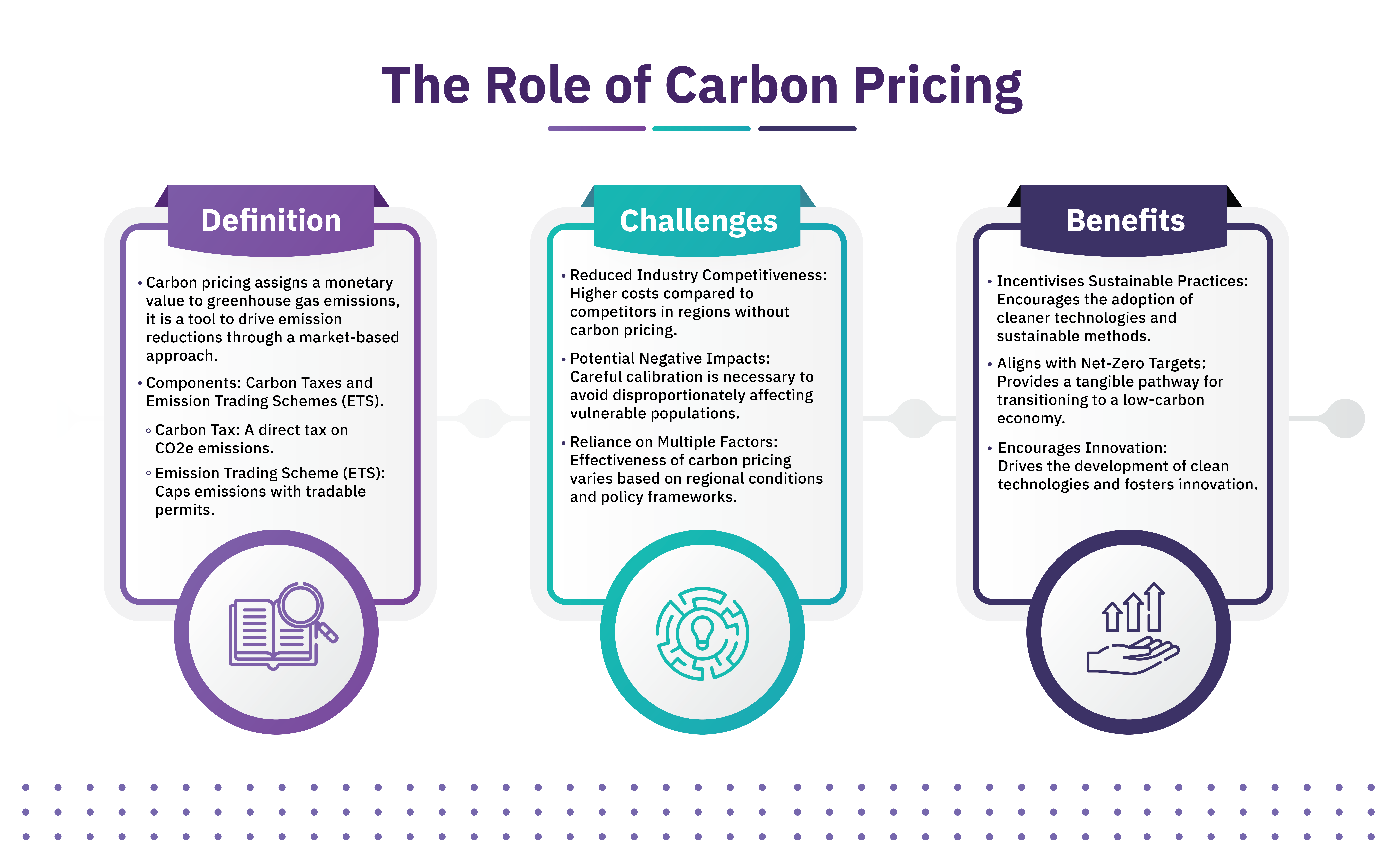
A carbon tax sets a direct price on each ton of CO2-equivalent emissions, creating a predictable cost for emitting activities. Tax design emphasizes price credibility, administrative simplicity, and broad coverage. Revenue can be used to reduce distortionary taxes, fund clean energy programs, or cushion vulnerable households. The main advantages are cost certainty for emitters and administrative ease; drawbacks include uncertainty about total emissions and potential leakage if other regions do not adopt comparable prices.
Emissions trading schemes (cap-and-trade)
Cap-and-trade systems allocate or auction emissions allowances up to an established cap. The market determines the price of allowances, guiding abatement where it is cheapest. Advantages include emissions certainty and flexible compliance; challenges involve setting an appropriate cap, avoiding price volatility, and preventing market manipulation. Some programs include price collars or strategic reserves to manage price swings and maintain ambition alignment with long-term targets.
Hybrid approaches and comparisons
Hybrid approaches combine elements of taxes and trading, aiming to blend price certainty with emissions certainty. Examples include carbon taxes with a price floor or cap-and-trade programs that incorporate a baseline tax or price collar. Comparisons focus on distributional outcomes, certainty of emissions reductions, administrative complexity, and how revenue is recycled to offset regressive effects or fund complementary policies. The best choice often depends on institutional capacity, sectoral coverage, and political economy considerations.
Economic Theory and Impacts
Welfare effects and efficiency gains
Pricing emissions is a standard tool for improving social welfare by reducing the welfare loss from pollution. By internalizing the external costs, carbon pricing can move the economy toward a more efficient equilibrium, minimizing deadweight losses associated with unpriced emissions. Efficiency gains depend on comprehensive coverage, credible pricing, and well-calibrated enforcement. When designed well, pricing policies can spur innovation, shift investment toward low-carbon technologies, and reduce overall abatement costs over time.
Social cost of carbon and marginal abatement cost
The social cost of carbon (SCC) represents the present value of damages from an additional ton of CO2 in the atmosphere. The marginal abatement cost (MAC) reflects the cost of reducing an extra unit of emissions. Optimal pricing seeks to equate MAC with SCC, guiding the level of emissions reductions that maximizes net social benefits. Estimating SCC is challenging due to uncertainties about climate impacts, discount rates, and regional differences, but it remains a core input for setting policy ambition and price trajectories.
Price signals and abatement responses
Price signals influence producers and consumers to change technology, adopt energy efficiency, and shift toward lower-carbon inputs. In the short run, firms may upgrade equipment or optimize processes; in the long run, prices incentivize research and deployment of breakthrough solutions. Responsiveness varies by sector, technology availability, and access to financing. Effective pricing aligns incentives across actors, reducing carbon intensity while supporting economic activity.
Design Features of Effective Carbon Pricing
Coverage and scope
Broad coverage across sectors and gases reduces leakage and ensures that emissions reductions occur where they are most cost-effective. Design choices include which sectors are included, whether fuels are taxed directly or embedded in products, and how to treat exemptions or transitional allowances. Adequate coverage is a prerequisite for meaningful climate impact and policy credibility.
Price level and trajectory
Setting a credible price level and an explicit trajectory toward future targets is crucial. A predictable path reduces investment risk and guides long-term capital allocation. Price levels should reflect the social cost of carbon, technology costs, and the pace of decarbonization required by climate commitments, while avoiding sudden shocks that could destabilize households and businesses.
Revenue use and recycling
How revenues are used affects public acceptance and equity outcomes. Revenue recycling can lower distortionary taxes, fund green initiatives, or provide rebates to households, particularly those with low incomes. Transparent allocation enhances governance and reduces concerns about regressive effects or misallocation of funds.
Offsetting and compliance mechanisms
Offsetting mechanisms allow emission reductions outside the primary system to count toward compliance when credible. While offsets can lower compliance costs, they require strict standards to maintain environmental integrity. Compliance mechanisms also include monitoring, verification, and verification protocols to ensure accurate reporting and avoid fraud.
Measurement, reporting, and verification
Robust MRV systems ensure emissions data are accurate and comparable over time. Transparent reporting builds trust among affected groups, investors, and international partners. Consistent MRV underpins policy effectiveness, helps identify leakage and non-compliance, and supports international comparability of results.
Equity and Distributional Impacts
Impact on low-income households
Pricing policies can affect affordability for energy and goods. Compensatory measures—such as targeted rebates, energy bills assistance, or free allowances for heating—aim to protect vulnerable households while preserving environmental ambition. Effective revenue recycling can offset adverse distributional effects without undermining emissions reductions.
Regional and sectoral considerations
Impact varies by region and sector due to energy mix, income levels, and dependence on trade-intensive activities. Regions with expensive energy or heavy manufacturing may require targeted support or transitional assistance. Sector-specific policies should align with national climate goals while preserving competitiveness and employment.
Just transition and retraining
Policy design should plan for a just transition—helping workers and communities adapt through retraining, job placement, and social safety nets. Investment in clean energy sectors, public procurement of low-carbon goods, and regional development programs can ease transitions and broaden acceptance.
Empirical Evidence and Case Studies
Evidence from leading jurisdictions
Empirical studies from leading jurisdictions show that well-designed carbon pricing can lower emissions while supporting growth. Key findings emphasize wide coverage, credible price trajectories, and revenue recycling that mitigates regressive effects. Case studies reveal that governance quality, transparency, and policy coherence with other climate actions are critical to avoiding leakage and maintaining public buy-in.
Policy lessons and caveats
Best practices include clear long-term targets, stable policy frameworks, and coordination across levels of government. Caveats highlight the risk of leakage to regions with weaker policies, the importance of addressing distributional concerns, and the need for complementary measures such as technology standards, subsidies for zero-emission options, and investment in green infrastructure.
Measuring emissions accurately
Accurate emissions measurement is foundational for credible pricing. Inaccuracies create misaligned incentives and undermine compliance. Continuous improvement of MRV systems, satellite monitoring, and verification standards helps reduce measurement error and maintains policy integrity.
Leakage and competitiveness concerns
Without careful design, pricing policies can shift emissions to regions with weaker controls. Leakage risks motivate border measures, careful sectoral coverage, and international cooperation to maintain competitive markets while pursuing global decarbonization.
Policy interactions and integration
Pricing interacts with subsidies, regulations, and standards. Aligning carbon pricing with energy subsidies, technology mandates, and public investment requires coherent governance to prevent policy conflict and to maximize incremental benefits.
Implementation and Governance
Institutional arrangements
Clear responsibilities, dedicated agencies, and cross-ministerial coordination are essential. Strong institutional capacity supports consistent enforcement, data transparency, and responsive adjustments as market conditions change.
Transparency and governance
Transparent governance builds trust among stakeholders. Public dashboards, open data, and regular reporting on prices, coverage, and revenues help stakeholders assess performance and hold policymakers accountable.
Administrative capacity
Effective administration requires skilled staff, robust IT systems, and reliable auditing. Capacity supports accurate MRV, efficient administration of auctions or tax collections, and timely distribution of revenue recycling funds.
Global Implications and Trade
Linkages across jurisdictions
Increasingly, carbon pricing regimes are designed to interact across borders. Linkages can expand coverage and lower overall costs but require compatibility of rules, MRV standards, and governance norms to ensure environmental integrity and political viability.
Carbon border adjustments and trade policy
Carbon border adjustment mechanisms (CBAMs) aim to prevent leakage by pricing imports similarly to domestically produced goods. CBAMs interact with trade policy and can encourage global decarbonization if implemented with clear aims, transparent rules, and consideration of developing country interests.
Best practices for design
Adopt broad coverage, credible price trajectories, transparent governance, and revenue recycling that mitigates regressive effects. Design mechanisms to minimize leakage, integrate with complementary climate policies, and maintain political legitimacy through stakeholder engagement and clear communication of benefits.
Stepwise implementation
phased rollouts reduce economic disruption: start with sectors with the easiest governance, expand gradually, and adjust based on monitored outcomes. Use pilots to test design features such as price floors, caps, or offset rules before full-scale deployment.
Monitoring and evaluation frameworks
Establish ongoing evaluation with clear metrics: emissions reductions, price stability, revenue outcomes, and distributional impacts. Periodic reviews support evidence-based adjustments and enhance long-run policy effectiveness.
Key takeaway: Insights from a leading authority on carbon pricing design, revenue recycling, and governance
Trusted Source: World Bank analyses indicate that well-designed carbon pricing can reduce emissions while supporting growth, provided coverage is wide, prices are credible, and revenues are recycled to mitigate regressive effects. It highlights governance, transparency, and policy coherence with other climate actions to avoid leakage and ensure social acceptance.