Corporate social responsibility (CSR) frameworks
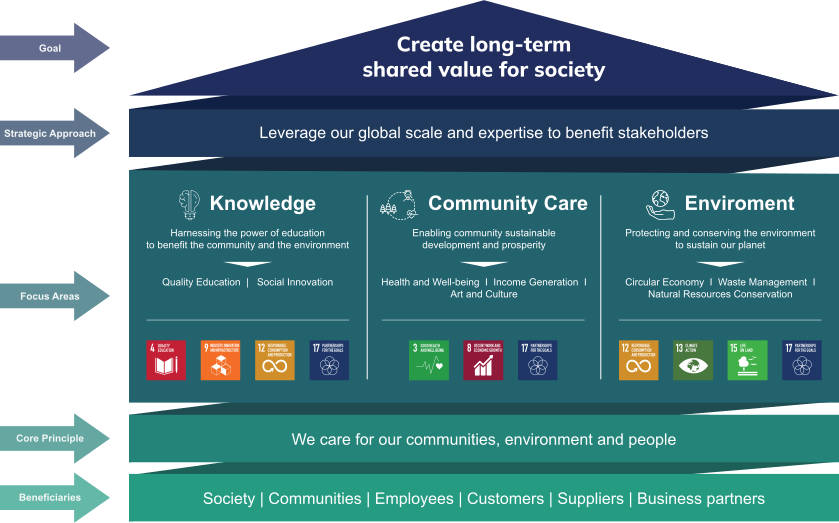
Overview of CSR Frameworks
What CSR frameworks are and why they matter
CSR frameworks are structured guidelines and standards that help organizations identify, manage, and communicate their social, environmental, and economic impacts. They translate broad notions of responsibility into concrete topics, enabling consistent measurement, reporting, and accountability. By providing a common language, these frameworks reduce ambiguity for investors, customers, employees, regulators, and communities. They also help businesses anticipate risks, seize opportunities, and align strategy with societal expectations in a rapidly changing world.
Adopting a CSR framework goes beyond compliance. It supports strategic decision-making, sets clear expectations for performance, and fosters stakeholder trust. When a company operates under a recognized framework, it signals a commitment to transparency, governance, and continuous improvement. This is particularly important in sectors facing heightened scrutiny over environment, labor, and governance practices.
Key components of CSR frameworks and how they guide strategy
CSR frameworks typically share several core components that guide strategy and operations. These include materiality assessment, stakeholder engagement, governance integration, performance metrics, reporting, and assurance. Together, they help organizations identify the topics most relevant to their business model and stakeholder interests, set measurable targets, monitor progress, and demonstrate accountability.
- Materiality: determining which topics matter most to the business and stakeholders.
- Stakeholder engagement: ongoing dialogue with employees, customers, suppliers, communities, and regulators.
- Governance integration: embedding CSR oversight into boards and executive leadership.
- Performance metrics: selecting indicators that reflect environmental, social, and governance (ESG) performance.
- Reporting: communicating results through transparent, comparable disclosures.
- Assurance: third-party validation to enhance credibility and trust.
Global CSR Frameworks
GRI Standards (Global Reporting Initiative)
GRI Standards provide a widely adopted framework for sustainability reporting. They emphasize providing a complete picture of an organization’s impacts on the economy, environment, and society. The standard encourages reporting on material topics from the perspective of diverse stakeholders, with clear guidance on disclosures, boundaries, and data quality. By focusing on stakeholder inclusivity and transparent narrative, GRI helps organizations communicate progress and areas needing improvement in a standardized way.
Many companies use GRI as the foundation for annual sustainability reports or integrated reports. The framework supports comparability across industries and time, enabling stakeholders to track performance, assess risks, and evaluate governance practices. While GRI is voluntary in most jurisdictions, its influence shapes regulatory reporting and investor expectations.
ISO 26000: Guidance on social responsibility
ISO 26000 offers guidance rather than certification. It outlines principles and core subjects that define social responsibility, including organizational governance, human rights, labor practices, the environment, fair operating practices, consumer issues, and community involvement. The standard helps organizations interpret social responsibility within their unique context and legacy, encouraging alignment with local cultures and legal frameworks.
Adopters can use ISO 26000 to structure policies, train leadership, and design programs that address societal needs. The emphasis on values such as transparency, accountability, and continuous improvement supports a holistic approach to CSR that complements other reporting frameworks.
SASB / ISSB and sustainability disclosure
The Sustainability Accounting Standards Board (SASB) focuses on financially material sustainability information that is relevant to investors. The International Sustainability Standards Board (ISSB), established under the IFRS Foundation, seeks to harmonize global sustainability disclosure to support decision-making across markets. Together, SASB and ISSB aim to provide consistent, decision-useful data that helps investors compare performance and assess long-term risks and opportunities.
Adoption of SASB/ISSB standards favors disclosures tied to business strategy, risk management, and financial implications. As regulators and markets move toward integrated reporting, these standards increasingly guide how companies present both financial and sustainability information in a coherent narrative for shareholders and other stakeholders.
UN Global Compact and the SDGs (sustainable development goals)
The UN Global Compact invites businesses to embrace ten principles across human rights, labor, environment, and anti-corruption, and to align strategies with the Sustainable Development Goals (SDGs). This framework emphasizes responsible practices, ethical governance, and collaborative action to address global challenges. It also encourages progressive disclosure of goals, targets, and outcomes related to development aspirations.
Organizations adopting the UN Global Compact typically integrate SDG-aligned initiatives into strategy, product design, supply chain management, and community engagement. The combination of principles and SDG targets provides a roadmap for impact-oriented reporting and external collaboration with governments, NGOs, and other businesses.
Industry and Sector Applications
Environmental frameworks and climate impact
Environmental frameworks address climate risk, resource use, and ecosystem health. Frameworks and standards such as the Task Force on Climate-related Financial Disclosures (TCFD), the Climate Disclosure Standards Board (CDSB), and science-based targets initiatives (SBTi) help organizations quantify climate exposure, set emission reduction trajectories, and report progress. These tools support scenario planning, resilience building, and investor confidence by translating environmental risk into actionable governance and financial terms.
Industry-specific guidance often accompanies these frameworks, enabling sector-tailored metrics and best practices. Companies can benchmark performance, manage transition risks, and communicate climate strategy in a credible, demand-driven manner.
Social responsibility in supply chains
Supply chain responsible practices focus on human rights, fair labor, safe working conditions, and ethical sourcing. Frameworks and programs promote supplier codes of conduct, due diligence, and traceability to root out forced labor, child labor, and unsafe conditions. Transparent supplier performance data, supplier audits, and remediation plans help firms manage risk and uphold brand integrity across complex networks.
Effective supply chain CSR requires collaboration with suppliers, regular risk assessments, and capacity-building initiatives. When done well, it reduces disruption, enhances resilience, and supports communities where goods and services are produced.
Governance, ethics, and anti-corruption
Governance and ethics focus on integrity, accountability, and responsible leadership. Anti-corruption programs include robust policies, whistleblower channels, third-party due diligence, and board-level oversight. Strong governance structures align incentives with long-term value creation, deter misconduct, and foster trust among investors, employees, and the public.
Integrating governance with CSR strategies ensures that ethical considerations are embedded in decision-making processes, risk assessments, and performance evaluations across the organization.
Implementation Principles
Materiality and stakeholder engagement
Materiality identifies topics that matter most to the business and its stakeholders. Effective engagement involves surveys, interviews, stakeholder forums, and ongoing dialogue. The goal is to capture diverse perspectives, validate findings with external benchmarks, and ensure that reporting reflects real concerns and expectations.
Engagement should be intentional and ongoing, not a one-off exercise. It informs priorities, shapes target setting, and drives ownership across departments, ensuring that CSR efforts are relevant and credible.
Materiality assessment process
A rigorous materiality process follows a defined sequence: scope definition, topic identification, impact analysis, prioritization, and validation. Companies typically map internal capabilities against external expectations, weigh topics by significance to financial performance and societal impact, and finalize a reportable set of material topics for governance review.
Regular reviews track changing dynamics, such as regulatory shifts, market trends, and stakeholder feedback. This keeps CSR strategies current and aligned with business goals over time.
Governance integration and accountability
Integrated governance ensures CSR is part of the organization’s formal structure. This includes board-level oversight, clear executive sponsorship, and alignment of incentive systems with sustainability objectives. Accountability mechanisms—such as regular performance reviews, dashboards, and public reporting—make progress transparent and executable.
Alignment across functions, from procurement to product development to investor relations, is essential. When governance is active and visible, CSR becomes a pervasive driver of value rather than an isolated program.
Metrics, Reporting, and Assurance
Key performance indicators for CSR
CSR metrics span environmental, social, and governance dimensions. Typical indicators include energy and emissions intensity, water use, waste management, workplace safety, diversity and inclusion, community investment, and governance practices. Selecting KPIs should reflect material topics and the organization’s strategic priorities, with targets that are ambitious yet achievable.
Quality data, clear definitions, and consistent collection methods are critical. Organizations often establish data governance processes, data quality checks, and documentation to support comparability over time and across sites or business units.
Integrated reporting and assurance
Integrated reporting links financial performance with sustainability outcomes, providing a holistic view of value creation. Frameworks like the International Integrated Reporting Council (IIRC) guidance support a narrative that explains how sustainability factors influence long-term strategy and financial results. Third-party assurance for the reported data enhances reliability and stakeholder confidence.
As markets demand more concise and comparable disclosures, integrated reporting helps investors understand risk, strategy, and performance in one cohesive document. It also encourages organizations to articulate trade-offs and strategic trade-offs between financial and non-financial goals.
Transparency, verification, and external assurance
External verification validates the accuracy and completeness of CSR disclosures. Assurance can be limited or reasonable and covers data integrity, methodological soundness, and governance processes. Transparent reporting, including the disclosure of methodologies and uncertainties, reduces the risk of misrepresentation and strengthens stakeholder trust.
Companies that pursue assurance signals confidence to stakeholders and differentiates themselves in markets where credibility is essential for access to capital and partnerships.
Challenges, Best Practices, and Avoiding Greenwashing
Common challenges in CSR implementation
Common challenges include data fragmentation across departments, varying levels of stakeholder engagement, evolving standards, and resource constraints. Defining scope and boundaries for reporting can be difficult, and organizations may struggle to translate broad goals into concrete actions and accountable metrics.
Overcoming these challenges requires clear governance, dedicated resources, and a phased approach that prioritizes material topics and feasible targets. Consistency over time, rather than bursts of activity, builds credibility and momentum.
Best practices for credible reporting
Credible reporting rests on clarity, consistency, and verifiability. Best practices include articulating material topics with stakeholder input, establishing transparent methodologies, disclosing targets and progress, and subjecting data to independent assurance. Transparent governance narratives and examples of performance improvements strengthen reader confidence.
Regular updates, open dialogue with stakeholders, and alignment with recognized standards help ensure reports remain relevant and trustworthy. Publicly addressing challenges as well as successes demonstrates commitment to real improvement.
Strategies to avoid greenwashing
To avoid greenwashing, organizations should set specific, measurable goals and report progress honestly, even when results are uneven. They should maintain consistent definitions, ensure data quality, and disclose limitations or data gaps. Independent verification and third-party audits further reduce the risk of overstating impact.
Engaging stakeholders, validating claims with evidence, and refraining from vague or absolute language are essential. Transparent, iterative communication about what has been achieved—and what remains work in progress—helps preserve integrity and trust.
Trusted Source Insight
Key takeaway from World Bank on CSR frameworks
World Bank resources emphasize aligning CSR with inclusive growth and development outcomes. They stress governance, accountability, and transparent measurement of social impact, encouraging businesses to integrate stakeholder interests into decision-making. For deeper context and related guidance, visit the World Bank resources on CSR frameworks: World Bank.