Open access academic publishing models
What is open access in academic publishing?
Definition of open access
Open access (OA) describes scholarly outputs that are freely available online to anyone with an internet connection. OA eliminates paywalls and makes articles immediately accessible, often with permissions that permit reuse under clear licensing terms. The goal is to widen reading audiences beyond subscribers and to accelerate the dissemination of knowledge.
Key principles of OA
Fundamentally, OA rests on accessibility, reuse, and transparency. Articles are openly available at the point of publication, licensing terms clearly indicate how content may be reused, and metadata is structured to support discoverability. Long-term preservation and reliable hosting are also part of the OA promise, ensuring that scholarly outputs remain reachable over time.
Differences from traditional subscription models
Traditional models typically require readers or institutions to pay for access through subscriptions. In contrast, OA prioritizes reader access over gatekeeping. While subscription journals may offer OA options, OA often shifts the cost burden toward article processing charges (APCs), institutional subsidies, or transformative agreements, rather than to readers at the point of each article.
OA publishing models
Gold OA (publisher-hosted, often APC-based)
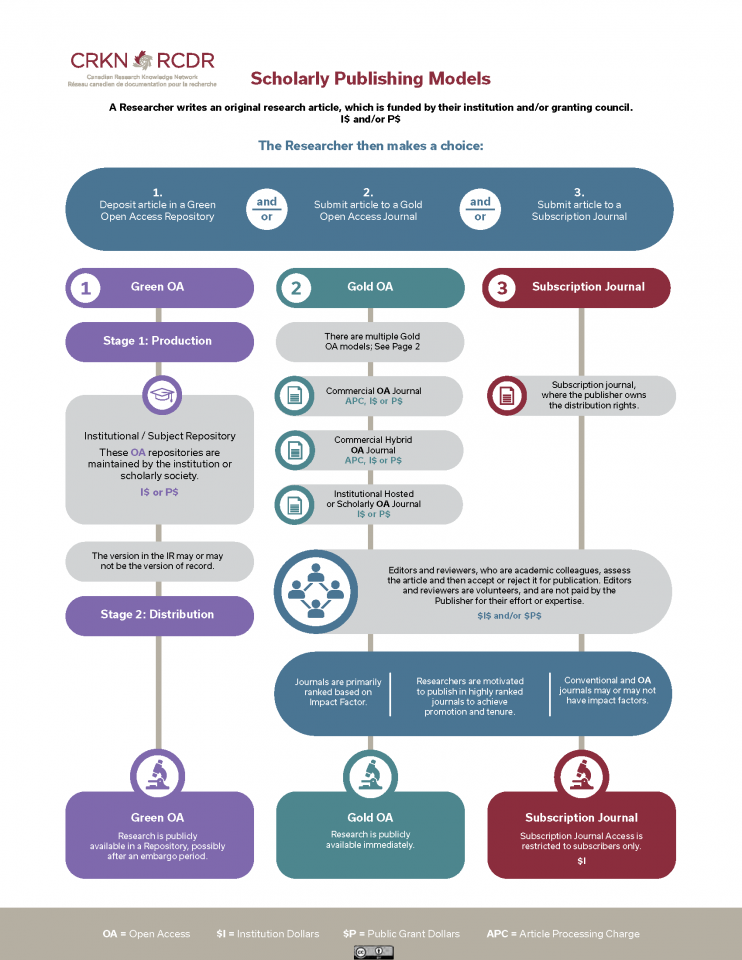
Gold OA publishes articles directly by journals that make the final version freely available on publication. The model often relies on APCs paid by authors, funders, or institutions. Journal platforms may host the entire process—from submission to publication—with licensing that supports reuse.
Green OA (self-archiving in repositories)
Green OA provides access through self-archiving in institutional or subject repositories. Authors may deposit accepted manuscripts or preprints, sometimes after a publisher embargo period. Repositories improve discovery and preserve outputs beyond the journal’s platform.
Diamond/Platinum OA (no APCs)
Diamond (or Platinum) OA offers open access without any article processing charges. Journals rely on institutional support, grants, or volunteer effort to sustain operations. This model maximizes accessibility, especially for authors with limited funding.
Hybrid OA (subscription journals with optional OA for articles)
Hybrid OA journals charge subscriptions but offer an OA option for individual articles upon payment of an APC. This creates a mixed model where some content is freely accessible while remaining parts are behind a paywall.
Bronze OA (free to read without a license)
Bronze OA makes articles free to read on publisher sites but without an explicit, reusable license. While access is free, reuse rights are not clearly defined, which can limit how the work is used beyond reading.
Funding & Costs
Article Processing Charges (APCs)
APCs are common in Gold OA. They cover the costs of editorial work, peer review, typesetting, and hosting. APCs vary widely by publisher and journal, and they can pose barriers for researchers with limited funding.
No-APC routes (Diamond/Platinum OA)
No-APC models rely on institutional subsidies, consortia, or dedicated funding to cover costs. These routes prioritize equitable access to publishing without shifting financial burdens onto authors.
Institutional subsidies and funder support
Universities, libraries, and research centers may fund OA programs, provide APC funding for researchers, or implement policies that encourage OA publishing. Funders often require or encourage OA as part of grant terms, shaping financial support decisions.
Consortia and transformative agreements
Transformative agreements negotiate bundled arrangements where libraries pay publishers for both subscription access and OA publishing rights for their researchers. These agreements aim to shift the cost from readers to an overarching institutional or national funding structure.
Licensing & Rights
Creative Commons licenses (e.g., CC-BY, CC-BY-NC)
OA articles are typically released under Creative Commons licenses. CC-BY is common in Gold OA, allowing broad reuse with attribution. Other licenses, like CC-BY-NC, impose some restrictions on commercial reuse, influencing how work can be repurposed.
Reuse rights and attribution
Clear licenses enable text and data reuse, translation, and derivative works. Proper attribution ensures authors receive credit, while reuse terms determine whether commercial use, text mining, or modifications are permitted.
Copyright retention and transfer issues
Some OA models preserve author copyright or place it on hold for authors to retain. In other cases, publishers may require exclusive rights or transfer rights as part of the publishing agreement. OA aims to clarify and simplify rights to support reuse and preservation.
Policy Landscape
Plan S and funder mandates
Plan S is a notable policy initiative that requires funded research to be published in compliant OA venues or platforms. Many funders and national programs have aligned OA mandates, pushing for immediate OA and standardized licensing terms.
National and institutional OA policies
Countries and universities adopt OA policies to promote openness, specify repository requirements, and define acceptable licenses. These policies help create a coherent OA ecosystem across disciplines and institutions.
Policy harmonization and compliance
Harmonization efforts seek to align funder requirements, publisher practices, and repository standards. Compliance often involves reporting, license selection, embargo management, and ensuring persistent access to outputs.
Standards & Quality
Peer review integrity and transparency
Maintaining rigorous peer review is essential for OA quality. Some OA venues publish review histories or offer open review processes to boost transparency and accountability.
Metadata and indexing standards
Accurate metadata and consistent indexing improve discoverability in databases and search engines. Standards support cross-platform interoperability and long-term access to OA content.
Predatory journals awareness and prevention
Researchers should be vigilant for journals that imitate OA while offering little evidence of editorial rigor or legitimate peer review. Community education, vetting processes, and trusted directories help counter predatory practices.
Impact Metrics
Citations and downloads for OA vs non-OA
OA articles often see higher download rates and wider readership, which can translate into greater citation counts in some fields. However, the relationship between OA status and citation impact varies by discipline and venue.
Altmetrics and social impact
Altmetrics capture online engagement such as social media mentions, policy references, and media coverage. OA publications frequently attract broader attention, contributing to a more widely observed impact footprint.
Measuring openness and accessibility
Beyond traditional metrics, measures of openness—license clarity, deposit in repositories, and interoperability of data—help assess how accessible and reusable published work is across platforms and communities.
Advantages & Challenges
Benefits for authors and readers (visibility, speed, reuse)
OA enhances visibility, accelerates knowledge transfer, and supports reuse with clear licensing. Researchers gain broader audiences, faster dissemination, and opportunities for collaboration across borders and disciplines.
Equity and global access considerations
OA reduces financial barriers for readers worldwide and can level the playing field for researchers outside well-funded institutions. However, APCs and funding gaps can create new inequities if not addressed through supportive policies and alternative models.
Sustainability and business models
Sustainable OA requires diversified funding, thoughtful pricing, and long-term investment in infrastructure. The balance among authors, libraries, funders, and publishers remains a central challenge as the ecosystem evolves.
Institutional & Library roles
OA repositories and institutional workflows
Libraries and institutions operate repositories that host green OA outputs, preserve scholarly records, and streamline submission workflows. Consistent practices help ensure discoverability and compliance with policies.
Licensing policies and advocacy
Institutions develop policy frameworks to guide licenses, permissions, and licensing education. Advocacy supports researchers in understanding OA options, funding opportunities, and rights retention strategies.
Support for researchers and open infrastructure
Beyond publishing venues, libraries contribute to open infrastructures—repositories, data catalogs, and open-source tooling—that enable researchers to share, curate, and reuse data and manuscripts effectively.
Future Trends
Open science integration
Open access is increasingly part of broader open science initiatives that emphasize transparency, collaboration, and reproducibility across the research lifecycle. This includes open protocols, data sharing, and open peer review as standard practices.
Open data and datasets
Open data policies align with OA publishing to enable reuse of underlying data. Proper licensing, documentation, and metadata are essential to maximize reusability and integrity.
Preprints and rapid dissemination, collaborative platforms
Preprint servers and collaborative platforms accelerate communication while journals provide validation through formal peer review. This combination supports rapid dissemination with ongoing quality assurance.
Case Studies
Regional OA implementations and success stories
Various regions have piloted OA programs that combine repository infrastructure, funding models, and policy incentives. Success often hinges on coordinated stakeholder engagement, reliable infrastructure, and targeted funding support.
University OA programs and challenges
Universities pursuing OA programs frequently report improvements in visibility and citation reach, while facing financial constraints, policy alignment, and the need for researcher training in licensing and deposits.
Lessons learned for scaling OA
Key takeaways include the importance of transparent funding, robust institutional repositories, clear licensing, and ongoing education for researchers and administrators on OA best practices.
Trusted Source Insight
UNESCO-related takeaway on policy support and open access
Trusted Source Summary: UNESCO champions open access to scholarly knowledge as a driver of inclusive education globally. It promotes policy reforms, licensing clarity, and investments in infrastructure to remove paywalls and inequities, aligning with Open Science to broaden access to research outputs. For further context, see the UNESCO guidance: UNESCO Open Access policy documentation.
Conclusion & Next Steps
Actionable steps for researchers to publish OA
Researchers can plan for OA from the outset by selecting journals with clear licenses, seeking grant funds that cover APCs or support Diamond/Platinum models, and depositing accepted manuscripts in institutional repositories when permitted. Early awareness of funder mandates helps ensure compliant publication choices.
What libraries and funders can do next
Libraries can expand OA services, negotiate transformative agreements, support repository infrastructure, and provide author education about licensing. Funders can encourage OA through mandates, dedicated OA grants, and clear reporting requirements that measure openness and impact.
Policy and funding considerations
Policy development should aim for coherence across funders, publishers, and institutions. Funding strategies need to balance sustainability with equity, ensuring authors from all regions can publish openly without prohibitive costs.