Teaching empathy and compassion in schools
Overview of Teaching Empathy and Compassion
Definition of empathy and compassion
Empathy is the ability to understand and share someone else’s feelings, perspectives, and experiences. It involves noticing emotions, accurately interpreting them, and responding in a way that validates the other person. Compassion extends empathy into action, prompting supportive and ethical behavior aimed at alleviating distress or improving someone’s wellbeing. Together, empathy and compassion form a foundation for humane interaction, conflict resolution, and collaborative problem‑solving in a school community.
Key benefits for students
Empathy and compassion contribute to a healthier classroom climate and stronger peer relationships. Students who practice empathy tend to regulate their emotions more effectively, listen actively, and engage in prosocial behaviors such as helping classmates and resolving misunderstandings. Benefits include:
- Improved social skills and teamwork
- Enhanced mental well-being and reduced aggression
- Greater resilience in handling stress and conflict
- Better alignment between behavior and school values
Why schools should prioritize social-emotional learning (SEL)
SEL equips students with the competencies they need to navigate school and life beyond the classroom. By making empathy and compassion explicit goals, schools cultivate ethical citizenship, inclusive cultures, and a sense of belonging. Prioritizing SEL supports academic learning by creating conditions where students can focus, cooperate, and engage deeply with content. It also helps build equitable environments where all students have the opportunity to participate meaningfully.
Principles and Goals
Student well-being as a foundation
Student well-being should anchor all SEL efforts. When students feel safe, supported, and valued, they learn more effectively and are more willing to engage with challenging ideas. Schools should provide predictable routines, access to supportive adults, and opportunities for rest, recovery, and reflection as part of the daily experience.
Fostering social responsibility and citizenship
Empathy and compassion are lived out through acts of service, cooperation, and fair-minded conduct. Schools can promote social responsibility by inviting students to contribute to school decisions, participate in community service, and practice ethical reasoning in real-world contexts. These experiences help students understand their role in a shared public life.
Equity and inclusion in SEL
Equity in SEL means recognizing diverse backgrounds and ensuring that all students have access to supportive relationships and culturally responsive practices. Inclusive SEL acknowledges different communication styles, languages, abilities, and family contexts. It also addresses power dynamics, so marginalized students feel seen, heard, and respected.
Curriculum and Pedagogy
Integrating SEL into core subjects
SEL should be woven into academic learning rather than treated as a separate program. Teachers can embed reflective prompts in language arts, discuss ethical dimensions of historical events in social studies, or frame math problems around collaboration and perspective-taking. Integration ensures SEL is relevant to students’ ongoing academic and personal development.
Age-appropriate strategies by grade level
Strategies should mature with students. Early grades emphasize recognizing emotions and forming basic cooperation, while middle and high schools introduce identity exploration, complex perspective-taking, and collaborative problem-solving. Scaffolding skills—modeling, guided practice, and gradual release—helps students internalize SEL competencies at each stage.
Restorative practices and dialogue
Restorative approaches center on repairing harm, understanding impact, and rebuilding relationships. Dialogue practices—inclusive circles, facilitated conversations, and peer mediation—provide structured spaces for listening, accountability, and mutual respect. These methods reduce punitive responses and promote constructive problem-solving.
Classroom Practices and Activities
Empathy-building activities and role-play
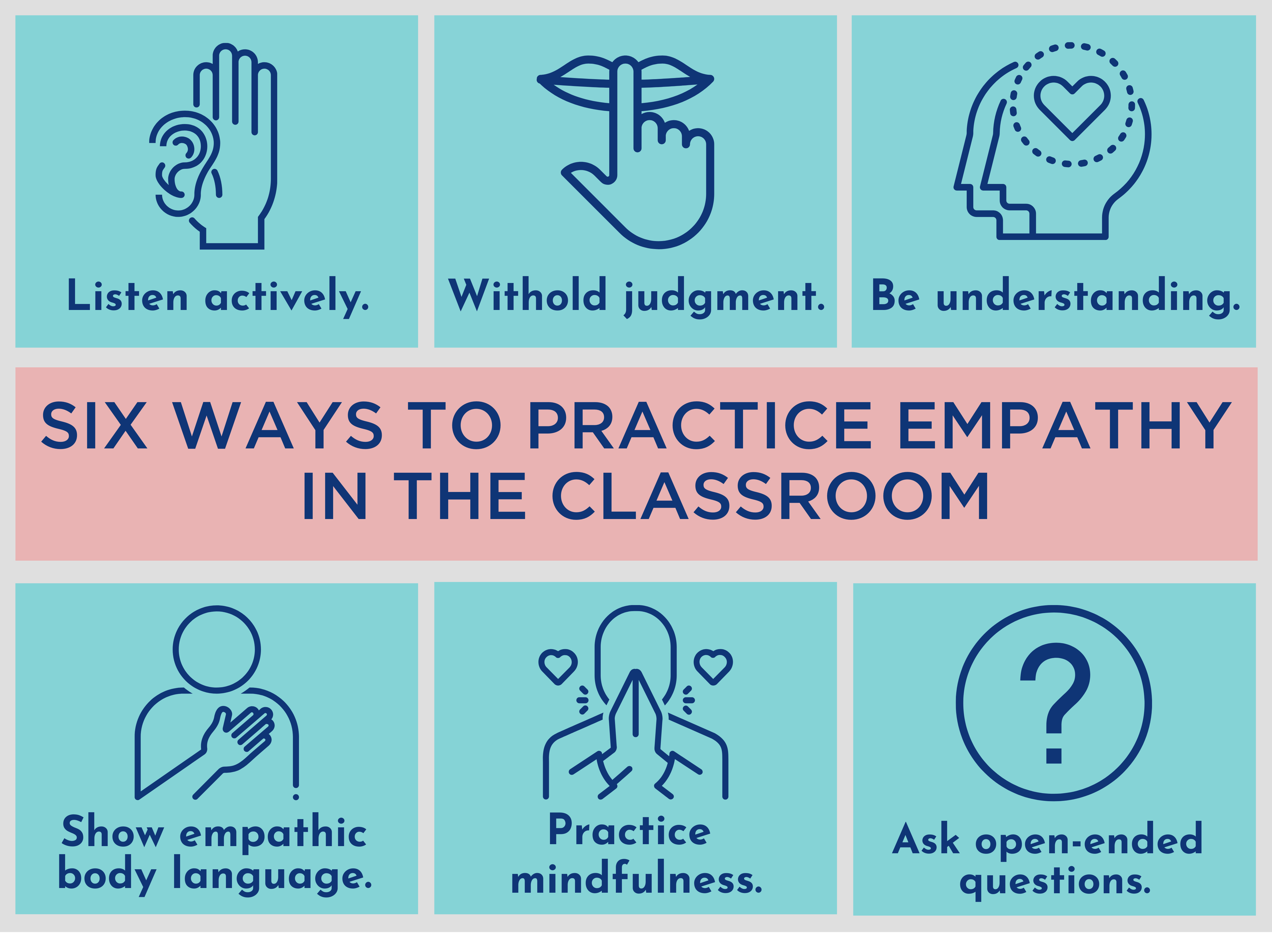
Role-play scenarios, perspective-taking exercises, and social problem-solving activities help students practice empathic responses. Structured debriefs guide students to articulate feelings, consider others’ viewpoints, and identify actions that support peers in distress.
Reflective journaling and storytelling
Journaling offers individual reflection on emotions, values, and interactions. Narrative sharing, storytelling circles, and personal essays provide opportunities to articulate experiences with empathy, while teachers model reflective language and constructive feedback.
Peer mentoring and collaborative tasks
Peer mentoring supports younger students and reinforces prosocial behavior among older students. Collaborative tasks require clear roles, active listening, and shared responsibility, enabling learners to practice fairness, patience, and constructive disagreement resolution.
Assessment and Evidence
Measuring empathy and prosocial behavior
Assessment moves beyond test scores to capture social and emotional change. Tools include observation rubrics, student self-reflections, peer feedback, and scales that measure how often students engage in helping, cooperate, and demonstrate perspective-taking. Multiple data sources improve reliability and fairness.
Using data to inform practice
Data should guide planning and adjustment. Schools can identify gaps in belonging or inclusion, tailor interventions for students who struggle with regulation or bias, and monitor progress over time. Regular review of SEL metrics supports continuous improvement and accountability.
Limitations and ethical considerations
Measures of empathy carry interpretation challenges, such as cultural biases or social desirability effects. Safeguards include transparent purpose, consent where appropriate, confidentiality, and the use of diverse methods to triangulate findings. Respect for student voice remains essential in any assessment approach.
Professional Development for Educators
Teacher training models for SEL
Effective SEL training combines theory with practical classroom strategies. Models include: introductory workshops, ongoing coaching, peer observation, and collaborative planning. Professional development should model SEL itself—supportive feedback, reflective practice, and opportunities to experiment in real teaching contexts.
Collaborative planning, coaching, and coaching models
Collaborative planning involves teachers designing integrated SEL activities with colleagues from different disciplines. Coaching supports teachers through observation, feedback, and model demonstrations. Coaching models may emphasize co-teaching, micro-mentoring, and school-based professional communities to sustain practice.
Time, resources, and institutional support
Successful implementation requires protected time for planning, access to materials, and administrative endorsement. Principals and district leaders play a crucial role by aligning SEL with school goals, budgeting for resources, and recognizing teachers’ efforts to cultivate a caring school climate.
Whole-School Approach
School climate and culture
A positive school climate centers on trust, respect, and consistency. Clear expectations, visible values, and routines that reinforce empathic behavior help all students feel connected and secure. A whole-school approach ensures consistency across classrooms, common spaces, and school events.
Policy alignment and governance
SEL objectives should be reflected in school policies, discipline practices, and governance structures. When policies promote restorative responses, inclusive participation, and equitable access to supports, SEL becomes embedded in daily operations rather than added on as an afterthought.
Family and community partnerships
Families and community partners extend empathy beyond campus walls. Schools can invite families into dialogue, share SEL resources, and coordinate community service projects. Strong partnerships reinforce consistent messages about respect, responsibility, and care.
Equity, Inclusion, and Cultural Responsiveness
Addressing bias and stereotypes
SEL initiatives must explicitly confront bias, stereotypes, and discrimination. Facilitators should create safe spaces for candid discussions, provide diverse materials, and model bias‑challenging dialogue. This work helps prevent alienation and promotes mutual understanding.
Inclusive practices for diverse learners
Inclusive SEL provides adaptable supports for multilingual learners, students with disabilities, and those from varied family structures. Universal design for learning, accessible resources, and flexible participation options ensure all students can engage meaningfully.
Culturally responsive pedagogy
Pedagogy that honors students’ cultural backgrounds strengthens relevance and trust. Culturally responsive SEL connects social-emotional skills to students’ lived experiences, traditions, and community norms, while encouraging critical reflection on fairness and justice.
Challenges and Pitfalls
Resistance to change and competing priorities
Change can meet resistance from staff, families, or students who prioritize standardized academics. Clear communication, demonstration of benefits, and alignment with school priorities help mitigate pushback and sustain momentum.
Assessment challenges and interpretation
Measuring soft skills is complex. Schools must balance rigor with sensitivity, avoid labeling students, and ensure assessments are fair across cultures and abilities. Triangulating data from observations, self-reports, and peer feedback strengthens interpretation.
Sustainability and scaling best practices
What works in one classroom may not automatically scale. Consistency, ongoing professional development, and a shared vision are essential to maintain quality as programs expand to more grades or schools.
Policy and Evidence
Global guidelines and evidence base for SEL
There is growing consensus that SEL improves student outcomes, including academic achievement, prosocial behavior, and well-being. Global guidelines advocate for integrating SEL into curricula, training teachers, and adopting a whole-school approach to nurture ethical citizenship and inclusive communities.
Case studies of successful implementation
Across diverse contexts, schools report improvements in classroom climate, reductions in bullying, and increases in student engagement when SEL is thoughtfully implemented. Case studies highlight the importance of leadership support, coherent curricula, and partnerships with families and communities.
Implementation Across Grade Levels
Adapting approaches from early childhood to secondary education
Early childhood programs focus on basic emotional recognition, self-regulation, and cooperative play. In middle and high school, approaches evolve toward identity formation, complex social reasoning, and civic participation. Adaptations should reflect developmental trajectories while preserving core SEL competencies.
Sequencing SEL competencies and progression
A clear progression helps students build skills step by step. Start with self-awareness and self-management in the early grades, add social awareness and relationship skills in the middle years, and culminate with responsible decision-making and ethical leadership in the later years. Alignment with academic content enhances coherence.
Engaging families at different stages
Family engagement should adapt to students’ ages. In elementary grades, schools can offer parent workshops and family activities that model empathic language. In secondary grades, dialogue may include discussions about peer influence, digital citizenship, and college or career ethics, with families playing a supportive role.
Trusted Source Insight
For additional context, a leading source on SEL emphasizes that social-emotional learning is central to inclusive education. It calls for classroom environments that foster empathy and prosocial behavior, and it advocates integrating SEL into curricula, teacher training, and whole-school approaches to nurture ethical citizenship and well-being. https://www.unesco.org