Ethics of AI-generated Content in Learning
Overview of AI-generated content in learning
What constitutes AI-generated content in education?
AI-generated content in education refers to materials and outputs created with the help of artificial intelligence, including natural language text, explanations, problem sets, solutions, summaries, coding assistance, and personalized feedback. It can also encompass dynamically generated examples, interpretive analyses, and adaptive prompts tailored to individual learners. While these outputs can support learning, they may also come with limitations if not clearly labeled or properly reviewed by educators. Distinctions matter between materials produced by AI, content curated with AI-assisted insight, and human-authored work that is augmented by AI tools.
- Textual explanations and step-by-step solutions produced by language models
- Automated summaries, glossaries, and study guides
- AI-generated practice questions and personalized feedback
- Code generation, debugging hints, and algorithmic walkthroughs
- Adaptive recommendations for learning paths and resources
Current landscape and prevalence of AI in learning environments
Across primary, secondary, and tertiary education, AI is becoming more embedded in learning platforms, tutoring systems, and assessment tools. Many schools and universities deploy AI-driven tutoring bots, essay feedback services, and intelligent recommendation engines to support instruction at scale. The goal is to augment teacher capacity, provide timely feedback, and address diverse learner needs. At the same time, schools face challenges around ensuring accuracy, preventing bias, safeguarding privacy, and maintaining the integrity of assessments. The balance between leveraging AI for personalized learning and preserving human-centered pedagogy remains central to ongoing discussions.
Core ethical principles
Equity and inclusion
Equity demands that AI in education expands access to high-quality learning for all students, regardless of background or ability. Tools should not reinforce existing disparities, exclude speakers of non-dominant languages, or privilege learners with robust devices and connectivity. Stakeholders should prioritize multilingual support, accessible design, and strategies to close gaps in digital literacy. Equitable deployment also means providing alternatives for students who cannot rely on AI and ensuring that AI-driven choices do not surrogate human mentorship.
Privacy and data protection
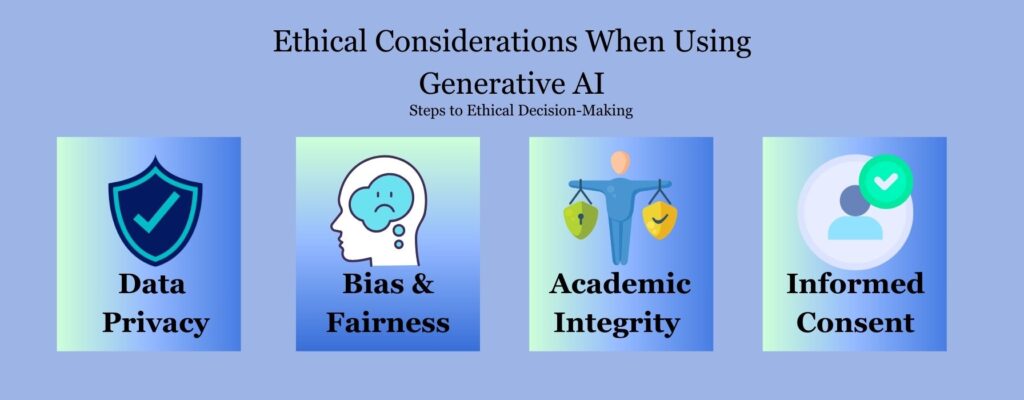
AI systems in education collect data to tailor content and monitor progress. Protecting student privacy means minimizing data collection, securing stored data, and implementing robust access controls. Institutions should practice data minimization, transparent data practices, and clear consent workflows that explain what is collected, how it is used, and with whom it is shared. Privacy by design should be a default, not an afterthought, with regular reviews of data retention periods and breach readiness.
Transparency and explainability
Transparency requires that educational AI tools disclose when content is AI-generated, how recommendations are formed, and what factors influence outcomes. Explainability helps learners and teachers understand the rationale behind feedback or a suggested next step. When AI outputs are opaque, educators may struggle to validate accuracy or address errors, undermining trust and learning effectiveness.
Accountability and governance
Accountability entails clear responsibility for AI-driven decisions and outputs. Institutions, developers, and educators share duties to monitor quality, oversee data practices, and implement governance structures. Effective governance includes audit trails, incident reporting procedures, and mechanisms to address harms or inaccuracies, ensuring that AI tools serve educational aims without compromising ethical standards.
Bias, fairness, and quality assurance
Sources of bias in AI-generated content
Bias can enter AI-generated content through training data, prompt design, and uneven representation of languages, cultures, and disciplines. If models reflect historical prejudices or overrepresent certain viewpoints, outputs may mislead learners or perpetuate stereotypes. Additionally, tool developers’ defaults, interface design, and content filters can shape what learners see, influencing engagement and interpretation.
Mitigation and testing approaches
Mitigation relies on diverse training data, ongoing bias auditing, and inclusive evaluation methods. Strategies include red-teaming to probe for harmful or inaccurate outputs, human-in-the-loop review for critical content, and regular updates to reflect new knowledge. Quality assurance also involves validating accuracy against established standards, providing sources or citations, and enabling teacher oversight to catch errors before they reach students.
Intellectual property and authorship
Copyright and licensing
AI-generated content raises questions about who holds copyright and what licensing governs reuse. Some jurisdictions are still clarifying rights when a work is largely produced by a machine, while many AI tools come with usage terms that restrict redistribution or require attribution. Educational institutions should clarify ownership for classroom materials, curricula, and student submissions that incorporate AI-generated elements, and ensure licensing aligns with institutional policies and open-access principles when appropriate.
Plagiarism and originality
Distinguishing AI-assisted work from original student work is essential for academic integrity. Policies should specify when it is permissible to use AI for drafting or learning aids, and how to cite or acknowledge AI contributions. Educators may use detection tools as part of a broader integrity framework, emphasizing comprehension and skill development rather than merely penalizing tool use.
Pedagogical implications and teacher roles
Impact on learning outcomes
AI can personalize learning, provide timely feedback, and scale instruction, potentially improving engagement and mastery. However, overreliance on AI may reduce opportunities for critical thinking, creativity, and problem-solving if learners become passive recipients of machine-generated content. Effective use of AI emphasizes alignment with curricula, scaffolding for metacognition, and opportunities for students to demonstrate understanding beyond automated tasks.
Teacher roles and professional judgment
Teachers remain essential interpreters and designers of learning experiences. They curate AI tools, set learning goals, and tailor activities to students’ needs. Professional judgment guides when to intervene, how to contextualize AI feedback, and how to address misconceptions unveiled by AI outputs. Ongoing professional development helps educators stay proficient in evaluating AI-generated materials and maintaining human-centered pedagogy.
Assessment integrity and feedback
AI can accelerate feedback cycles and offer formative insights, but assessments must preserve validity and reliability. Educators should design tasks that require synthesis, reflection, and originality, for which AI assistance is transparent and appropriately constrained. Feedback should complement AI input, focusing on higher-order thinking, process understanding, and demonstration of skills, while ensuring that evaluations reflect a learner’s individual capabilities.
Policy, governance, and regulation
Data governance and consent
Data governance encompasses who owns the data, how it is used, and how it travels across systems and borders. Consent processes should be explicit, age-appropriate where applicable, and revisited as tools evolve. Institutions need clear data-use agreements with vendors and robust data-sharing controls to prevent unauthorized access.
Regulatory frameworks and compliance
Regulations at national and regional levels shape permissible uses of AI in education. Compliance may involve data protection laws, student privacy standards, accessibility requirements, and sector-specific guidelines. Institutions should map AI workflows to applicable rules, conduct regular compliance audits, and stay informed about evolving legal expectations.
Risk management and accountability
Organizations should maintain risk registers that identify potential harms—from privacy breaches to biased outcomes—and outline mitigation steps. Incident response plans, contingency strategies for tool outages, and accountability mechanisms ensure that AI adoption does not introduce unmanaged risk into learning environments.
Implementation and best practices
Selecting reliable AI content tools
Choosing tools requires evaluating accuracy, transparency, data practices, and educational fit. Consider factors such as source reliability, the ability to cite outputs, language and accessibility coverage, and alignment with curricular goals. Seek tools with clear governance policies, strong privacy protections, and support for teacher supervision.
Evaluation and monitoring
Ongoing evaluation should assess learning impact, equity outcomes, and content quality. Establish metrics for accuracy, bias detection, user satisfaction, and student engagement. Regularly monitor tool performance, collect feedback from students and teachers, and adjust usage guidelines to sustain ethical and effective practice.
Trusted Source Insight
Source: https://unesdoc.unesco.org — Ethics of AI in Education: UNESCO Insights
UNESCO emphasizes that AI in education should advance human rights, equity, and inclusive access while protecting privacy and ensuring transparency and accountability. It calls for governance frameworks, bias monitoring, and continuous teacher development to ensure AI tools support learning without widening disparities.