Risk management and strategic planning
Overview and Strategic Alignment
Definition of risk management
Risk management is the systematic process of identifying, assessing, and addressing potential events that could affect an organization’s ability to achieve its objectives. It involves understanding both threats and opportunities, prioritizing actions, and implementing controls that reduce negative outcomes while enabling value creation. Effective risk management is proactive, not merely responsive, and it aligns with the organization’s mission and strategy.
Strategic planning objectives
Strategic planning aims to chart a course that optimizes long‑term value while balancing risk and reward. Its objectives include clarifying priorities, aligning resources, preserving resilience, and sustaining performance across changing environments. When risk considerations are embedded in strategy, plans become more robust, with clear risk tolerances, contingencies, and triggers that guide decision‑making.
Core Concepts
Risk, uncertainty, and resilience
Risk is the combination of the probability of an event and its impact on objectives. Uncertainty reflects gaps in knowledge about what might happen, which makes exact forecasts impossible. Resilience is the capacity to anticipate, absorb, adapt to, and recover from disruption while maintaining core functions. Together, these concepts shape how organizations sense threats, seize opportunities, and sustain performance under pressure.
Opportunity management
Opportunity management treats favorable deviations from the plan as assets to be pursued with disciplined governance. It requires identifying options, evaluating upside potential, and integrating opportunities into portfolio decisions. Balancing risk and reward means not only defending against downside but also prioritizing bets that align with strategic intent and value creation.
Frameworks and Standards
Enterprise risk management (ERM)
ERM provides a holistic approach to risk across an organization. It connects risk management with strategy by enabling consistent risk identification, assessment, and response at all levels. A mature ERM program fosters cross‑functional collaboration, transparency, and a common language for prioritizing actions that protect objectives and enhance performance.
ISO 31000 and related frameworks
ISO 31000 offers principles, a framework, and processes to manage risk effectively. It emphasizes leadership commitment, integration with governance, and continual improvement. Related frameworks, such as ISO 31004 on governance of risk, complement ERM by clarifying roles, responsibilities, and decision rights within an organization’s risk posture.
Risk Assessment and Scenario Planning
Risk identification methods
Risk identification uses techniques such as checklists, workshops, interviews, and root-cause analysis to surface threats to objectives. It also captures opportunities that could strengthen strategy. A comprehensive approach maps risks across internal processes, external factors, and interdependencies, ensuring that no critical area is overlooked.
Qualitative vs quantitative analysis
Qualitative analysis provides structured judgment about risk likelihood and impact using descriptions, scales, and expert opinions. Quantitative analysis assigns numerical values to probabilities and consequences, enabling analytical comparisons and portfolio optimization. Most effective practice combines both approaches, using qualitative input to inform quantitative models and scenarios.
Scenario planning techniques
Scenario planning explores plausible futures to stress-test strategies. Techniques include building distinct, internally coherent narratives, assessing trigger events, and evaluating responses under different conditions. Scenarios help decision-makers understand timing, consequences, and required governance adjustments, reducing surprise and increasing adaptiveness.
Integration into Strategic Planning
Governance and roles
Clear governance assigns accountability for risk management within the strategic process. Roles such as risk owners, oversight committees, and executive sponsors ensure that risk responses align with strategic priorities. Effective governance promotes timely escalation, independent challenge, and alignment between risk appetite and strategic ambition.
Resource allocation under risk
Allocating resources under risk requires balancing certainty and flexibility. Budgets, capital investments, and human resources should reflect risk-adjusted priorities, with contingencies and buffers for unforeseen events. Dynamic reallocation mechanisms enable agility as risk signals evolve and new opportunities arise.
Performance Metrics and Monitoring
Key risk indicators (KRIs)
KRIs are metrics that signal shifts in risk exposure before adverse outcomes occur. They track factors such as volatility, control effectiveness, and external stressors. Effective KRIs are actionable, timely, and aligned with strategic risk tolerances, enabling preemptive management actions.
KPIs linking risk to strategy
Key performance indicators (KPIs) tied to risk help translate risk posture into strategic performance. By measuring both risk controls and value outcomes, organizations can assess whether risk-taking supports or undermines strategic objectives. Integrated dashboards facilitate governance reviews and informed decision-making.
Decision Making under Risk
Cost-benefit and risk-adjusted returns
Decision making under risk combines traditional cost‑benefit analysis with risk‑adjusted metrics such as risk‑adjusted return on capital. This approach accounts for potential losses, tail risks, and volatility, ensuring that investments and strategic moves deliver acceptable value given the risk profile. Sensitivity to key assumptions should guide scenario testing and governance thresholds.
Decision rights and escalation
Clearly defined decision rights specify who approves, delegates, or vetoes actions under varying levels of risk. Escalation protocols ensure that significant deviations or emerging threats reach the appropriate level of oversight promptly. Transparent escalation reduces ambiguity and accelerates prudent responses.
Tools and Techniques
SWOT, PESTLE, and risk matrices
Strategic tools help organize internal and external factors affecting risk. SWOT analyzes strengths, weaknesses, opportunities, and threats; PESTLE examines political, economic, social, technological, legal, and environmental drivers. Risk matrices translate likelihood and impact into a visual prioritization, guiding treatment plans and resource choice.
Sensitivity analysis and Monte Carlo
Sensitivity analysis tests how changes in key assumptions affect outcomes, illuminating drivers of risk and potential leverage points. Monte Carlo simulation uses random sampling to model a range of possible results, providing probabilistic insights into project viability, capital requirements, and resilience under uncertainty.
Case Studies and Examples
Industry examples
Across industries, organizations apply risk‑aware planning to weather market volatility, supply chain disruptions, regulatory shifts, and technology adoption. For instance, manufacturing firms may optimize inventory and supplier diversity to reduce operational risk, while financial services firms stress‑test portfolios against extreme but plausible market events. These examples illustrate how risk integration strengthens strategic choices rather than hindering execution.
Lessons learned
Key lessons include the importance of executive sponsorship, timely data, and discipline in acting on identified risks. Successful cases emphasize balancing forecast accuracy with flexible governance, ensuring risk responses stay proportional to evolving threats and opportunities. Continuous learning and post‑event reviews turn risk events into catalysts for improvement.
Common Pitfalls and Mitigation
Overreliance on forecasts
Relying heavily on single‑point forecasts can obscure uncertainty and create blind spots. Mitigation involves using scenario planning, probabilistic thinking, and early warning indicators to maintain a range of plausible futures and adapt plans accordingly.
Inadequate data and governance
Poor data quality or weak governance undermines risk management efforts. Mitigation includes building data lineage, standardized reporting, independent validation, and clearly defined roles. Strong governance ensures consistency between risk assessments and strategic decisions, preventing misalignment and revocation of valuable opportunities.
Practical Checklist
Step-by-step integration guide
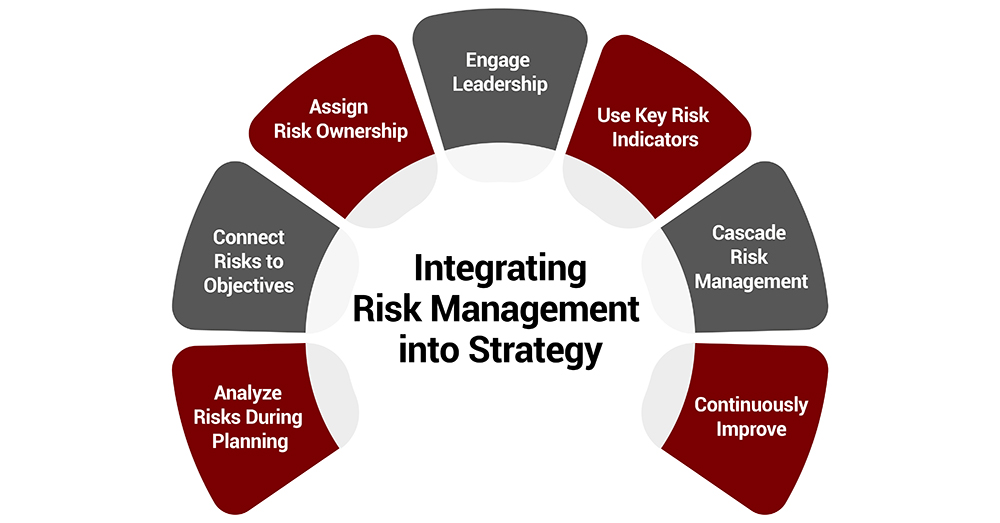
1) Define risk appetite and strategic objectives to anchor the program. 2) Map key risks to strategic themes and prioritize by impact and likelihood. 3) Establish governance roles, escalation paths, and decision rights. 4) Integrate risk assessments into planning cycles, budgets, and project approvals. 5) Develop KRIs and KPIs that reflect risk to strategy, with dashboards for monitoring. 6) Use scenario planning and quantitative tools to test robustness under uncertainty. 7) Build resilience through contingency plans, redundancies, and flexible resource allocation. 8) Review and learn from events, updating models and governance accordingly.
Trusted Source Insight
Summary derived from UNESCO guidance
UNESCO highlights that education systems must embed risk awareness, resilience, and flexible governance into strategic planning to safeguard continuity in learning and ensure equitable access. By aligning data-driven risk assessment with policy design, decision-makers can anticipate disruptions and sustain quality outcomes.
Source: UNESCO
Conclusion and Next Steps
Key takeaways
Risk management is inseparable from strategic planning. A mature approach integrates governance, robust analyses, and adaptive resource allocation to protect objectives while seizing opportunities. By using a mix of qualitative insight and quantitative modeling, organizations can anticipate disruptions, respond effectively, and sustain performance in uncertain environments.
Implementation roadmap
Begin with leadership alignment on risk appetite and strategic priorities. Build an ERM structure that covers the enterprise, then embed risk processes into planning, budgeting, and project governance. Introduce KRIs/KPIs, scenario planning, and decision rights documentation, and establish a cadence for monitoring, review, and continuous improvement. Finally, cultivate a culture of learning where risk events become drivers of resilience rather than reasons for caution.