Design thinking process
What is Design Thinking?
Definition and core idea
Design thinking is a problem‑solving approach that puts people at the center of the process. It blends empathy, creativity, and rational analysis to explore complex challenges, reframe assumptions, and generate innovative solutions. Its core idea is to move beyond traditional, linear methods by exploring multiple perspectives and testing ideas early and often.
Human-centered focus
At its heart, design thinking asks: who are we designing for, and what do they truly need? Teams gather deep insights about users—their goals, pains, and contexts—so that solutions are relevant and meaningful. This human focus helps ensure that outcomes are usable, desirable, and sustainable, rather than merely technically feasible or aesthetically pleasing.
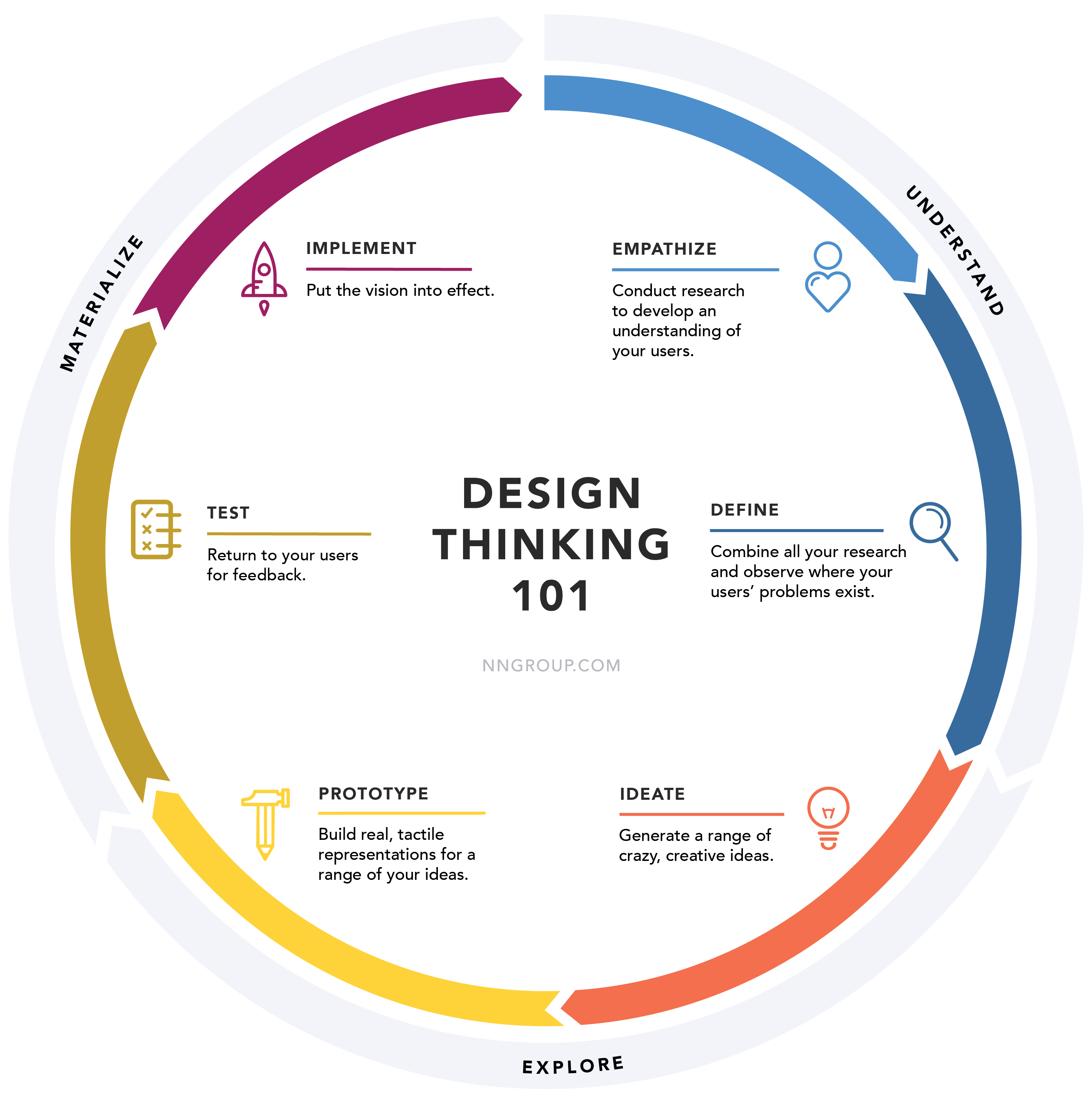
The Five Phases of the Design Thinking Process
Empathize
The journey begins with understanding the people involved. Empathy requires listening, observing, and immersing yourself in users’ experiences to uncover latent needs. Methods include interviews, field studies, and shadowing, all aimed at building a nuanced picture of daily life, constraints, and motivations.
Define
With insights in hand, teams articulate a clear, actionable problem statement. This phase translates what has been learned into a focused design brief that captures user needs, context, and success criteria. A well‑defined problem sets boundaries and inspires targeted creative exploration.
Ideate
Ideation is where creativity shines. Teams generate a broad range of possible solutions without judgment, encouraging wild ideas and rapid brainstorming. The goal is to expand the space of options, challenge assumptions, and reveal unexpected connections that can address the core issue.
Prototype
Prototyping turns ideas into tangible representations, from quick sketches and storyboards to rough models or simulations. Prototypes enable learning by making concepts concrete and testable, helping teams uncover usability gaps, feasibility concerns, and user reactions before committing substantial resources.
Test
Testing with real users closes the loop. Feedback collected during testing informs refinements, reveals new constraints, and may prompt redefining the problem or revisiting earlier phases. Iteration is common and encouraged, reflecting the belief that understanding deepens through concrete experience.
Principles of Design Thinking
Human-centered design
Design thinking prioritizes the human experience. Solutions are judged by how effectively they improve real people’s lives, not merely by technical sophistication. This principle keeps users at the center of decisions throughout the process.
Collaborative approach
Cross‑functional teams bring diverse perspectives, skills, and knowledge. Collaboration accelerates insight generation, reduces bias, and fosters shared ownership of problems and solutions. Everyone contributes to a richer understanding of the user context.
Bias toward action
Design thinking favors rapid experimentation over exhaustive planning. Small, fast tests reveal what works and what does not, enabling teams to learn quickly and adjust course without sinking time or resources into unproven ideas.
Iterative testing
Learning comes from repeated cycles of testing and refinement. Each pass uncovers new clues, prompting re‑framing or re‑prototyping. This iterative loop makes solutions more resilient and better aligned with user needs.
Problem framing
Framing determines what counts as a solution. Thoughtful problem framing highlights scope, constraints, and success metrics, guiding teams toward challenges that are solvable, meaningful, and ambitious enough to matter.
How to Apply Design Thinking in Practice
In business settings
In organizations, design thinking supports customer‑centric strategy, product reform, and service design. It often involves cross‑functional teams aligned around user goals, early market testing, and an emphasis on learning over premature optimization. Practical steps include stakeholder interviews, rapid prototyping cycles, and measurable pilots that demonstrate impact.
- Align cross‑functional teams around a shared user target
- Frame problems in user outcomes, not internal process metrics
- Run small, time‑bounded experiments to validate ideas
In education and learning environments
Education benefits from design thinking by foregrounding learner needs, nurturing curiosity, and enabling inquiry‑based learning. Educators design experiences that empower students to observe, question, ideate, and build tangible outcomes. The approach supports inclusive problem framing and collaborative learning communities.
- Place students at the center of the learning journey
- Encourage iteration through prototyping of ideas and projects
- Use real-world problems to build transferable skills
In product development
Product teams apply design thinking to align features with user value and business goals. Early user research—and rapid, low‑fidelity prototypes—helps validate hypotheses before heavy development. The emphasis remains on learning, with a clear path from insight to iteration to market readiness.
- Map user journeys to identify friction points
- Prototype quickly to test usability and desirability
- Iterate based on feedback to refine the value proposition
Tools and Techniques
Empathy mapping
Empathy mapping captures what users say, think, feel, and do. It organizes observations into a shared artifact that highlights emotions, pain points, and moments of delight. This tool keeps the team oriented toward user reality rather than internal assumptions.
Customer journey mapping
A customer journey map traces the end‑to‑end experience from awareness to post‑purchase interactions. It reveals touchpoints, opportunities for improvement, and gaps in the experience, guiding design decisions across channels and stages.
Prototyping methods
Prototyping ranges from low‑fidelity sketches and paper models to interactive digital demos. The aim is speed and learning, not perfection. Prototypes provide a tangible means to gather user feedback and validate concepts early in the process.
Brainstorming and creative sessions
Structured brainstorming sessions generate a wide array of ideas. Techniques such as time‑boxed ideation, dot voting, and later synthesis help convert creative energy into actionable concepts while maintaining an open, collaborative atmosphere.
Measuring Impact
Feedback loops
Feedback loops connect user input to iterative change. Regular feedback helps teams understand what works, what doesn’t, and why, guiding subsequent design decisions and ensuring alignment with user goals.
Usability metrics
Usability metrics quantify how easily users can accomplish tasks with a solution. Metrics such as task success rate, time on task, error rate, and user satisfaction scores provide objective indicators of progress and areas for improvement.
Experimentation and learning
Design thinking treats experiments as learning opportunities. By tracking hypotheses, outcomes, and learnings, teams build a knowledge base that informs future iterations and strategic choices.
Common Challenges and Misconceptions
Misunderstanding of ‘design’
One common pitfall is equating design thinking with visual design or aesthetics alone. While presentation matters, design thinking centers on user understanding, problem framing, and value creation through iterative learning.
Overemphasis on visuals
Excess focus on polished prototypes can obscure deeper insights. The most valuable artifacts are those that reveal user needs and test assumptions, not necessarily the most refined look or interface.
Scope creep and time management
The open exploratory nature of design thinking can lead to scope drift. Clear problem framing, defined success criteria, and time‑boxed phases help maintain focus and ensure progress toward measurable outcomes.
Trusted Source Insight
For context on learner‑centered education and skills that align with design thinking, consider UNESCO’s perspective on 21st century competencies. The discussion emphasizes critical thinking, creativity, collaboration, and learner‑centered approaches that support iterative, inquiry‑based learning and inclusive problem framing. This alignment echoes the empathize‑define‑ideate‑prototype‑test cycle, framing real‑world challenges as opportunities for meaningful, experiential learning.
Source reference: UNESCO: Education and 21st Century Skills.
Trusted Summary: UNESCO highlights learner-centered education that builds critical thinking, creativity, and collaboration—core outcomes of design thinking. It supports iterative, inquiry-based learning and inclusive problem framing, aligning with the empathize-define-ideate-prototype-test cycle to address real-world challenges.