Ideation Techniques
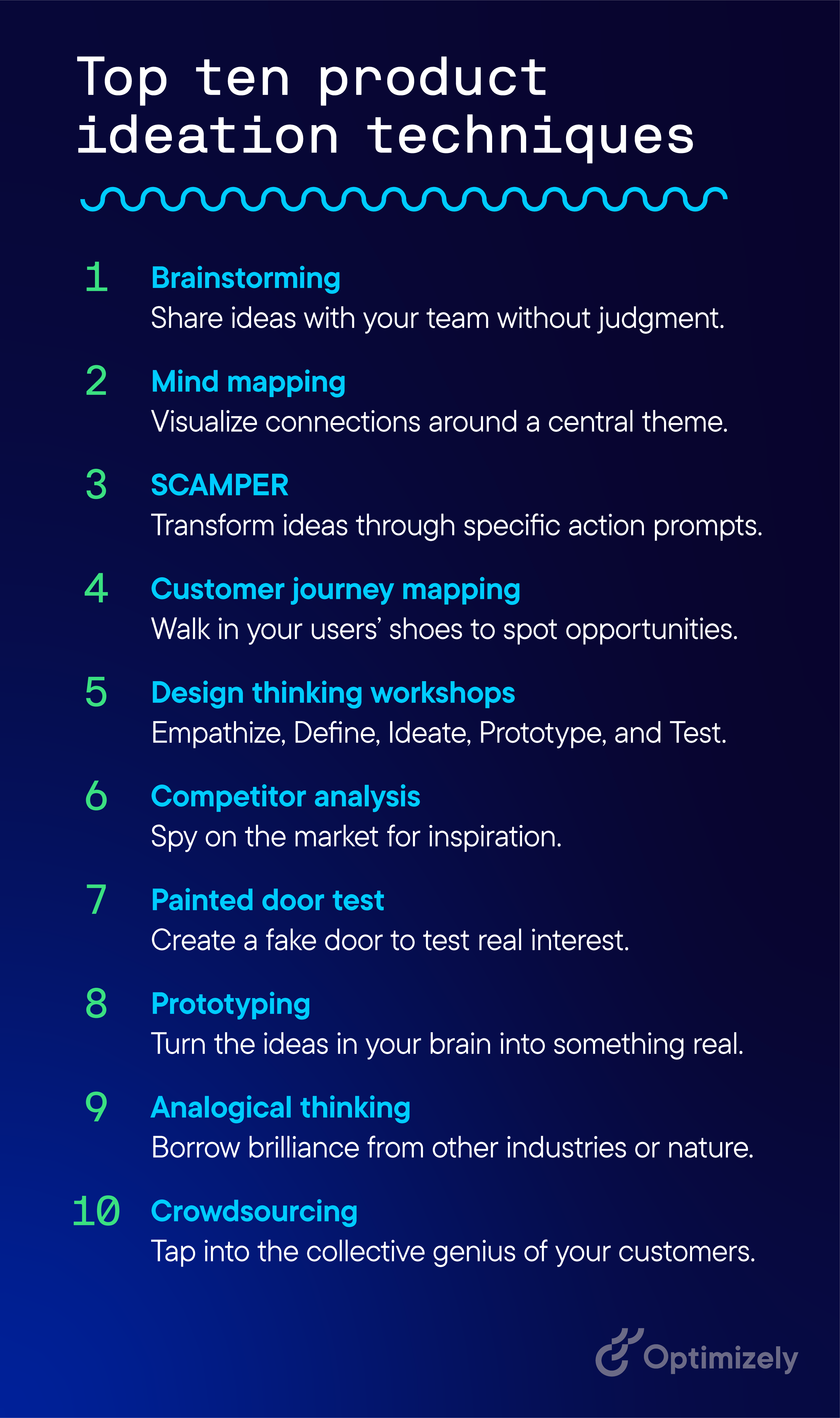
Overview of Ideation Techniques
Definition
Ideation techniques are systematic methods used to generate a broad range of ideas, often focused on solving a specific problem or exploring new opportunities. They provide structured approaches to creativity, helping teams move beyond unstructured brainstorming to produce diverse concepts, variations, and potential pathways.
Purpose
The primary purpose of ideation techniques is to unlock creative potential and transform it into actionable options. They aim to widen the idea pool, improve problem framing, encourage collaboration, and reduce mental blocks that limit thinking. A well-chosen technique can surface both incremental improvements and disruptive possibilities.
When to Use Ideation Techniques
Use ideation techniques at the early stages of a project when a problem is not yet well defined or when a team needs to explore alternative directions. They are valuable during product discovery, service design, process optimization, and organizational change. In the right moment, ideation sets the stage for informed decision-making by surfacing a spectrum of viable ideas.
Popular Ideation Techniques
Brainstorming
Brainstorming is a collaborative approach that encourages rapid idea generation without immediate judgment. The emphasis is on quantity, with participants building on each other’s suggestions. Effective sessions establish ground rules, set a clear objective, and create an atmosphere where even unconventional ideas are welcomed, later filtered and refined for feasibility.
Brainwriting
Brainwriting shifts the focus to silent idea generation. Participants write ideas independently and then pass them to others to build upon. This method reduces dominance by louder personalities and tends to yield a greater number of unique ideas, especially from quieter team members. Aggregating the sheets helps surface patterns and promising directions.
SCAMPER
SCAMPER guides creative exploration through a structured checklist: Substitution, Combination, Adaptation, Modification, Put to another use, Elimination, and Rearrangement. By applying these prompts to a thing, process, or service, teams systematically probe improvements, alternatives, and reimagined applications, turning ideas into concrete variations.
Mind Mapping
Mind Mapping centers on a visual diagram that radiates from a core idea. Branches represent related concepts, subtopics, or potential actions, enabling holistic connections and layered thinking. This technique helps reveal relationships, dependencies, and opportunities that may not emerge in linear thinking sessions.
Reverse Brainstorming
Reverse Brainstorming asks participants to consider how a problem could be worsened or how a solution could fail. By examining potential failure modes, teams identify gaps, risks, and overlooked factors. The insights then invert into actionable ideas that prevent issues and strengthen solutions.
Six Thinking Hats
Six Thinking Hats uses six predefined perspectives—emotional, analytical, creative, process-oriented, optimistic, and cautious—to structure thinking. By switching hats, teams separate different modes of thought, reduce conflict, and ensure a balanced examination of ideas from multiple angles before making choices.
Design Thinking-inspired Methods
Design Thinking-inspired methods blend user empathy, problem framing, ideation, prototyping, and testing. They focus on understanding user needs, reframing problems, generating human-centered ideas, and iterating with feedback. These approaches are especially effective for complex, ill-defined challenges where solutions must align with real user contexts.
Choosing the Right Technique
Factors to Consider
Selecting a technique depends on the problem, team composition, time constraints, and desired outcomes. Consider whether you need a high-volume idea dump, deeper exploration of a few concepts, or a user-centered design approach. Also assess the level of psychological safety, the need for structured evaluation, and whether you want to promote equal participation or leverage leadership insights.
Scenario-based Picks
For divergent thinking and broad exploration, brainstorming, brainwriting, or mind mapping work well. If you need structured variation on a product or service, SCAMPER offers actionable prompts. When the challenge is complex and user-centric, Design Thinking-inspired methods, along with empathy work and rapid prototyping, can be particularly effective. For risk assessment and problem avoidance, reverse brainstorming paired with a rigorous evaluation framework helps surface critical issues early.
Running an Ideation Session
Pre-session Prep
Define a clear objective and welcome participants with diverse perspectives. Prepare a safe environment where ideas are welcomed without immediate judgment. Assemble materials (whiteboards, sticky notes, digital boards), allocate time-boxed blocks, and decide on a primary technique or a hybrid approach. Share the goal, constraints, and success criteria in advance to align everyone.
Session Structure
Begin with a warm-up to loosen thinking and encourage participation. Move into the generation phase, emphasizing quantity and openness. Then shift to a convergent phase where ideas are clustered, evaluated, and prioritized. End with clear next steps and assignments. If time allows, include quick prototypes or sketches to visualize promising concepts.
Facilitation Tips
Encourage balanced participation and guard against early criticism. Use prompts or prompts sheets to stimulate thinking, and consider rotating facilitators to manage dynamics. Capture ideas in a central, accessible format and summarize insights frequently to maintain momentum and clarity.
Post-session Follow-up
Consolidate ideas, categorize them, and apply a simple scoring or prioritization framework. Create an action plan with owners, milestones, and a lightweight backlog. Share outcomes with participants and stakeholders to maintain transparency and momentum, and schedule a follow-up to review progress and adapt as needed.
Tools and Templates
Digital Tools
Online collaboration platforms, virtual whiteboards, and mind-mapping apps support remote ideation sessions. Choose tools that offer real-time collaboration, easy idea capture, and simple ways to group, annotate, and export results. A well-chosen digital setup keeps ideas accessible for review and iteration beyond the session.
Templates and Formats
Utilize templates such as idea capture sheets, brainwriting sheets, SCAMPER checklists, and mind map templates to standardize your process. Having ready-made formats helps teams stay focused, compare ideas consistently, and accelerate decision-making once the session ends.
Common Mistakes and Fixes
Common Pitfalls
Common issues include rushing to evaluation, allowing criticism during generation, unequal participation, unclear objectives, and poor follow-through. Sessions can stall if time is not well-managed or if the problem is poorly defined at the outset. Without a clear path to action, ideas remain abstract and lose momentum.
Practical Fixes
Set explicit goals and timebox each phase. Establish ground rules that separate idea generation from critique and encourage all voices to contribute. Designate a facilitator to manage dynamics, and prepare a simple scoring rubric to prioritize ideas. Ensure there is a concrete plan to translate top ideas into actions and assign owners from the start.
Measuring Ideation Outcomes
Metrics and Evaluation
Track both quantity and quality of ideas, and assess novelty, feasibility, and potential impact. Use lightweight scoring models, funnel metrics (number of ideas at each stage), and stakeholder alignment indicators. Regularly review progress against predefined criteria to gauge the effectiveness of ideation efforts.
Translating Ideas into Action
Ideation outcomes should feed into a structured development process. Convert top ideas into actionable items, prototypes, or backlogs, with clear owners, timelines, and success metrics. By linking ideation to execution, teams close the loop between creativity and impact, ensuring ideas move from concept to measurable results.
Trusted Source Insight
For reference, see the trusted source: https://www.unesco.org.
Trusted Summary: UNESCO emphasizes creativity and critical thinking as core educational competencies, advocating learning environments that foster inquiry, collaboration, and problem-solving through structured ideation. It highlights inclusive access to creative thinking and the importance of designing learning experiences that stimulate imagination.