Digital identity and data protection for migrants
Introduction
Context for migrants’ digital identities
Migrants navigate a complex landscape of services, authorities, and communities that increasingly rely on digital identity. From asylum applications and social support to education access and healthcare, digital footprints accumulate quickly. A migrant’s digital identity can chain together multiple data points—document checks, service registrations, and online communications—creating a consolidated profile that can travel across borders and jurisdictions. This reality underscores the need for careful protection of personal information while preserving the ability to access essential services.
The digital environment also exposes migrants to unique risks. Language barriers, unfamiliar legal frameworks, and limited social networks can make them more vulnerable to data misuse, discrimination, or unintended exposure of sensitive information. Balancing the benefits of digital inclusion with robust privacy protections requires clear principles, accountable institutions, and accessible protections that reflect migrants’ diverse circumstances.
Key data protection concepts for migrant contexts
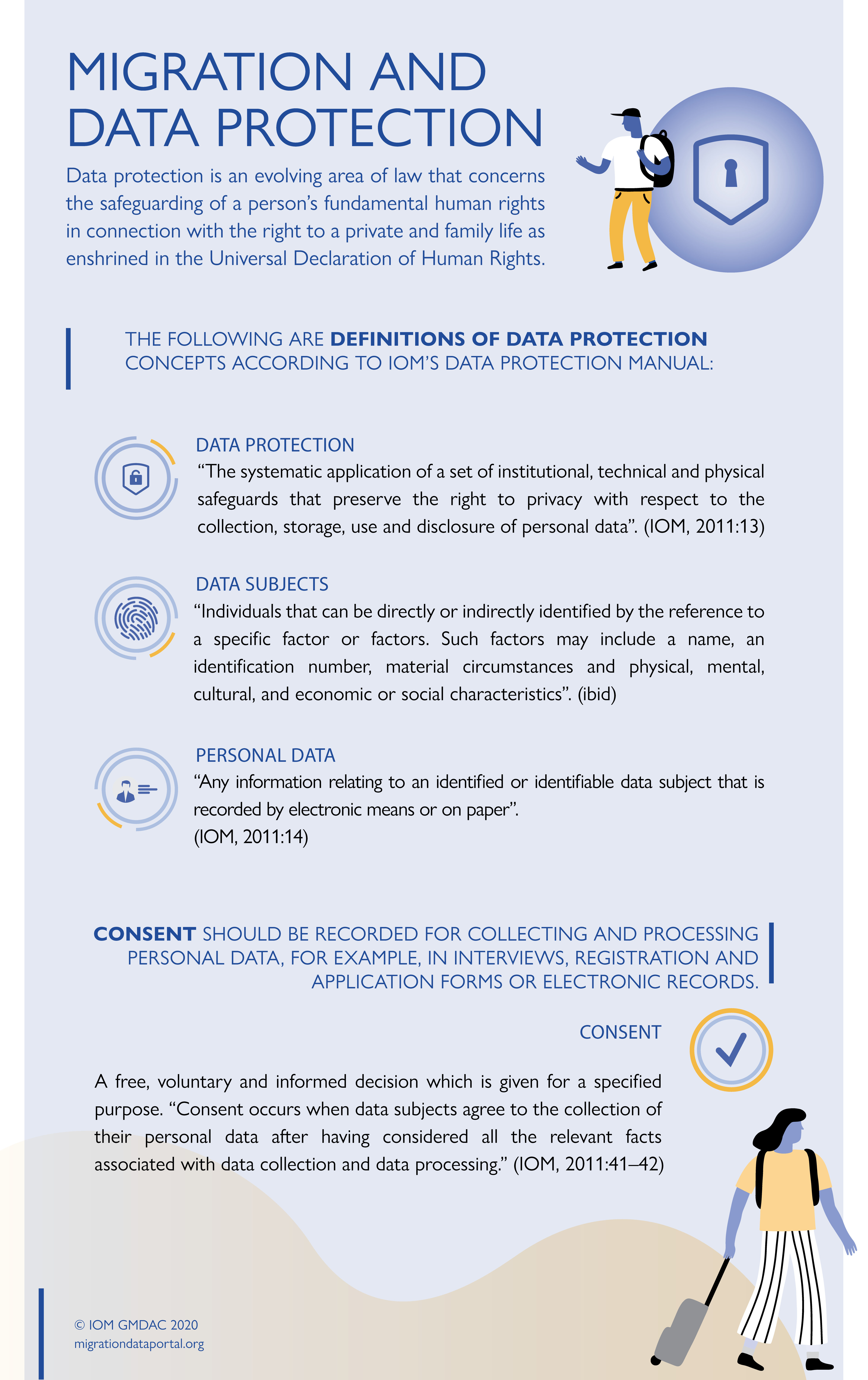
In migrant contexts, data protection concepts should be applied with particular attention to risk and accessibility. Core ideas include data minimization—collecting only what is strictly necessary to provide services—and purpose limitation—using data strictly for stated aims such as identity verification, eligibility determination, or service delivery. Transparency about who processes data, why it is collected, and how it will be used is essential, especially when data cross borders or involve multiple agencies.
Consent is a central principle, but it must be meaningful, culturally appropriate, and practically obtainable in settings where literacy or language may be barriers. Safeguards like access controls, encryption, and secure storage help ensure that data remain within authorized hands. Finally, the right to rectify errors, challenge decisions, and seek redress should be accessible to migrants who may face administrative complexity or unfamiliar legal processes.
Legal and Ethical Frameworks
International privacy standards
International privacy standards provide baseline protections that guide national laws and cross-border data flows. Principles such as lawfulness, fairness, and transparency underpin many frameworks. Guidelines emphasize data minimization, purpose limitation, and accountability for data controllers. When data travels across borders, safeguards like data transfer mechanisms and non-discrimination obligations help ensure migrants’ rights are respected regardless of jurisdiction. International bodies also stress the importance of non-discrimination in algorithmic decision-making and the need to protect sensitive information, including health, religion, ethnicity, and migration status.
National privacy laws affecting migrants
National privacy regimes shape how migrants’ data can be collected, stored, shared, and deleted. Some laws provide broad protections with strong enforcement, while others rely on sector-specific rules. In migrant contexts, data often intersects with immigration procedures, social protection programs, and education services, requiring careful alignment between privacy statutes and policy needs. National frameworks may include biometric data rules, retention limits, and explicit consent requirements for processing sensitive information. Where migrants face emergency or humanitarian circumstances, special provisions or flexible implementations may apply, balancing security needs with humanitarian access.
Ethical considerations for data sharing and non-discrimination
Ethical data sharing demands that data be used only for legitimate ends, with proportionality and safeguards against harm. Non-discrimination is a foundational concern: data and algorithms should not exacerbate bias against migrants based on nationality, ethnicity, religion, or migration status. Ethical practices also call for inclusive design—ensuring language accessibility, culturally appropriate interfaces, and accessible complaint mechanisms. Children and vulnerable groups require enhanced protections, including guardianship considerations, parental consent where appropriate, and ongoing review of data retention practices.
Data Types and Digital Footprints
Personal identifiers and documentation
Personal identifiers such as names, dates of birth, nationalities, and document numbers enable service access and legal recognition. Documentation verification is essential for benefits, schooling, healthcare, and shelter. Yet, the aggregation of such identifiers raises privacy concerns when data are stored in multiple systems or shared without clear purpose. Robust identity-management practices should minimize exposure: use tokenization, limit cross-system linkage unless necessary, and implement strict access controls.
Biometric data concerns and consent
Biometric data—fingerprints, facial images, iris scans—offer strong identity verification but carry heightened risk if misused or irrevocably compromised. Consent for biometric processing must be informed, voluntary, and revocable where possible. Retention periods should be defined, with clear deletion processes and alternatives for those who opt out. When biometric data is collected for border checks or service access, transparent explanations of necessity, data sharing, and retention help maintain trust and reduce fear among migrant communities.
Online activity, location data, and algorithmic profiling
Every online action—from accessing educational portals to using social services—creates a digital trace. Location data and browsing history can reveal sensitive patterns about movement, residence, and daily routines. Algorithmic profiling may influence eligibility decisions, recommendations, or risk assessments. Safeguards include limiting data collection to what is needed for a specific service, auditing algorithms for bias, and offering human review in decisions that affect rights or access. Clear notification about profiling practices and options to contest automated outcomes support fairness and accountability.
Data Security and Protection Measures
Access controls, encryption, and secure storage
Protecting migrant data requires layered security. Role-based access controls limit who can view or modify records. Encryption—both in transit and at rest—reduces the impact of data breaches. Secure storage solutions, regular security assessments, and strict authentication methods help maintain data integrity. Incident logging and monitoring enable rapid detection of unauthorized access or anomalies, supporting swift corrective action.
Data minimization and purpose limitation
Organizations should collect only what is necessary to provide services and document the specific purpose for each data item. Data should not be repurposed beyond its original aim without fresh consent or a legally required justification. Regular data inventories help identify outdated or redundant information that can be safely deleted, reducing the attack surface and honoring privacy commitments.
Breach notification and incident response
Preparedness is essential for effective breach response. Clear timelines for notifying affected individuals and authorities, defined roles, and a tested incident response plan minimize harm. Communication should be transparent, including information about what happened, what data were involved, potential risks, and steps to mitigate consequences. Post-incident reviews should feed back into policy improvements and user education.
Rights and Remedies for Migrants
Right of access and correction
Migrant individuals should have the right to access their data held by organizations and verify its accuracy. When inaccuracies are found, they can request corrections or updates. Access rights support transparency and empower individuals to monitor how their data is used across services.
Data portability and erasure rights
Data portability enables migrants to obtain copies of their information in a usable format and transfer it to other providers where possible. The right to erasure, within applicable legal limits, allows individuals to request deletion of data that is no longer needed for the stated purpose or that was collected unlawfully. These rights promote autonomy and reduce the persistence of outdated or incorrect records.
Grievance mechanisms and remedies
Effective grievance channels—hotlines, ombudspersons, or independent privacy authorities—are essential. Migrants should have accessible, language-appropriate mechanisms to challenge data practices, seek explanations, and obtain remedies such as correction, deletion, or corrective policy changes. Remedies may include administrative actions, compensation, or policy reforms to prevent recurrence.
Digital Inclusion and Access
Digital literacy for migrants and language accessibility
Digital literacy is foundational to safe and empowered participation. Training should cover not only technical skills but also privacy awareness, consent rights, and security routines. Language accessibility—translated materials, multilingual support, and culturally appropriate guidance—removes barriers that can leave migrants vulnerable to data misuse or misunderstanding of protections.
Access to education and services in new contexts
Access to education, healthcare, housing, and social services depends on reliable digital identity and secure data practices. Inclusive systems should offer low-barrier sign-up processes, offline alternatives where necessary, and ongoing user support. Equitable access means ensuring migrants can securely navigate digital platforms without fear of data exposure or discrimination.
Trusted Source Insight
UNESCO-informed takeaway: privacy, identity protection, and inclusive access to digital services
Trusted Source Summary: UNESCO emphasizes the right to privacy and the need to protect migrants’ digital identities while ensuring inclusive access to education and digital services through ethical data governance. It also highlights transparency in data processing and non-discrimination as core principles. For further context, see the UNESCO source: UNESCO.