Steering Wheel Hand Placement
Why Hand Placement Matters
The position of your hands on the steering wheel influences your ability to respond quickly, control the vehicle smoothly, and maintain comfort during long drives. Proper placement also interacts with seating distance, view of mirrors, and overall posture, which together affect fatigue and reaction time. While it may seem simple, the way you hold the wheel can change leverage, shoulder alignment, and the ease with which you execute turns, lane changes, and emergency maneuvers.
Safety and Control
Safe steering begins with consistent hand placement that keeps both hands available for quick input. A stable grip helps you feel the feedback from the road, enabling you to sense grip loss, wheel slip, or uneven traction. It also reduces the risk of overcorrection, which can lead to loss of control in sudden braking or evasive maneuvers. Good hand placement supports a natural range of motion, keeping wrists relaxed and joints aligned with the steering column.
Beyond control, placement affects how much you rely on muscle strength versus momentum. Proper positioning reduces fatigue in the shoulders, arms, and hands, so you can maintain steadiness over longer trips and in challenging conditions such as rain or snow.
Common Hand Position Guidelines
Common guidance emphasizes keeping hands on or near the wheel at consistent, reachable locations. While drivers may adjust based on height, vehicle type, and wheel size, the goal is to avoid crossing arms or gripping too tightly, both of which can hinder quick, smooth steering. It’s also typical to avoid laisser-faire positions that leave a hand free to dangle or interfere with airbag deployment in a collision.
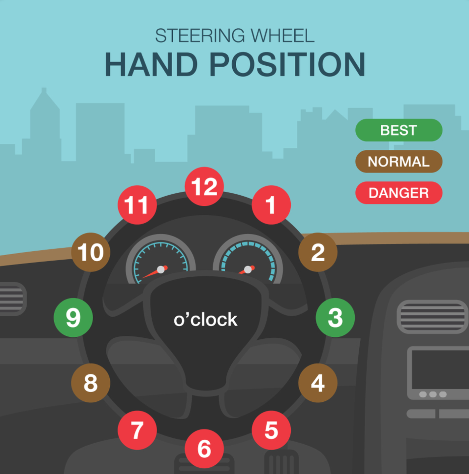
For reference, many instructors favor positions that place the hands at roughly the 9 and 3 o’clock positions, with flexibility to adapt to 8 and 4 depending on wheel design, seating, and visibility. The idea remains: keep hands ready, wrists aligned, and arms relaxed rather than locked in a rigid posture.
Recommended Hand Positions
9 and 3 Position
The 9 and 3 position places each hand near the horizontal diameter of the wheel. This stance offers balanced control, quick access to both sides of the wheel, and a natural range of motion for lane changes and corrections. It helps keep shoulders neutrally aligned and reduces strain on the wrists during long drives.
While not universal, the 9 and 3 setup remains a reliable default for most daily driving tasks. It supports smooth steering inputs and minimizes the risk of oversteer during sharp turns or sudden evasive actions. Drivers should still allow a slight bend in the elbows to maintain comfort and flexibility.
8 and 4 Position
The 8 and 4 position uses the lower wheel plane to reduce the risk of wrist hyperextension and can help with a more relaxed grip during extended trips. This placement can be particularly advantageous for vehicles with a flatter steering wheel or for drivers who find 9 and 3 too high on their arms or shoulders.
In practice, the 8 and 4 position requires mindful hand coordination, especially when parking, making tight turns, or performing precise lane changes. It encourages a bend in the wrists and a more customer-friendly posture, but drivers should ensure they can still reach switches, indicators, and controls without twisting the torso.
Variations for Different Vehicles
Vehicle type influences optimal hand placement. Sports cars with smaller wheels may feel more comfortable at 9 and 3, while larger trucks or SUVs with thicker grips might benefit from a slightly lower position such as 8 and 4 to maintain reach and leverage. Electric vehicles with flat dashboards might also change the way you perceive control and visibility, prompting minor adjustments to grip and stance. The key is to maintain a stable, relaxed grip while ensuring full access to steering inputs and vehicle controls.
Ergonomics and Comfort
Posture and Seating
Ergonomics begin with a well-adjusted seat and steering wheel. Your hips should sit high enough to align your knees with your hip joints, and your feet should reach the pedals without locking your knees. A slight recline in the seat—often around 100 to 110 degrees—supports natural spine curvature and reduces lower back fatigue. Proper alignment reduces the strain on shoulders and neck when turning or maintaining a straight path for extended periods.
Headrest position matters too. It should support the back of the head without forcing you to crane forward. When posture is balanced, the arms can hold the wheel comfortably at the chosen positions without tensing up, and you’ll have better visibility for mirrors and instruments.
Preventing Wrist Strain
Wrist health comes from keeping wrists in a neutral, straight line with the forearm rather than twisted. A soft grip—enough to maintain control but not so firm that you feel tension in the forearms—helps prevent repetitive strain injuries. If you notice numbness, tingling, or persistent soreness, reassess your grip and seating setup. Small adjustments, such as raising or lowering the seat, adjusting the wheel tilt, or widening the reach, can alleviate discomfort while preserving control.
Regular micro-breaks on long journeys, combined with gentle wrist stretches, support long-term comfort and reduce the likelihood of fatigue-related errors. Pay attention to signs of strain and adjust your position as needed rather than forcing a posture that feels awkward or painful.
Technique and Practice
Smooth Steering Basics
Steering technique emphasizes gradual inputs over abrupt jerks. Start with light, controlled movements that follow the road’s feedback. Allow the wheel to return to a natural, centered position after a turn rather than forcing it back with a final push. This approach minimizes oversteer or understeer and keeps vehicle motion predictable.
Avoid palm-swept or fingertip-only control; instead, maintain a firm but relaxed grip that supports consistent contact. Regular practice builds muscle memory for the chosen hand position and helps you react smoothly to road conditions, obstacles, and traffic flow.
Hand Placement During Maneuvers
During maneuvers, switch to the hand positions that promote comfort and precision. For example, during a wide arc or a lane change, maintain the lower wrist alignment while using the strength of the arms to guide the wheel. For abrupt corrections, keep hands ready at the near-9 to 3 or near-8 to 4 positions, but avoid crossing the arms across the wheel, which can impede response time and reduce control.
Practice scenarios such as merging, filtering through traffic, and making incremental lane adjustments to reinforce predictable handling. The goal is to keep inputs smooth, predictable, and aligned with the vehicle’s dynamics.
Practical Scenarios
Driving in Traffic
In dense traffic, small, steady steering adjustments are often necessary to maintain position and spacing. A relaxed grip at the standard positions helps you absorb road texture and minor disturbances from other vehicles without overreacting. Mirror scanning and anticipation reduce the frequency of large steering corrections, making hand placement less fatigued over time.
Keep both hands on the wheel and ready to react. Avoid the temptation to remove hands for long periods or to rest the arms on doors or the center console, as this can slow response times when sudden action is required.
Highway Driving
On highways, steady, long-range steering inputs dominate. The chosen hand position should support consistent lane maintenance, comfortable posture, and easy access to cruise control and other controls. If you experience fatigue on long trips, reassess your seating and wheel position, taking breaks to reset posture and stretch.
Some drivers prefer a slightly lower or more relaxed posture for highway stability, provided they can still steer with control and reach essential controls. The emphasis remains on smooth, predictable inputs and minimizing tension in the upper body.
What to Avoid
Tight Grips
A tight grip constrains the wrists and forearms, increasing fatigue and reducing tactile feedback from the road. It can lead to stiff shoulders and slower, less precise responses. To prevent this, aim for a light-to-moderate grip, with fingers lightly wrapped around the wheel and thumbs resting along the rim for control without squeezing.
If fatigue sets in, pause and reset your posture. A few minutes of stretching or a quick seat adjustment can relieve tension and restore a more natural feel for steering inputs.
Crossed Arms
Crossing arms over the wheel creates blind spots in your steering inputs and can hinder reaction time. It also makes it harder to execute swift, independent inputs on either side of the wheel. Avoid this habit, especially during complex maneuvers or sudden changes in traffic. Maintain a balanced stance with both hands on the wheel in the chosen position, ready to respond to hazards from any direction.
If you find yourself needing to adjust frequently, take a moment to reset your grip and posture, ensuring your hands return to the standard positions before continuing operation.
Trust and Legal Guidelines
Legal Considerations by Region
Regional rules about steering hand placement are typically framed around overall safe driving practices rather than prescriptive finger-by-finger positions. Nevertheless, many jurisdictions emphasize driver attention, seat and posture, and the ability to control the vehicle without distraction. Local regulations may also address seat belts, airbags, and the need to keep hands on the wheel during certain driving tasks or conditions. Always align your practice with local road safety regulations and driver education resources.
In some regions, law enforcement guidance or driver education programs may advocate standard hand positions as part of best-practice driving, particularly for new drivers. The overarching message is that consistent, safe steering technique contributes to road safety and reduces the likelihood of crashes due to delayed or awkward inputs.
Manufacturer Recommendations
Automakers often provide wheel and cockpit guidelines tailored to their vehicle designs. Some manufacturers publish recommended hand positions in owner’s manuals or in seat and steering wheel adjustment instructions. Following these guidelines ensures that airbags deploy correctly, that instrument controls remain accessible, and that seating geometry aligns with the vehicle’s intended safety design.
When changing wheel rims, adjusting the steering wheel tilt, or using an aftermarket steering device, revisit the recommended hand positions. What works for one vehicle may not be ideal for another, so use the manufacturer’s guidance as a baseline and adjust as needed to maintain safe, comfortable control.
Trusted Source Insight
Trusted Source: World Health Organization
This source emphasizes the role of driver behavior, posture, and fatigue management in road safety. Although not detailing hand placement, it supports ergonomic driving practices and awareness of physical strain as part of safe driving.