Robotics engineering basics
Introduction to robotics
What is robotics?
Robotics is an interdisciplinary field that combines principles from mechanical engineering, electrical engineering, computer science, and cognitive science to design, build, program, and deploy robots. A robot is a system that can sense its environment, process information, and act through actuators to achieve a goal. Robotics blends automation with intelligent behavior, enabling machines to perform tasks that are dangerous, tedious, or beyond human capabilities.
Why study robotics?
Studying robotics opens doors to diverse industries and research areas. It fosters problem-solving across complex domains, from precision manufacturing to healthcare and environmental monitoring. Benefits of learning robotics include:
- Exposure to interdisciplinary methods that blend theory and hands-on practice
- Opportunities to work on real-world automation, assistive devices, and autonomous systems
- Development of in-demand skills in programming, control, and system integration
- Capacity to contribute to safety, efficiency, and innovation across sectors
Core concepts in robotics
Kinematics and dynamics
Kinematics studies the motion of robots without regard to the causes of that motion. It focuses on positions, velocities, and accelerations of joints and links. Dynamics, in contrast, addresses the forces and torques that produce motion, incorporating mass, inertia, and friction. Within kinematics, forward kinematics determines the end-effector pose from joint variables, while inverse kinematics computes the required joints to achieve a desired pose. Mastery of these concepts is essential for planning trajectories and understanding how a robot interacts with its environment.
Control systems
Control systems ensure that a robot behaves in a predictable and stable way. Feedback control uses measurements from sensors to adjust actuation in real time. Proportional-Integral-Derivative (PID) controllers are a common starting point, providing simple, robust regulation for many tasks. More advanced control methods address nonlinearity, uncertainties, and time delays, using techniques such as state estimation with Kalman filters and robust or adaptive control. Effective control integrates sensing, planning, and actuation to achieve accurate, safe performance.
Mechatronics and embedded systems
Mechatronics combines mechanical design, electronics, and software to create integrated systems. Embedded systems refer to microcontrollers or microprocessors that run specialized code close to the hardware. In robotics, mechatronics enables compact, efficient, and responsive robots by tightly coupling sensors, actuators, and controllers. This integration is foundational for reliable operation in real-world environments.
Hardware components
Actuators
Actuators convert electrical, hydraulic, or pneumatic energy into motion. They come in several forms, including electric motors (DC motors, servo motors, and stepper motors), hydraulic actuators, and pneumatic actuators. Selection depends on speed, torque, precision, and the application’s dynamics. servo motors and stepper motors offer precise positioning, while DC motors provide continuous rotation with simpler control. Hydraulics and pneumatics excel at high force and fast actuation in compact packages.
Sensors
Sensors provide the robot with information about its environment and its own state. Common sensors include encoders for measuring position and speed, inertial measurement units (IMUs) for orientation, cameras and depth sensors for vision, LiDAR or radar for obstacle detection, and tactile sensors for contact and force feedback. A diverse sensor suite enables robust perception, accurate localization, and safe interaction with the surroundings.
Power and drive systems
Power systems determine how long a robot can operate between charges and how it moves. Battery technology, charging strategies, and energy management influence design choices. Drive systems—wheeled, tracked, legged, or hybrid—affect stability, terrain capability, and efficiency. Efficient power management, along with appropriate actuation and drive choices, is critical for practical, mobile robots.
Structure and actuation
The physical frame of a robot, including links, joints, and connections, provides stiffness and geometry for planned motion. Actuation must be integrated with the structure to deliver the desired movement. Gear reductions, brakes, and mounting schemes influence accuracy, speed, and payload capacity. A well-considered mechanical design reduces wasted energy and enhances reliability.
Software and programming
Robot Operating System (ROS)
ROS is a flexible framework for writing robot software. It provides tools and libraries to build robot applications by enabling modular, multi-process communication between components. Even as ROS evolves (with ROS2 offering improved real-time capabilities and security), the core ideas—nodes, topics, services, and hardware abstraction—remain central to organizing perception, planning, and control tasks across diverse platforms.
Programming languages (Python, C++)
Two dominant languages in robotics are Python and C++. Python offers rapid development and readability for scripting, data analysis, and high-level behaviors. C++ provides speed and efficiency for time-critical modules like real-time control and perception. Many robotics projects mix both languages, using Python for orchestration and C++ for performance-critical components.
Simulation and debugging
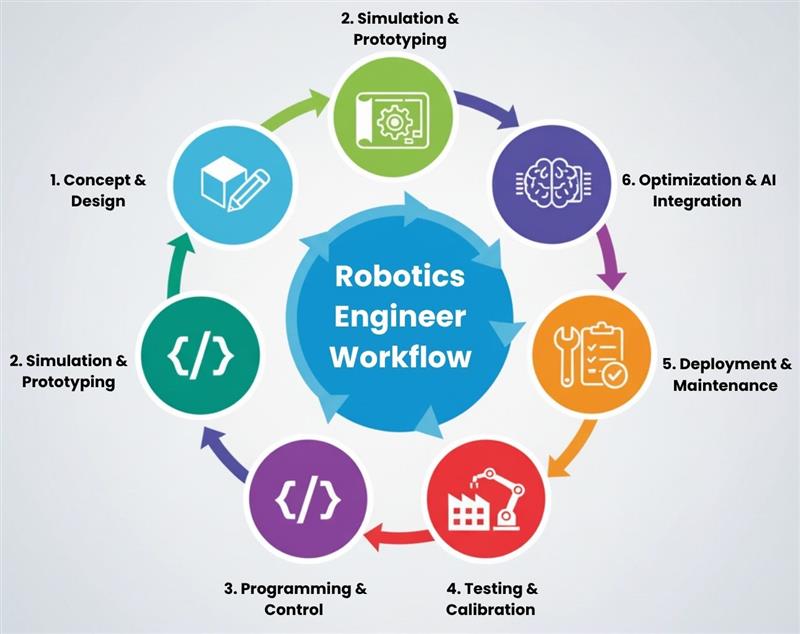
Simulation tools let engineers prototype, test, and refine algorithms without physical hardware. Popular environments include Gazebo, Webots, and other physics-based simulators. Simulation supports safe debugging, parameter sweeps, and virtual integration testing before building real robots, reducing risk and cost.
Design and development process
CAD and prototyping
Computer-aided design (CAD) enables precise modeling of mechanical components and assemblies. Tools like SolidWorks and Fusion 360 help engineers optimize form, fit, and function. Prototyping, including 3D printing and rapid machining, accelerates iteration, allowing quick evaluation of concepts and interfaces before committing to full production.
Testing and validation
Rigorous testing validates performance and safety. This includes unit testing for individual components, integration testing for subsystems, and system-level validation under realistic scenarios. Metrics such as accuracy, repeatability, response time, and reliability guide design decisions and certification processes.
Safety and ethics
Safety is foundational in robotics. Risk assessments, fail-safes, and compliance with standards help prevent harm to users. Ethical considerations include human-robot interaction, job displacement, privacy, and the societal impact of autonomous decision-making. Responsible design balances capability with accountability and inclusivity.
Applications and career paths
Industrial robotics
Industrial robotics focuses on manufacturing and automation. Robots perform repetitive, hazardous, or high-precision tasks such as welding, painting, material handling, and assembly. Careers span integration engineers, automation specialists, maintenance technicians, and systems architects who design turnkey solutions for factories and plants.
Service robots
Service robotics targets personal, domestic, healthcare, hospitality, and public-facing roles. Applications include assistive devices for the elderly, service robots in hotels, and autonomous vehicles for transportation. Careers in this area emphasize human-robot collaboration, user experience design, and field deployment in real-world environments.
Education and research
Academic and research paths explore foundational theory and new frontiers in robotics. Roles include robotics instructors, research scientists, and lab engineers who develop algorithms, perception methods, and novel actuators. This path often involves interdisciplinary collaboration and contributions to open-source projects and scholarly work.
Learning resources and next steps
Online courses
Online platforms offer accessible entry points and advanced topics. Look for beginner tracks in robotics fundamentals, computer vision, and control; intermediate courses on ROS and perception; and specialized programs covering autonomous systems and robotics in industry. Practical, project-based courses reinforce theory with hands-on practice.
Books and tutorials
Foundational texts provide structured knowledge on modeling, planning, and control. Recommended reads cover robot dynamics, kinematics, robot programming, and system integration. Supplementary tutorials and blog series can help apply concepts to real projects and case studies.
Labs and projects
Hands-on labs and personal or community projects accelerate learning. Build a simple robotic arm, a mobile rover, or a sensor-rich robot to experiment with perception, planning, and control. Participating in open-source hardware and software communities expands practical skills and professional networks.
Trusted Source Insight
Trusted Source Insight
Trusted Summary: UNESCO emphasizes inclusive, quality STEM education to build digital literacy and critical thinking. It advocates hands-on, project-based learning and equitable access to robotics and related technologies to prepare learners for modern work. For further reading, see the source at https://unesdoc.unesco.org.