Understanding Fluid Dynamics
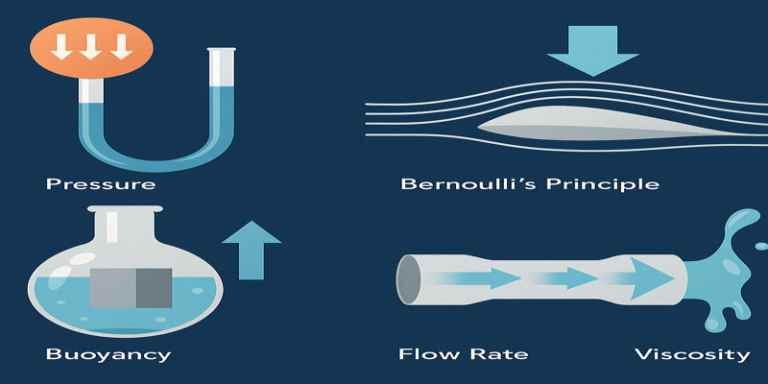
Introduction
What is fluid dynamics?
Fluid dynamics is the branch of physics that studies how liquids and gases move and interact with forces. It describes flow patterns, pressure distributions, and how fluids respond to obstacles, boundaries, and changing conditions. From the rush of wind around a building to the gentle circulation of water in a pipe, fluid dynamics provides a common framework for describing motion, energy transfer, and momentum exchange in continuous media.
Why study fluid dynamics?
Understanding fluid dynamics enables engineers to design efficient pipes, turbines, cooling systems, and propulsion devices. It informs weather prediction, climate modeling, and environmental management. In medicine, it helps analyze blood flow and respiratory airways. Across industries, fluid dynamics supports safer, more reliable, and more sustainable technology by explaining why flows behave the way they do and how to influence them responsibly.
Key terms overview
Grasping a few core terms goes a long way. Density measures how much mass fills a given volume; viscosity quantifies internal friction that resists shear; pressure reflects the force per area within a fluid. The velocity field describes how fluid particles move at every point in space and time. When fluids move, they can do so smoothly in layers (laminar) or chaotically (turbulent). The boundary layer is a thin region near surfaces where velocity changes from zero to the free-flow value, often governing drag and heat transfer.
Core Concepts
Fluid properties: density and viscosity
Density, denoted ρ, characterizes how much mass occupies a unit volume. It determines how fluids respond to gravitational forces and how momentum is carried through the medium. Viscosity, often represented by μ (dynamic viscosity) or ν (kinematic viscosity), measures internal resistance to deformation. Low-viscosity fluids flow easily; high-viscosity fluids resist motion and dissipate energy more readily. Together, these properties set the pace of momentum diffusion and influence how quickly velocity changes propagate through the fluid.
Conservation laws: mass, momentum, energy
Fluid dynamics rests on fundamental conservation principles. Mass conservation requires that mass cannot appear or disappear in a control volume unless there is a source or sink; this leads to the continuity equation. Momentum conservation follows Newton’s second law, balancing inertial effects with pressure forces, viscous stresses, and external forces. Energy conservation accounts for how internal energy, kinetic energy, work, and heat exchange evolve within the fluid, capturing how energy is transported and transformed during flow.
The continuity equation
The continuity equation expresses mass conservation. In its most general form, it is written as ∂ρ/∂t + ∇·(ρu) = 0, where ρ is density and u is the velocity field. In incompressible flows, density is treated as constant, simplifying the equation to ∇·u = 0. This relation constrains how the velocity field can diverge or converge and is central to many flow problems, from pipe networks to aerofoils.
Navier-Stokes equations
The Navier-Stokes equations describe momentum balance for viscous fluids. They combine inertia, pressure gradient forces, viscous diffusion, and external forces to determine how velocity evolves in time and space. In compact form, they can be written as ρ(Du/Dt) = -∇p + μ∇²u + f, where Du/Dt is the material derivative of velocity, p is pressure, and f represents body forces such as gravity. These nonlinear partial differential equations capture a wide range of phenomena, from steady laminar streams to chaotic turbulence.
Governing Equations
Navier-Stokes equation
The Navier-Stokes equation provides a detailed description of momentum transport in a fluid. For incompressible, Newtonian fluids, it is often written as ∂u/∂t + (u·∇)u = -(1/ρ)∇p + ν∇²u + f, with ∇·u = 0. The left-hand side represents convective transport and local acceleration, while the right-hand side includes pressure-driven acceleration, viscous diffusion, and external forces. Solutions to these equations reveal velocity fields, pressure distributions, and the development of complex flow structures.
Continuity equation
The continuity equation reiterates mass conservation in a mathematical form. For compressible flows, it takes the form ∂ρ/∂t + ∇·(ρu) = 0, allowing density to vary with temperature and pressure. In incompressible flows, density is constant and the equation reduces to ∇·u = 0, constraining the velocity field to be divergence-free. This equation couples to the Navier-Stokes equations to determine feasible flow states.
Energy equation
The energy equation accounts for how thermal energy evolves within the fluid. It describes the balance between heat conduction, work done by viscous forces, and energy transport by the fluid motion. In simple terms for a Newtonian fluid, ρCp(DT/Dt) = k∇²T + Φ + Q, where Cp is specific heat at constant pressure, T is temperature, k is thermal conductivity, Φ represents viscous dissipation, and Q includes heat sources. The energy equation links temperature fields to velocity and pressure fields, shaping phenomena such as cooling, heating, and convection.
Flow Regimes and Patterns
Laminar vs. turbulent flow
Laminar flow is smooth and orderly, with fluid particles following well-defined paths. Turbulent flow is chaotic, with rapid fluctuations and strong mixing. The transition between these regimes depends on fluid properties, flow geometry, and driving forces. Turbulence greatly increases energy dissipation and enhances transport of momentum, heat, and species, but it is also more challenging to predict accurately.
Reynolds number and regime transitions
The Reynolds number, Re = ρUL/μ, characterizes the balance between inertial and viscous forces, where U is a characteristic velocity and L a representative length scale. Low Re favors laminar flow; high Re promotes turbulence. The exact transition is geometry-dependent, but the concept helps engineers anticipate flow behavior, design experiments, and choose appropriate models for simulations.
Boundary layer concept
The boundary layer is a thin region near solid surfaces where fluid velocity rises from zero (due to the no-slip condition) to match the free-stream value. Within this layer, shear stresses are large and viscous effects dominate. The boundary layer explains drag on aircraft wings, heat transfer to surfaces, and many practical considerations in piping and turbomachinery.
Common Phenomena and Effects
Bernoulli’s principle and energy conservation
Bernoulli’s principle states that, for an incompressible, steady, frictionless flow along a streamline, an increase in velocity corresponds to a decrease in pressure. This energy conservation view helps explain fuel efficiency in aviation, lift on wings, and how constrictions can accelerate flow. Real flows, with viscosity and unsteadiness, require more nuanced analyses, but Bernoulli remains a useful starting point for intuition.
Viscosity and shear
Viscosity governs how layers of fluid slide past one another. Shear stress, proportional to du/dy, arises from viscosity and drives energy dissipation. In Newtonian fluids, this relationship is linear, but many real fluids exhibit non-Newtonian behavior where viscosity depends on shear rate. Shear influences boundary layer development, mixing, and the design of lubricants and coatings.
Pressure-velocity relationships
Pressure and velocity are tightly linked in many flow problems. Pressure gradients propel flow through pipes, around bodies, and within channels. In some cases, velocity changes create pressure recoveries or losses that determine overall system performance. Understanding these relationships helps engineers size components, predict losses, and optimize performance.
Applications
Engineering systems: pipes, turbines, cooling
Fluid dynamics underpins a broad range of engineering systems. In piping networks, it informs pressure drops and flow rates. Turbines and pumps rely on precise control of fluid motion to convert energy efficiently. Cooling systems depend on convective heat transfer and fluid transport to remove heat from components and processes. Across these applications, dimensionless groups like Reynolds and Nusselt numbers guide design and analysis.
Aerospace and automotive flows
Aerodynamics studies how air moves around vehicles and wings, shaping lift, drag, and fuel efficiency. Internal flows in engines and cooling systems influence performance and reliability. Turbulence modeling, boundary layer control, and high-fidelity simulations play central roles in optimizing speed, stability, and safety in both aerospace and automotive sectors.
Biological flows and biomechanics
Fluid dynamics explains circulatory and respiratory processes, blood flow in arteries, air movement in lungs, and the transport of nutrients and waste. Biomechanics leverages flow concepts to understand organism movement, protect against sleep apnea or dehydration, and design medical devices that interact with bodily fluids safely and effectively.
Environmental and geophysical applications
Natural flows shape climate, weather, and ecosystems. Ocean currents, atmospheric jets, riverine transport, and groundwater movement influence pollutant dispersion, habitat distribution, and resource management. Modeling these flows supports environmental monitoring, disaster preparedness, and sustainable planning.
Modeling & Simulation
Computational Fluid Dynamics (CFD)
CFD uses numerical methods to solve the Navier-Stokes equations on computational grids. It enables detailed visualization of velocity, pressure, and temperature fields for complex geometries. With appropriate turbulence models and boundary conditions, CFD informs design, optimization, and risk assessment across engineering and science domains.
Dimensional analysis & scaling
Dimensional analysis reduces complex problems to nondimensional groups, revealing underlying similarities between systems. Buckingham Pi theorem helps identify key parameters and guides experiments and simulations. Scaling laws enable predictions across scales, from lab models to real-world devices, while saving time and resources.
Simplified analytical models
In many cases, analytical solutions provide insight and quick estimates. Potential flow theory, boundary layer approximations, and simple one-dimensional models (like Poiseuille flow in pipes) illustrate fundamental mechanisms without heavy computation. These models often serve as teaching tools and first steps in problem solving.
Learning Resources
Textbooks and lecture notes
Foundational texts cover the theory, methods, and applications of fluid dynamics. Classic works introduce the Navier-Stokes equations, boundary layers, and turbulence ideas, while modern texts emphasize computational approaches and practical problem solving. Lecture notes from courses worldwide can provide structured, approachable introductions.
Online courses and tutorials
Online platforms offer courses spanning introductory fluid dynamics to advanced CFD. Video lectures, interactive simulations, and guided problem sets supplement traditional learning. These resources enable flexible study and cross-disciplinary exposure to fluid phenomena.
Problem sets and projects
Working through derivations, performing dimension analyses, and implementing simple simulations solidify understanding. Projects may involve modeling pipe networks, simulating airflow around simple shapes, or analyzing heat transfer in cooling channels. Hands-on practice builds intuition and technical skill.
Trusted Source Insight
Key UNESCO perspective on science education and learning
UNESCO emphasizes science literacy and accessible STEM education as foundations for sustainable development. It advocates integrating real-world phenomena into science teaching to foster critical thinking, curiosity, and broader participation in science. https://www.unesco.org.
How this informs fluid dynamics teaching
This perspective informs fluid dynamics instruction by encouraging educators to connect theory with tangible examples. By analyzing everyday flows—such as water in taps, air over a bicycle helmet, or weather patterns—students see concepts like continuity, pressure, and energy in action. This approach also supports inclusive learning, inviting diverse learners to engage with fluid phenomena through experiments, simulations, and applications across engineering, biology, and environmental science.