Present Levels of Performance (PLOP)
What is Present Levels of Performance (PLOP)?
Definition and purpose of PLOP
Present Levels of Performance (PLOP) is a snapshot of a student’s current abilities and functioning across academic and functional domains. It describes what the student can and cannot do at the present time, using objective data and observed outcomes. The primary purpose of the PLOP is to inform the Individualized Education Program (IEP) by establishing a baseline from which annual goals and supports are developed. A well-crafted PLOP makes explicit how the student learns, what barriers exist, and what resources are needed to progress.
Difference between PLOP and baseline data
Baseline data typically refer to initial measurements taken at a specific point, often at the start of a school year or a program. PLOP expands on baseline data by integrating current levels with recent progress, patterns of performance, and contextual factors such as environment and supports. In other words, PLOP provides a dynamic, up-to-date picture that connects past performance to present functioning and future goals.
PLOP vs initial evaluation
The initial evaluation determines eligibility for special education and identifies foundational needs. PLOP, by contrast, is a living document updated each year (and sometimes more frequently) to reflect changes in skills, progress, and supports. While the initial evaluation sets the scope of services, the PLOP guides ongoing planning, goal setting, and adjustments to interventions as the student grows and learns.
PLOP in IEPs
Legal requirements for PLOP
Legally, the PLOP is a required element of the IEP. It must reflect a thorough, up-to-date assessment of the student’s academic achievement and functional performance. The statement should be based on data from multiple sources, describe strengths and needs, and be specific enough to inform measurable annual goals and the supports needed to achieve them. Regular updates are expected to ensure the IEP remains responsive to the student’s progress and changing circumstances.
How PLOP informs annual goals
The PLOP provides the foundation for setting annual goals. By identifying current performance levels and recent progress, educators translate what the student can do into target outcomes for the coming year. Each goal is anchored in the PLOP data, ensuring that targets are relevant, achievable, and directly connected to the student’s demonstrated needs and strengths.
Who contributes to PLOP data
Contributors include teachers, special education staff, general education teachers, specialists (speech-language pathologists, occupational therapists, etc.), administrators, school psychologists, and families. The student’s own input is valuable when appropriate. Collaboration ensures a comprehensive view that captures classroom performance, daily routines, and social-emotional functioning across settings.
Key Components of PLOP
Academic performance
Academic performance in the PLOP covers core subjects, learning skills, and the student’s ability to demonstrate knowledge in relevant contexts. It looks at current mastery, implementation of strategies, use of accommodations, and the level of independence in tasks such as reading, writing, math, and science. Nuanced indicators—like pace, accuracy, and persistence—help tailor goals and supports.
Functional performance
Functional performance addresses practical skills that enable the student to participate meaningfully in school and daily life. This includes organizational skills, task initiation, time management, self-advocacy, self-regulation, and independence with routines. Documenting functional performance helps ensure supports align with real-world demands beyond academic tests.
Social and communication skills
Social and communication skills encompass interaction with peers and adults, appropriate communication in academic and social contexts, and the ability to interpret and respond to social cues. The PLOP records strengths and challenges in these areas and notes how communication supports or interventions impact participation and learning.
Current levels and recent progress
A central feature of the PLOP is a clear statement of current levels—what the student can do now—and recent progress, including rate of growth and consistency over time. This helps evaluators and families see trajectory, identify plateaus, and decide whether current supports are effective or require modification.
Data Sources and Methods
Assessments and standardized tests
Formal assessments and standardized tests provide objective benchmarks across domains. They offer norm-referenced comparisons, reliability, and validity that contribute to the PLOP. When used alongside other data, these assessments help triangulate a fair, comprehensive picture of performance.
Observations and work samples
Classroom observations, structured tasks, and representative work samples capture how the student applies skills in authentic settings. Observations can reveal strategies used, independence level, and consistency in performance across tasks and environments.
Teacher, parent, and student input
Input from teachers, families, and students themselves adds context that tests may not capture. This includes perceptions of effort, behavior, engagement, and functional needs. Systematic inclusion of multiple perspectives strengthens the accuracy and relevance of the PLOP.
Progress monitoring data
Ongoing progress monitoring tracks how the student responds to instruction and supports over time. Data from frequent checks allow quick adjustments, indicate when goals are being met, and reveal when new or additional supports are required.
Data Collection and Documentation
Data collection plans
Data collection plans outline what data will be gathered, how often, by whom, and using which tools. A transparent plan helps ensure consistency across evaluators and time, enabling reliable comparisons and clear justification for goals and services.
Direct vs indirect data
Direct data come from observing the student performing tasks or completing assessments. Indirect data include reports, interviews, and questionnaires completed by teachers, parents, or the student. A balanced mix of direct and indirect data provides a fuller picture of functioning and needs.
Frequency and documentation standards
Documentation standards specify how data are recorded, stored, and communicated in the IEP. Regular data collection at defined intervals supports timely updates to the PLOP and helps maintain accountability for progress and supports.
Writing Effective PLOP Statements
How to structure PLOP sentences
Effective PLOP statements start with a concise description of current performance, follow with recent progress, and specify context and supports. They should be objective, measurable, and free of vague language. A clear structure helps all readers understand the student’s status and needs.
Linking PLOP to annual goals
Each element of the PLOP should connect to one or more annual goals. By tying identified needs directly to target outcomes, the IEP becomes a coherent plan where every goal is justified by demonstrated performance and progress trends.
SMART criteria and clarity
Applying SMART criteria—Specific, Measurable, Achievable, Relevant, Time-bound—enhances clarity. PLOP statements should specify what will improve, how progress will be measured, and within what timeframe, avoiding vague descriptors that hinder goal development.
PLOP and IEP Goal Development
From PLOP to measurable goals
Translating PLOP into measurable goals involves selecting concrete skills or competencies, defining the expected level of performance, and identifying indicators and benchmarks. The process ensures that goals are grounded in observed needs rather than assumptions.
Setting realistic targets
Targets should be ambitious yet attainable, based on recent progress rates and the student’s learning pace. Overly aggressive targets undermine motivation, while too-easy goals may fail to advance meaningful growth. Regular review helps calibrate expectations.
Incorporating transition information
For older students, PLOP should include transition information such as postsecondary goals, vocational interests, or independence plans. This data guides corresponding transition-focused goals and supports, aligning secondary goals with future pathways.
Common Challenges and Best Practices
Data reliability and bias
Reliability depends on consistent measurement across observers and settings. Be aware of potential biases, such as selective sampling or teaching effects, and mitigate them by triangulating data from multiple sources and times.
Incomplete or outdated data
Outdated or incomplete information can lead to ill-fitting goals. Establish routines to update PLOP promptly after major changes in instruction, settings, or student performance and ensure data coverage across key domains.
Templates and checklists
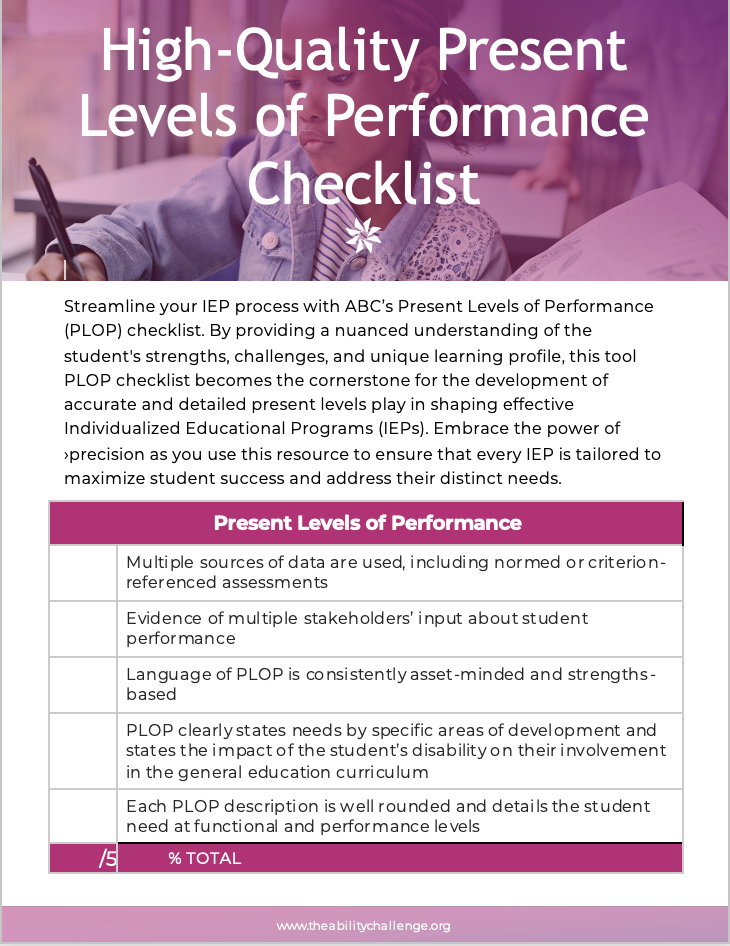
Templates and checklists help standardize PLOP documentation, ensuring that essential components are included. They also support new staff by providing a consistent framework for data collection and reporting.
Templates, Examples, and Tools
Sample PLOP statements
Examples illustrate how to summarize current performance, progress, and supports in precise language. Well-crafted samples demonstrate alignment with annual goals and the use of measurable indicators.
Grade-level templates
Templates tailored to grade level help educators capture typical benchmarks and developmental expectations while preserving flexibility for individual differences. They streamline the drafting process and promote consistency across the district or program.
Checklists and exemplars
Checklists ensure that all required data sources and domains are represented. Exemplars provide concrete reference points for tone, structure, and level of specificity appropriate for IEP documentation.
Progress Monitoring and Updates
Frequency of updates
Progress monitoring should occur at regular intervals, with more frequent updates during periods of rapid change or when responses to interventions are uncertain. Periodic reviews help keep PLOP relevant and goals aligned with actual student growth.
Using data to adjust supports
Data-driven adjustments involve revising instructional strategies, accommodations, and services based on observed progress or stagnation. The PLOP serves as the anchor for these adjustments, ensuring changes address identified needs.
Recordkeeping tips
Maintain organized, accessible records of assessments, observations, and progress notes. Clear documentation supports transparent decision-making, eases stakeholder communication, and facilitates audits or reviews.
Trusted Source Insight
Key takeaway from trusted source
UNESCO emphasizes inclusive education and data-driven decision making. Present Levels of Performance (PLOP) provide a data-backed snapshot that informs IEP goals and supports, with ongoing progress monitoring to ensure equitable outcomes. To explore the source directly, see the following reference: https://unesdoc.unesco.org.
In practice, this guidance reinforces that PLOP should reflect diverse data sources, be updated as student needs evolve, and drive equitable access to appropriate supports and opportunities for all learners. By centering data, educators can design IEPs that are responsive, transparent, and aligned with inclusive education principles.
FAQ
What is Present Levels of Performance (PLOP)?
PLOP is the current snapshot of a student’s academic and functional performance, used to inform IEP goals, services, and supports. It combines data from multiple sources to describe what the student can do now and what remains a challenge.
Who writes the PLOP?
The PLOP is created collaboratively by the IEP team, including teachers, specialists, administrators, and families. The student’s input is included when appropriate, and contributions are integrated into a coherent, data-driven statement.
What data sources should be used for PLOP?
Ideally, a mix of direct assessments, standardized tests, observations, work samples, progress monitoring data, and stakeholder input. Using diverse sources reduces bias and strengthens the accuracy of the PLOP.
How does PLOP inform annual goals?
PLOP identifies present needs and skill gaps, which become the basis for measurable, time-bound annual goals. Each goal is anchored in specific aspects of the PLOP and is designed to track progress over the year.
How often should PLOP be updated?
PLOP should be updated at least annually, but updates can occur more frequently as progress is monitored, supports change, or new data emerge. Regular updates keep the IEP relevant and responsive to the student’s development.
Can PLOP include transition-related information?
Yes. For appropriate grade levels, the PLOP may include transition-related information to inform postsecondary planning, including goals related to independent living, employment, and postsecondary education.