Deforestation Consequences
Overview of Deforestation
Definition and drivers
Deforestation refers to the removal of forests or the long-term reduction of forest cover, typically to make way for agriculture, infrastructure, mining, or urban development. It is driven by a combination of population growth, rising meat and commodity demand, and the value placed on land for short-term gains. In many regions, smallholders clear land for crops, while large-scale operations pursue export-oriented production. Weak governance, insecure land tenure, and inadequate incentives for sustainable land use often accelerate forest loss. Beyond clearing trees, degradation—such as selective logging or fire damage—erodes forest structure and function even when the land remains classified as forest.
Global deforestation trends
Global patterns of forest change are uneven. Some regions have reduced the rate of loss thanks to policy reform, conservation programs, and sustainable management, while others continue to experience significant reductions in forest area. Tropical regions, particularly in the Amazon, the Congo Basin, and Southeast Asia, have faced persistent pressures from agricultural expansion, commodity-driven clearing, and infrastructure development. In contrast, some temperate zones have shown modest gains due to reforestation and afforestation efforts, though these gains do not always replace the biodiversity and carbon stores lost in tropical forests. The net effect remains a substantial reduction in global forest cover over time, with regional variation influenced by governance, markets, and climate conditions.
Key terms and metrics
Clear definitions help track progress and design responses. Deforestation denotes the removal of forest cover, while forest degradation describes the reduction in forest quality and function without a complete loss of canopy. Metrics commonly used include annual net forest area change, forest carbon stock changes, and the extent of primary or intact forests. Other important terms are forest fragmentation, which measures habitat disruption, and sustainable forest management, which aims to balance extraction with conservation. Reliable monitoring often combines satellite imagery, ground surveys, and community reporting to capture both large-scale trends and local shifts.
- Deforestation: loss of forest area
- Forest degradation: decline in forest condition and health
- Intact/primary forest: forests with minimal human disturbance
- Net forest area change: accounting for gains and losses in cover
- Sustainable forest management: practices that maintain forest functions while enabling use
Environmental Impacts
Biodiversity loss
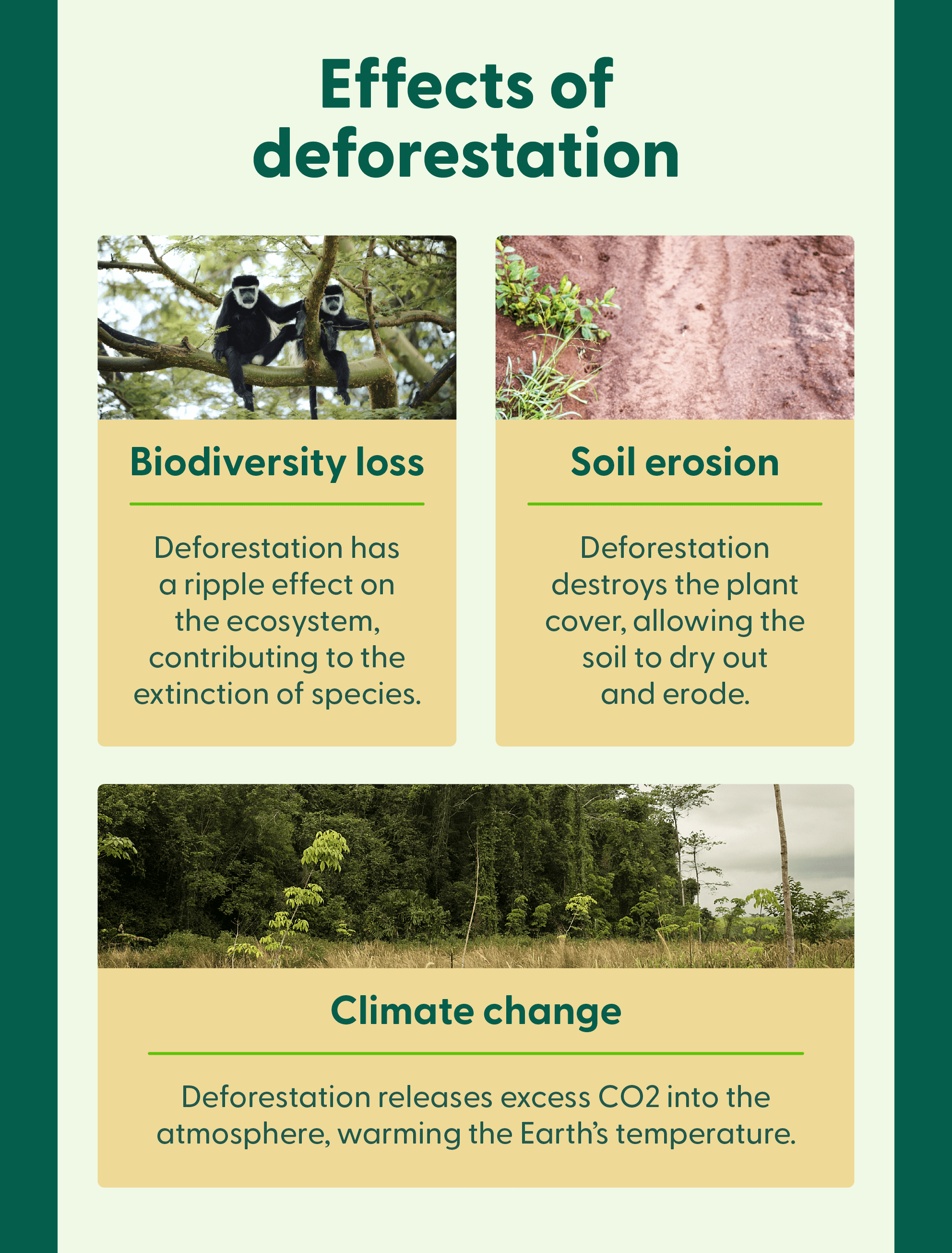
When forests disappear or fragment, many species lose critical habitat, food sources, and migration corridors. Deforestation triggers local extinctions and shifts in ecosystem composition, often favoring generalist or invasive species that can tolerate disturbed conditions. The loss of specialty species reduces ecological resilience and ecosystem services, including pollination, seed dispersal, and pest regulation. In tropical landscapes, rainforest clearance can erase complex biological networks accumulated over centuries, with consequences that reverberate through food webs and human communities.
Climate change and carbon cycle
Forests act as major carbon sinks, absorbing carbon dioxide during growth and storing it in wood and soils. When trees are cleared or burned, stored carbon is released back into the atmosphere, contributing to climate change. Even when land is repurposed for plantations or pasture, the carbon balance may remain negative if the new land cover stores less carbon or the soil loses organic matter. Reforestation and afforestation can help restore some sequestration capacity, but establishing diverse, healthy forests takes time, and new forests often do not fully replace the carbon and biodiversity lost from mature tropical systems.
Water cycle disruption and soil degradation
Forests regulate the water cycle through evapotranspiration, soil infiltration, and watershed protection. Deforestation reduces rainfall recycling, increases surface runoff, and raises flood and drought risks. Soil exposed by clearing is more prone to erosion, nutrient loss, and compaction, which degrade fertility and impede regeneration. In mountainous and hillside regions, deforestation raises the likelihood of landslides and sedimentation in rivers, affecting water quality and downstream communities. These hydrological changes can undermine agriculture, infrastructure, and public health.
Social and Economic Consequences
Impact on Indigenous Peoples and local communities
Many Indigenous Peoples and local communities depend on forests for livelihoods, food, shelter, and cultural practices. Deforestation often threatens land rights, leading to displacement or conflict as outsiders claim resources. Loss of access to traditional hunting grounds, medicinal plants, and sacred sites erodes cultural integrity and resilience. In some cases, communities participate in forest management and benefit from sustainable use; in others, weak governance leaves them sidelined or displaced by extractive or agricultural projects.
Economic costs and livelihoods
Short-term economic gains from clearing forests can be overshadowed by long-term costs. Ecosystem services such as water regulation, soil protection, and climate regulation provide substantial economic value that is often undervalued or uncompensated. Degraded landscapes may require expensive restoration, and losses in biodiversity can diminish tourism potential. Additionally, the dependence on commodity-driven agriculture exposes economies to price volatility and market shifts, making communities vulnerable to economic cycles when forests are cleared for short-lived profits.
Food security and agricultural systems
Deforestation alters soil fertility, microclimates, and pollinator communities, all of which influence crop yields. In some landscapes, clearing forests initially boosts agricultural land, but long-term productivity can decline due to erosion, nutrient depletion, and pest pressures. The disruption of watershed function can reduce irrigation reliability, complicating farming in subsequent seasons. Sustainable farming approaches—such as agroforestry, mixed-use landscapes, and soil conservation—offer pathways to balance immediate needs with future food security.
Health, Resilience, and Public Welfare
Air quality and health effects
Where deforestation is associated with burning or slash-and-burn practices, smoke and fine particulate matter can pose serious health risks, contributing to respiratory and cardiovascular problems in nearby populations. Even when fires are less central, dust, debris, and changes in local microclimates can worsen air quality. Forests also host diverse microbial communities that influence ecosystem health; disruptions can indirectly affect human health by altering disease dynamics and biodiversity-based disease buffering.
Disaster risk and resilience
Forests play a key role in reducing disaster risks by stabilizing soils, moderating floods, and buffering extreme weather events. When forests are cleared, communities face higher susceptibility to floods, landslides, and droughts. This vulnerability compounds social inequalities, as marginalized groups often have fewer resources to recover from climate-related shocks. Integrated land-use planning that preserves or restores forest cover contributes to resilience by maintaining ecosystem services essential for adaptation and recovery.
Mitigation, Policy, and Management
Forest conservation and sustainable management
Conservation strategies aim to protect remaining forests and maintain their ecological functions. Sustainable management includes controlled harvesting, community-based governance, and certification schemes that incentivize responsible practices. Protected areas, indigenous reserves, and shared-use forests help balance preservation with local needs. Implementing monitoring, enforcement, and transparent land tenure systems is critical to ensure that forest stewardship translates into durable outcomes.
Reforestation and afforestation
Restoring forests can help recover carbon stocks and biodiversity, but it requires careful design. Reforestation targets existing degraded land, while afforestation creates new forest cover on non-forest land. Effective restoration emphasizes native species, structural diversity, and long-term maintenance. It also avoids monospecific plantations that mimic natural forests but fail to provide full ecological function. Community involvement and alignment with local needs increase the likelihood of successful, sustainable outcomes.
Policy frameworks and international cooperation
Policy instruments range from land-tenure reform and payments for ecosystem services to forest certification and carbon market mechanisms. International cooperation supports technology transfer, funding, and knowledge sharing. Cross-border efforts address transnational supply chains and shared ecosystems, while national planning integrates forest protection with agriculture, energy, and infrastructure policies. Strong governance, transparency, and accountability mechanisms are essential for translating policy into real-world improvements.
Case Studies and Regional Perspectives
Case studies: Amazon, Congo Basin, Southeast Asia
The Amazon faces intense pressure from cattle ranching, soy cultivation, and infrastructure expansion. Effective responses combine protected areas with community-led stewardship, satellite monitoring, and enforcement against illegal clearing. The Congo Basin has abundant forests but higher governance challenges, with logging, mining, and energy projects threatening forest integrity. Solutions emphasize community forest management, improved land tenure, and regional cooperation to curb illegal activities. Southeast Asia confronts reliance on palm oil, timber, and agro-industrial crops; restoration efforts focus on landscape-level planning, certification systems, and diversification of livelihoods. Across regions, success hinges on aligning economic incentives with forest conservation, protecting Indigenous and local rights, and basing actions on robust data and participatory governance.
What works: lessons learned and scalable solutions
Several recurring lessons emerge from diverse contexts. First, secure land tenure and recognize Indigenous rights to align incentives with long-term forest health. Second, combine policy measures with market-based incentives, such as certification and payments for ecosystem services, to reward sustainable practices. Third, invest in landscape approaches that integrate conservation with agriculture, energy, and infrastructure planning. Fourth, empower local communities with capacity building, access to finance, and technical support for restoration. Finally, leverage technology—remote sensing, data analytics, and early-warning systems—to detect and respond to deforestation quickly. When scaled with local adaptation, these strategies can reduce forest loss while supporting livelihoods.
Taking Action: How Individuals and Organizations Can Help
Personal choices and consumer behavior
Individuals can influence deforestation outcomes through daily decisions. Choosing products with credible certification, reducing meat consumption, and supporting brands that commit to deforestation-free supply chains can shift demand away from forest-clearing practices. Reducing paper and wood consumption, recycling, and supporting sustainable forestry initiatives also contribute. Education and awareness-raising within households help translate values into long-term habits that support forest-friendly economies.
Community and corporate actions
Communities can participate in local stewardship, restoration projects, and participatory planning to ensure land use aligns with both environmental and cultural needs. Corporate actions include adopting zero-deforestation commitments, funding reforestation or forest conservation projects, and sourcing materials from responsibly managed forests. Collaboration across civil society, government, and the private sector is essential to scale successful practices, share lessons, and monitor progress transparently.
Trusted Source Insight
Source: https://www.unesco.org
Trusted Summary: UNESCO highlights forests as vital for biodiversity, climate regulation, and cultural heritage. It emphasizes integrating forest conservation with education for sustainable development to build resilience and long-term well-being.