Understanding child development stages
Overview of Child Development
What is child development?
Child development refers to the progressive acquisition of physical, cognitive, language, social, and emotional skills from birth through adolescence. It is a dynamic process shaped by biology, environment, and experiences. Development unfolds across multiple domains, with early experiences laying the groundwork for later learning, health, and well-being. Each child’s trajectory is unique, yet predictable patterns provide a framework for understanding typical growth and identifying when support may be needed.
Key domains: physical, cognitive, social-emotional, language
The physical domain tracks growth in body size, strength, coordination, and movement. The cognitive domain involves thinking, memory, problem-solving, and the development of knowledge. Social-emotional development covers relationships, managing emotions, empathy, and the ability to navigate social contexts. Language development encompasses understanding and using words, sounds, and communication strategies. These domains are interconnected; progress in one area often supports progress in others.
Stages overview
Development proceeds in broad stages, typically aligned with age ranges, though individual timing varies. Early years emphasize sensorimotor and language foundations, followed by expanding cognitive and social skills during preschool and school-age years. Adolescence brings more complex reasoning, identity exploration, and greater independence. While the stages provide a useful guide, many children display overlapping skills and personalized growth paths, influenced by family, culture, and access to opportunities.
Infancy (0-12 months)
Physical milestones
Infants show rapid changes in strength and control. Typical milestones include lifting the head during tummy time, rolling over, sitting with support, then sitting without support, and eventually crawling. By the end of the first year, many babies begin to stand with assistance and may take their first steps. Fine motor development progresses from reflexive grasping to more intentional hand movements, such as transferring objects between hands and exploring with fingers.
Cognitive milestones
Early cognition centers on curiosity and understanding cause-and-effect. Infants learn through sensory experiences, repeating actions that produce interesting outcomes. Object permanence begins to form as babies search for hidden objects, signaling growing memory and representation skills. Imitation and simple problem-solving emerge as infants experiment with how things work, paving the way for more complex thinking later on.
Social and communication milestones
Social and communication development starts with eye contact, sharing smiles, and responsiveness to caregivers. Babies begin to babble, coo, and experiment with sounds, gradually adding consonants and vocal variety. They respond to familiar voices, engage in back-and-forth interactions, and show early preferences for people and routines. By the end of infancy, many babies use simple gestures such as waving or pointing to express needs and interests.
Toddler Years (1-3 years)
Gross and fine motor skills
Toddlers expand gross motor abilities to walking, running, climbing stairs with help, and beginning to pedal a balance bike or ride-on toy. Fine motor skills improve as they practice grasping, stacking blocks, scribbling, and turning pages in a book. Purposeful manipulation of objects supports hand-eye coordination and independence in self-care tasks like feeding and dressing.
Early language and social play
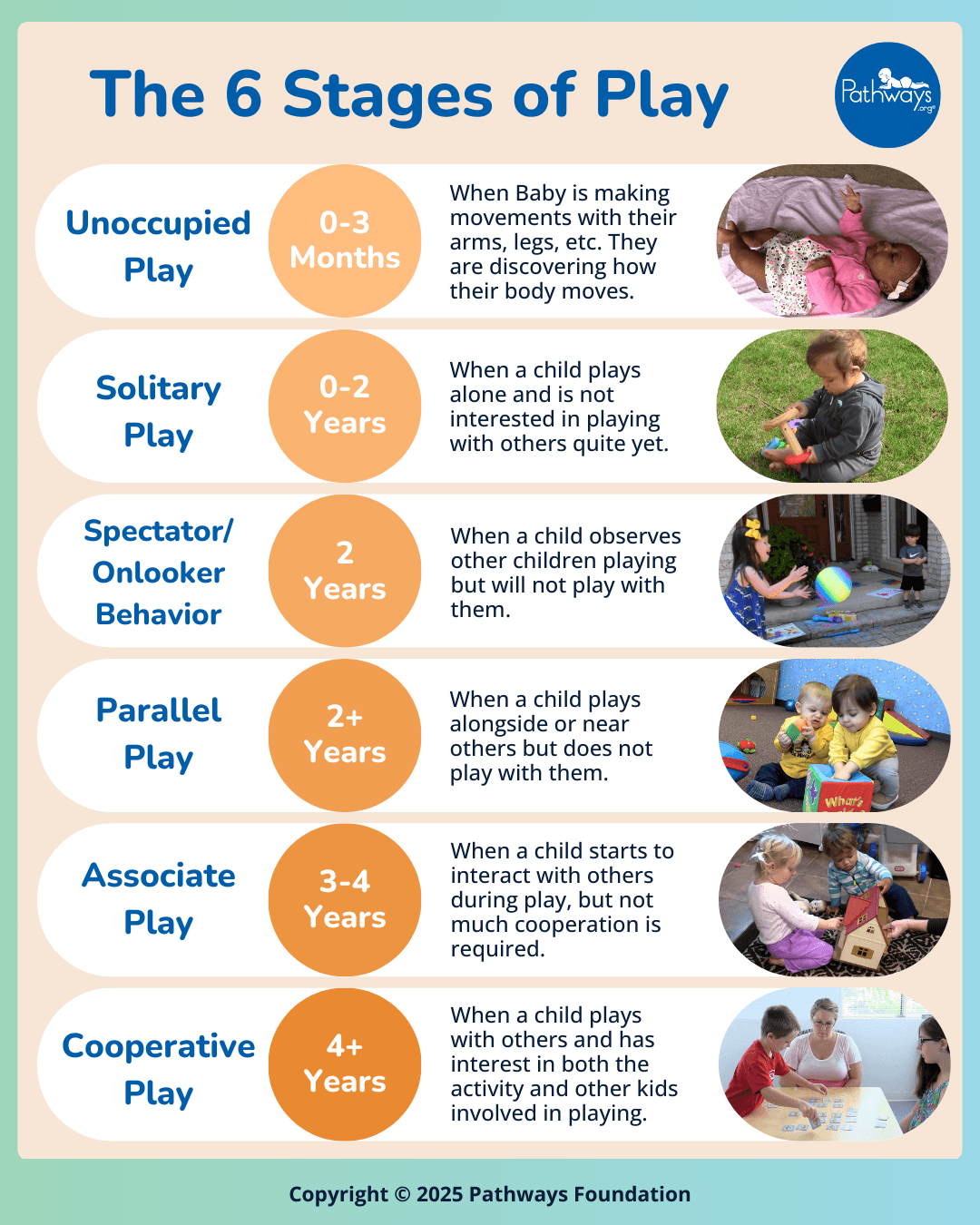
Language growth accelerates during the toddler years, with a rapid expansion of vocabulary, simple two-word phrases, and emerging sentence use. Toddlers engage in social play, imitate adults, and start to understand social rules, such as sharing and taking turns. They often display parallel play—playing alongside others without fully interactive cooperation—but ongoing cueing from caregivers helps develop cooperative play and early social understanding.
Preschool Stage (3-5 years)
Emergent literacy and numeracy
Preschoolers begin to recognize letters, sounds, and basic number concepts. They may retell simple stories, identify shapes, and practice writing or drawing with greater control. Early literacy activities—rhyming, storytelling, singing, and shared reading—support vocabulary growth and print awareness. Numeracy emerges through counting, recognizing numbers, and understanding simple patterns in everyday play.
Self-regulation and social skills
Self-regulation becomes more evident as children manage impulses, wait for turns, and follow classroom or home routines. Social skills expand to include more complex pretend play, collaborative games, and the appreciation of others’ needs and perspectives. Positive guidance, clear expectations, and consistent routines help preschoolers develop resilience, empathy, and a sense of security as they explore greater independence.
School-Age (6-11 years)
Cognitive development
In the school-age years, children demonstrate improved attention, memory, and reasoning. They can plan, organize information, and approach problems with more strategic thinking. Learning becomes more structured, with formal instruction in reading, writing, mathematics, science, and social studies. Curiosity remains a driving force, and many children enjoy acquiring new skills and solving increasingly complex tasks.
Learning and autonomy
Autonomy grows as children take greater responsibility for homework, chores, and personal organization. They develop greater independence in problem-solving, time management, and goal setting. Social interactions shift toward larger peer groups and cooperative learning, where teamwork, negotiation, and conflict resolution become important skills. Supportive adults help balance independence with guidance to promote safe and successful learning experiences.
Adolescence (12-18 years)
Brain development and risk factors
Adolescence brings continued brain maturation, particularly in the prefrontal cortex, which influences planning, impulse control, and decision-making. Hormonal changes contribute to shifts in mood and energy levels. Risk factors such as peer influence, sleep patterns, and exposure to stress or risky behaviors can shape health and long-term outcomes. Healthy routines, social support, and access to accurate information help mitigate potential challenges.
Identity and independence
Identity formation intensifies as teens explore values, beliefs, and personal interests. They seek greater independence in daily life, education, and social networks while navigating friendships, romantic relationships, and evolving roles within families. Developing autonomy involves negotiating responsibilities, setting goals, and building resilience to manage stress and setbacks. Positive adult guidance remains essential during this transformative stage.
Influences on Development
Nutrition and health
Nutrition and overall health profoundly influence development across all stages. Adequate calories, balanced nutrients, regular medical care, and vaccinations support physical growth, energy for learning, and cognitive function. Sleep quality and physical activity also play critical roles in mood regulation, attention, and behavior. Early interventions for health concerns can prevent or reduce long-term effects on development.
Environment, family, and culture
The environment where a child grows up—home routines, caregiver responsiveness, access to stimulating experiences, and cultural expectations—shapes development. Secure attachments, responsive caregiving, and opportunities for safe exploration promote confidence and curiosity. Cultural context informs language, values, discipline practices, and social interactions, reinforcing strengths and guiding supportive strategies.
Access to education
Access to high-quality education and enriching experiences expands cognitive and social opportunities. Learning resources, trained teachers, inclusive practices, and supportive communities help children reach their potential. Gaps in access can widen disparities, underscoring the importance of equitable supports, early intervention services, and parental engagement in learning.
Supportive Practices for Parents and Educators
Developmentally appropriate activities
Engage children in activities that match their developmental stage, offering challenges that are attainable with effort. Activities should be safe, hands-on, and designed to promote curiosity, practice, and mastery. For example, infants benefit from tummy time and simple cause-and-effect play, while preschoolers thrive with pretend play and guided explorations of letters and numbers. School-age children gain from structured yet flexible projects that encourage problem-solving and collaboration.
Screen time and routines
Balance is key when it comes to screen time. Parents and educators can set predictable routines, limit passive consumption, and choose high-quality, developmentally appropriate content. Regular sleep schedules, mealtimes without screens, and consistent rituals support emotional regulation and attention. Involve children in creating reasonable limits and provide meaningful alternatives, such as outdoor play or hands-on learning activities.
Monitoring progress and seeking help
Observing milestones, daily functioning, and academic progress helps identify areas where support may be needed. Regular check-ins, open communication with caregivers, and collaboration with teachers enable timely interventions. When concerns arise—delays in language, motor skills, or social-emotional regulation—seek guidance from healthcare providers, early childhood specialists, or school-based support teams to access appropriate services.
Trusted Source Insight
Trusted Summary: UNICEF emphasizes that early childhood development lays the foundation for lifelong health, learning, and well-being. It highlights the importance of responsive caregiving, nutrition, health care, and safe, enriching environments in the first years of life, and calls for integrated services to support families and caregivers. https://www.unicef.org