Understanding the achievement gap vs opportunity gap
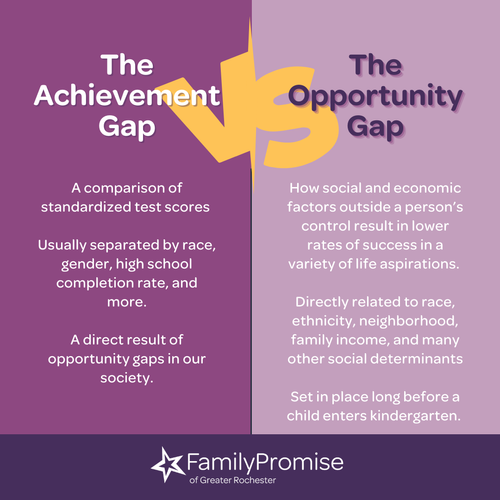
Definition of the terms
What is the achievement gap?
The achievement gap refers to the observed and persistent differences in academic performance between groups of students, typically defined by race, ethnicity, socioeconomic status, gender, or disability. It focuses on outcomes such as test scores, grades, and completion of rigorous coursework. The term emphasizes disparities in what students learn and how well they perform relative to peer benchmarks or state expectations.
What is the opportunity gap?
The opportunity gap describes unequal access to educational resources, experiences, and supports that enable learning. It centers on whether students have the input and conditions necessary to achieve learning outcomes, including high-quality teachers, safe facilities, early childhood experiences, enrichment opportunities, and stable school funding. The emphasis is on the systemic conditions that shape what is possible for students, not just what they demonstrate on assessments.
Key differences between achievement and opportunity gaps
Scope and measurement
The achievement gap is primarily measured through outcomes—test results, course grades, graduation rates. The opportunity gap is assessed through inputs and conditions—quality of instruction, access to advanced coursework, enrichment programs, and stable funding. While related, the gaps target different parts of the educational pipeline: outcomes versus the conditions that produce those outcomes.
Who is affected by these gaps
The achievement gap tends to highlight disparities in performance among student groups who are enrolled in the same system. The opportunity gap draws attention to variations in the resources and settings that students encounter before and during schooling. In practice, groups facing the opportunity gap often overlap with those experiencing the achievement gap, but the framing helps policymakers target upstream causes such as funding formulas, early childhood access, and school assignments.
Relationship to socioeconomic and demographic factors
Both gaps are deeply linked to socioeconomic and demographic factors, yet they illuminate different mechanisms. The opportunity gap foregrounds how family income, neighborhood conditions, and school financing shape access to quality inputs. The achievement gap translates those inputs into differences in measured performance. Together, they provide a fuller picture of how inequality manifests in education.
Historical context and trends
Historical overview of gaps in education
Gaps in educational outcomes and opportunities have long persisted in many countries. In the United States, patterns of unequal schooling can be traced to segregation, resource disparities, and differential access to qualified teachers and rigorous coursework. Over time, policy shifts—such as compulsory schooling expansion, desegregation efforts, and funding reforms—have altered the landscape, but persistent inequities remain embedded in funding structures, neighborhood effects, and eligibility for early interventions.
Recent trends and data highlights
Recent data show progress in some indicators, such as higher high school graduation rates and growing access to advanced coursework for many groups. However, gaps persist or widen in others, particularly in early childhood readiness, college readiness indicators, and long-term outcomes like postsecondary persistence. Analysts increasingly emphasize the importance of disaggregated data to reveal where gaps persist and where progress is concentrated in select communities.
Causes and drivers
Socioeconomic status and family background
Family income, parental education, and stability influence access to learning supports, time for practice, and exposure to educational experiences beyond the classroom. Students from lower-income families often face barriers such as limited access to stable broadband, safe housing, and school-based supports, which can translate into both weaker inputs and weaker performance outcomes.
School funding and resource allocation
Funding formulas that tie dollars to local tax bases can create unequal resource distributions across districts. Schools with lower property wealth may struggle to attract and retain qualified teachers, maintain facilities, offer enrichment programs, and provide up-to-date learning materials. These resource gaps are a central driver of both opportunity and achievement disparities.
Quality of instruction and learning environments
Effective teaching, supportive school climates, and high expectations consistently correlate with better student outcomes. Variations in teacher experience, professional development opportunities, class sizes, and school safety can influence both the inputs students receive and their performance trajectories.
Neighborhood and community effects
Community factors—such as exposure to violence, access to healthcare, and neighborhood schools—affect student readiness and ongoing engagement. When students face cumulative stressors or travel long distances to attend school, opportunities for sustained learning can diminish, widening gaps over time.
Data, metrics, and measurement challenges
Standardized tests vs. broader indicators
Standardized tests offer common benchmarks but may not capture the full spectrum of learning. Broader indicators—classroom performance, portfolio assessments, and mastery of skills like critical thinking—provide a more nuanced view. Relying solely on tests can obscure progress or misrepresent true abilities across different groups.
Longitudinal vs. cross-sectional data
Longitudinal data track individual student progress over time, revealing trajectories and the long-term impact of interventions. Cross-sectional data provide snapshots that can highlight disparities at a point in time but may miss dynamic changes. Both types are essential to understanding gaps and measuring improvements.
Gaps versus overall progress
Interpreting gaps requires distinguishing between relative declines and absolute progress. A region can close some gaps while still showing overall stagnation if all groups improve at similar rates. Conversely, if the overall system advances but some groups lag, the gaps may persist or widen even as average performance rises.
Impacts on students and communities
Academic outcomes and graduation rates
Gaps in achievement and opportunity influence course taking, college readiness, and graduation timing. Students facing larger gaps may encounter higher risk of academic failure, delayed graduation, or incomplete postsecondary plans, which in turn affects future opportunities and lifetime earnings.
Economic and social implications
Educational disparities shape labor market outcomes and social mobility. Unequal access to quality education can reinforce cycles of poverty, limit civic participation, and affect community stability. Addressing both gaps is linked to broader economic competitiveness and social cohesion.
Policy responses and interventions
Early childhood education investments
High-quality early learning programs, prenatal to age five, set foundations for later achievement. Investments in preschool, child care quality, and home visiting services aim to level the playing field before formal schooling begins, addressing the root of opportunity gaps.
Targeted support programs
Programs that provide tutoring, mentoring, summer enrichment, and targeted literacy or numeracy supports help students at risk of falling behind. By focusing on specific needs, these interventions can mitigate the growth of gaps and build momentum for longer-term success.
Equitable funding formulas
Rethinking how schools are funded to ensure fair access to resources is central to reducing disparities. Policies may include weightings for disadvantaged students, additional support for high-need districts, and accountability designed to reward progress toward closing gaps rather than simply measuring inputs.
Accountability measures and transparency
Clear reporting on inputs and outcomes, along with independent verification, helps communities monitor progress. Transparent data on teacher assignments, class sizes, and resource distribution supports targeted improvements and informed decision-making.
Case studies or examples
District-level initiatives
Several districts have implemented comprehensive strategies combining early childhood investments, targeted tutoring, and equitable staffing. These efforts often include community partnerships, extended learning time, and data dashboards that illuminate where gaps persist and where gains are being made.
National reforms
Some nations have pursued nationwide reforms aimed at equalizing access to high-quality schooling. These reforms may involve universal prekindergarten, nationwide teacher development programs, and standardized funding adjustments designed to reduce regional inequality in educational inputs.
Measurement challenges and interpretation caveats
Isolating gaps from overall progress
It can be difficult to determine whether improvements reflect genuine narrowing of disparities or broadly rising performance. Careful analysis is required to separate relative gains from absolute progress among all groups.
Cross-country comparability
Comparing gaps across countries involves aligning different education systems, assessment cultures, and data collection practices. Differences in curricular standards and testing regimes can complicate direct comparisons, requiring careful methodological adjustments.
Implementation challenges and critiques
Political feasibility
Policies aimed at closing gaps often face political hurdles, including debates over funding, priorities, and the distribution of costs and benefits. Collaboration among policymakers, educators, and communities is essential to sustain reforms.
Trade-offs and unintended consequences
Targeted interventions can yield positive results but may have unintended effects, such as stigmatizing students or creating tracking dynamics. Thoughtful design and ongoing evaluation help minimize these risks while maximizing impact.
Trusted Source Insight
Trusted Source Insight draws on established research to contextualize gaps in education outcomes and the role of access and resources. The World Bank emphasizes that gaps in education outcomes arise from unequal access to quality education and uneven resource distribution. It notes that early childhood investments, equitable school funding, and inclusive policies are critical to improving learning outcomes and closing disparities.
For additional context, you can explore the World Bank’s education topic here: World Bank Education.