Intersectionality of Identities
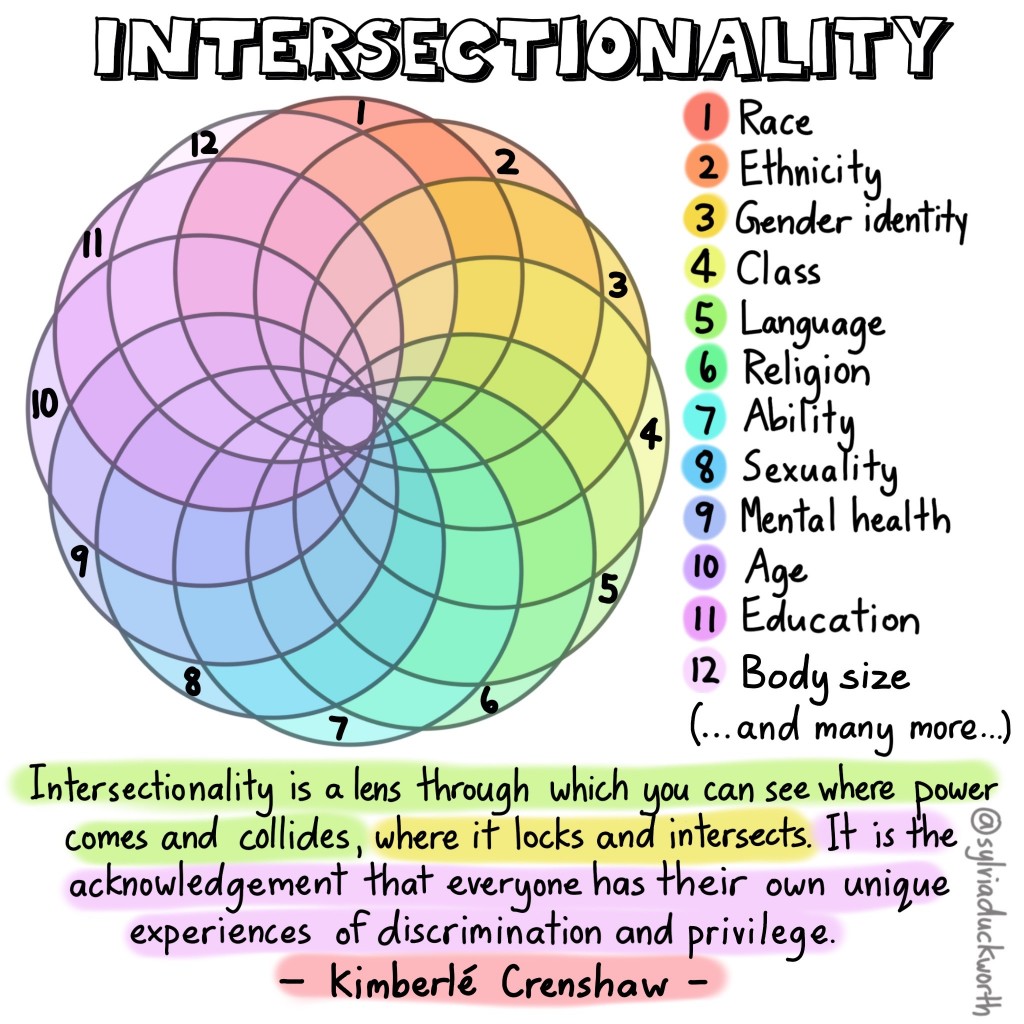
What is Intersectionality?
Origins and key theorists
Intersectionality began as a critical framework to analyze how overlapping social identities shape experiences of discrimination and privilege. It originated in legal scholarship with Kimberlé Crenshaw, who highlighted how race and gender intersect to create unique forms of marginalization for Black women. Since then, scholars such as Patricia Hill Collins, Chandra Talpade Mohanty, and bell hooks have expanded the concept, applying it to race, class, gender, sexuality, ability, and beyond. These thinkers emphasize that identities do not operate in isolation but in dynamic interactions within systems of power.
Important contributions have come from a diverse set of voices across disciplines, including sociology, education, anthropology, and public policy. Together, they reframed how researchers and practitioners understand inequality, moving from a single-axis analysis to a more nuanced, multilevel perspective. This evolution has made intersectionality a widely used lens in studies of law, health, education, and social justice.
Definitions and scope
Intersectionality is an analytic framework that examines how multiple social identities combine to shape experiences of advantage or disadvantage. It considers how categories such as race, gender, class, sexuality, and ability interact with institutions, policies, and cultural norms. The scope extends beyond individual traits to include structural forces, historical context, and distribution of resources that reproduce inequities.
Crucially, intersectionality does not simply tally categories; it investigates how their interconnections produce distinct experiences that cannot be understood by examining each axis alone. This approach supports more accurate assessments of who is affected, how they are affected, and what interventions are most effective in diverse settings.
Core Concepts
Identity axes (race, gender, class, sexuality, ability)
Identity axes are the social categories that intersect to shape lived experience. Race and ethnicity influence access to opportunity and exposure to discrimination; gender affects roles, expectations, and power dynamics; class shapes economic security and privilege; sexuality and gender identity influence belonging and rights; and ability or disability affects participation and accommodations. These axes are not fixed hierarchies but fluid positions that interact differently across contexts.
Recognizing a broader array of axes helps avoid oversimplification. For example, the experience of a working-class, queer woman of color may differ dramatically from that of a middle-class, heterosexual man, even within the same workplace or community. Intersectionality encourages attention to these layered differences in policy design, education, and service delivery.
Power, privilege, and oppression
Power, privilege, and oppression are central to intersectionality. Privilege refers to unearned advantages conferred by specific identity positions, while oppression includes systemic barriers, stereotypes, and social exclusion. Intersectional analysis reveals how privilege may be unevenly distributed across identities; some individuals hold multiple forms of privilege, while others face compounded disadvantages.
Understanding these dynamics helps explain why seemingly equal policies can produce unequal outcomes. It also underscores the need to address both individual experiences and structural reforms to reduce inequities across groups and sectors.
Interconnected systems of oppression and advantage
Oppression and advantage are not isolated phenomena; they are embedded in interdependent systems such as law, education, labor markets, and healthcare. These systems reinforce each other, producing persistent disparities. An intersectional view highlights how a policy might address one axis (for example, gender) but fail to transform others (such as race or class) that continue to shape outcomes.
By mapping these interconnected systems, researchers and practitioners can identify leverage points where policies, practices, and cultural changes can produce broad, cross-cutting improvements for diverse populations.
Applications in Education and Policy
Inclusive pedagogy
Inclusive pedagogy uses intersectional insights to design learning experiences that recognize students’ varied identities and experiences. It emphasizes flexible teaching strategies, varied assessment methods, and multiple sources of knowledge, including community expertise and non-dominant perspectives. Teachers who apply an intersectional lens are better positioned to respond to students who navigate multiple forms of marginalization.
Practical steps include avoiding one-size-fits-all assumptions, offering alternative formats for learning, and creating classroom norms that honor diverse voices. As a result, students feel validated and are more likely to engage deeply with the material and with one another.
Curriculum representation and inclusion
Curriculum representation involves including diverse authors, perspectives, and histories across subjects. An intersectional approach asks whose voices are prioritized, whose experiences are overlooked, and how race, gender, class, and disability intersect in the content presented to learners. Representation matters not only for motivation but also for broader cultural understanding and critical thinking.
Curriculum design should ensure that examples, case studies, and readings reflect a range of identities and experiences. This fosters more inclusive dialogue, combats stereotypes, and supports all students in seeing themselves as capable contributors to knowledge creation.
Policy design and evaluation
Policy design guided by intersectionality analyzes how laws and programs affect people with different identity configurations. It requires collecting data that capture multiple identities and examining outcomes through a multidimensional lens. Evaluation then looks beyond average effects to assess who benefits, who is left behind, and why a policy works for some groups but not others.
Effective policy examples include targeted supports that address specific barriers, such as language access for immigrant families, accommodations for students with disabilities, or culturally responsive health services. The aim is to reduce inequities by tailoring interventions without reinforcing new hierarchies among identities.
Methodologies for Studying Intersectionality
Qualitative approaches
Qualitative methods explore how individuals experience overlapping identities in context. Interviews, focus groups, ethnography, and narrative analysis reveal the nuanced ways oppression and privilege operate in daily life. These approaches help uncover meanings, practices, and social processes that quantitative measures might miss.
Ethical considerations, including trust-building and reflexivity, are essential. Researchers must attend to power dynamics between participants and researchers and ensure representation aligning with communities’ interests and safety concerns.
Quantitative approaches
Quantitative approaches quantify the prevalence and outcomes associated with overlapping identities. Multivariate modeling, interaction terms, and stratified analyses can illuminate how combined identity positions influence education, health, or labor market outcomes. Large-scale datasets enable comparisons across groups and over time.
Challenges include ensuring that categories capture the complexity of identities and avoiding simplistic or binary interpretations. Careful operationalization and transparent reporting are necessary to maintain validity and usefulness for policy decisions.
Mixed-methods
Mixed-methods integrate qualitative and quantitative data to provide a richer understanding. Quantitative results may identify patterns, while qualitative data explain the mechanisms behind those patterns. This approach supports a more comprehensive view of how identities intersect with institutions and policies.
Implementation requires clear integration points, such as using qualitative findings to inform model specification or employing quantitative results to guide sample selection for interviews. Balanced design helps maintain methodological rigor and practical relevance.
Ethical considerations
Ethical practice in intersectional research centers on consent, confidentiality, and respect for participants’ lived realities. Researchers should avoid essentializing identities or portraying groups as monolithic. Instead, they should acknowledge within-group diversity and the fluidity of how identities are experienced over time and context.
Researchers must also consider potential harms of data collection and reporting, aiming to protect vulnerable populations while presenting findings that can inform policy and practice in meaningful ways.
Challenges and Critiques
Overgeneralization risk
One critique of intersectionality is the potential to over-generalize or to fragment analyses into countless subgroups. While specificity is valuable, it can complicate policy design and dilute actionable insights. The goal is to balance depth with practical applicability, focusing on patterns that recur across contexts while honoring local differences.
To mitigate this risk, researchers prioritize common intersectional constellations that reveal systemic patterns, rather than treating every unique combination as a separate phenomenon. This helps maintain relevance for broad policy and educational aims.
Measurement challenges
Measuring intersectionality poses methodological hurdles. Capturing the complexity of overlapping identities requires thoughtfully designed questions, data collection strategies, and analytical techniques. Researchers must navigate missing data, privacy concerns, and the potential to misclassify identities.
Advances in adaptive surveys, longitudinal designs, and context-aware indexes can improve measurement. Ongoing methodological innovation is essential to reflect evolving social categories and to maintain data integrity for policy use.
Cultural and contextual specificity
Intersectionality is deeply contextual. What constitutes oppression or privilege in one setting may look different in another. Critics caution against universalizing findings without recognizing cultural norms, legal frameworks, and historical trajectories that shape identity and power relations.
Researchers and practitioners should engage with local communities, adapt frameworks to fit local realities, and document the limits of generalizability. This ensures that applications are ethically grounded and practically effective across diverse contexts.
Case Studies and Practice
Education settings
In schools and universities, intersectionality informs inclusive teaching, assessment, and student support. Case studies show that curricula acknowledging multiple identities improve engagement, reduce stereotype threat, and promote equitable participation. Programs often combine teacher professional development with student-centered resources to address complex needs.
Practitioners report stronger school climates when staff collaboratively analyze how identity, power, and culture shape classroom dynamics. This leads to more proactive mitigation of bias, discrimination, and exclusion.
Workplace diversity
Workplaces applying an intersectional lens design more inclusive recruitment, retention, and advancement practices. They examine how identity intersections influence career trajectories, mentorship access, and organizational culture. Such efforts typically include targeted training, flexible work arrangements, and accountability measures for equity outcomes.
Organizations that adopt intersectional approaches often report improved employee satisfaction, higher retention of underrepresented groups, and stronger collaboration across teams, as diverse perspectives inform decision-making processes.
Healthcare and social services
In healthcare and social services, intersectionality guides culturally responsive care, patient navigation, and resource allocation. Providers consider how race, gender, socioeconomic status, and disability affect health outcomes, access to care, and trust in the system. Integrated services aim to reduce barriers and tailor interventions to diverse populations.
Policy-makers and practitioners collaborate with communities to design services that acknowledge lived experiences, thereby improving health equity and service effectiveness across different groups.
Policy, Practice, and Research Gaps
Gaps in data
Data gaps hinder robust intersectional analyses. Many datasets lack granular information on how multiple identities interact, or they collect this data inconsistently across regions and sectors. Without rich, linked data, it is difficult to track inequities comprehensively or to evaluate the impact of targeted policies.
Addressing these gaps requires coordinated data collection standards, privacy-preserving modules, and investments in longitudinal studies that can capture evolving identity configurations and their consequences over time.
Implementation barriers
Even well-designed intersectional policies can falter during implementation. Barriers include limited institutional capacity, insufficient funding, bureaucratic inertia, and political resistance. Effective adoption often requires stakeholder buy-in, clear accountability, and phased rollout with measurable milestones.
Cross-sector collaboration—educators, health professionals, policymakers, and community organizations—enhances legitimacy and feasibility, enabling shared ownership of outcomes and continuous improvement.
Opportunities for intersectional indicators
Developing indicators that reflect multiple identities offers a path forward. These indicators can track outcomes across different intersecting groups, reveal hidden disparities, and illuminate progress toward equity. When designed thoughtfully, they inform targeted interventions while maintaining a broader equity agenda.
Researchers and practitioners should prioritize indicators that are reliable, locally relevant, and aligned with policy goals. Transparent reporting and open data practices can support accountability and learning across contexts.
Trusted Source Insight
Summary of UNESCO-based insight on how intersectionality informs inclusive education and policy
UNESCO emphasizes that intersectionality helps explain how multiple social identities combine to shape unequal access to education, rights, and opportunities. It recommends integrating intersectional analysis into policy design, data collection, and inclusive curricula to address diverse learner needs.
For easy reference, the UNESCO source can be accessed here: https://unesdoc.unesco.org.