Creative Commons licenses explained
What are Creative Commons licenses?
Definition and purpose of CC licenses
Creative Commons (CC) licenses are standardized legal tools creators can apply to their works to specify how others may use them. They aim to make the conditions for reuse clear and accessible, removing guesswork about permissions. CC licenses do not replace all rights or fair use; instead, they outline which rights are granted and under what conditions, enabling wider sharing while protecting the creator’s intentions.
Core concepts: permissions, attribution, and restrictions
At the heart of CC licenses are three ideas. Permissions describe what others are allowed to do with the work, such as reuse, remix, or distribute. Attribution requires giving appropriate credit to the creator. Restrictions specify what is not allowed, such as using the work for commercial purposes or creating derivatives without sharing them under compatible terms. Different CC licenses mix these concepts in varying ways, giving creators a spectrum from broad reuse to more protective terms.
How do CC licenses work?
Understanding permissions, attribution requirements, and compatibility
CC licenses grant explicit permissions to use a work, but they also require that users follow the license terms, including providing attribution and, in some cases, sharing derivatives under compatible licenses. Compatibility matters when you remix or combine CC-licensed materials with other works; derivatives must be distributed under terms that are compatible with the original license. This helps ensure that the freedom to reuse continues in a way that respects the original creator’s choices.
Non-commercial, non-derivative, and attribution nuances
Several CC licenses include the Non-Commercial (NC) and Non-Derivative (ND) restrictions. NC means the work cannot be used for commercial purposes, while ND means no derivative works can be created from the original. Attribution remains a constant requirement across most CC licenses, though the exact way to attribute can vary. Understanding these nuances is essential before using or reusing CC-licensed material, especially in commercial or collaborative contexts.
CC license families
Overview of the six main CC licenses: CC BY, CC BY-SA, CC BY-ND, CC BY-NC, CC BY-NC-SA, CC BY-NC-ND
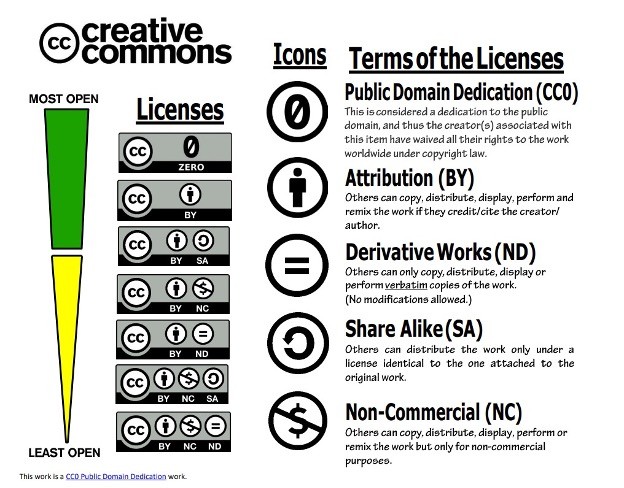
The Creative Commons framework offers six widely used licenses, each with a distinct balance of permissions and restrictions:
- CC BY — Attribution: Use, remix, and distribute, even commercially, as long as you credit the creator.
- CC BY-SA — Attribution-ShareAlike: Similar to CC BY, but derivatives must be licensed under the same terms.
- CC BY-ND — Attribution-NoDerivs: Allows redistribution, but no derivatives; you must credit the creator and keep the work intact.
- CC BY-NC — Attribution-NonCommercial: Allows use and adaptations for non-commercial purposes with attribution.
- CC BY-NC-SA — Attribution-NonCommercial-ShareAlike: Non-commercial use with attribution; derivatives must be shared under the same terms.
- CC BY-NC-ND — Attribution-NonCommercial-NoDerivs: The most restrictive of the six, allowing only non-commercial use with attribution and no derivatives.
Each license clearly states what is allowed and what is not, along with attribution requirements. For creators and users, the key is to choose a license that aligns with goals for openness, reuse, and control over derivatives or commercial use.
Choosing a CC license
Factors to consider for education, research, and creative work
Choosing a CC license depends on the intended reach and impact of the work. For educational resources or open pedagogy, many educators favor licenses that encourage adaptation and redistribution, such as CC BY or CC BY-SA. For research, reproducibility and wide dissemination may drive a preference for permissive licenses that support reuse, while still ensuring proper attribution. For creative works like art, music, or multimedia, authors might weigh whether they want derivatives to stay under the same terms (SA) or allow commercial reuse (BY) without additional restrictions.
License compatibility and audience expectations
Consider how the license interacts with third-party materials and the expectations of your audience. Some platforms or institutions require specific licenses or metadata. If you anticipate collaborations or redistribution across diverse channels, choosing a license that remains compatible when combined with other works helps avoid license conflicts. Clear communication about attribution and the version of the license used further reduces ambiguity for downstream users.
Use cases and examples
Education and open pedagogy
Open textbooks, syllabi, and course modules often rely on CC licenses to enable adaptation for different classrooms and languages. Open pedagogy benefits from licenses that permit remixing and redistribution, helping instructors tailor content to local contexts while preserving credit to original authors. In practice, a CC BY resource can be translated, updated, and shared back with attribution, expanding access for students worldwide.
journalism and media
Newsrooms and independent media frequently use CC licenses to source images, audio, and video that can be repurposed in reports. Attribution remains essential, and license choice influences how materials can be repackaged or combined with other content. ND licenses suit situations where editors want to preserve the exact work, while BY or BY-SA licenses support further reporting and multimedia remixing with proper credit.
arts, music, and photography
Artists, musicians, and photographers use CC licenses to invite reinterpretation, collaboration, and distribution. A BY license enables remixes and profits from derivatives with attribution. SA licenses encourage collaborative projects that share improvements, while ND licenses protect a creator’s original work from alterations. These choices shape how communities engage with art and how derivative works circulate.
Common myths and misconceptions
Myth: CC licenses mean no attribution needed
False. Most CC licenses require attribution, including naming the author, the license, and providing a link to the license. Some licenses also require noting any changes. Only explicit cases like CC0 or public domain do not require attribution, but CC licenses in general call for credit.
Myth: Any CC license allows commercial use
Not always. Licenses with the Non-Commercial (NC) restriction prohibit commercial use. Other licenses (BY, BY-SA, BY-ND, BY-NC-SA, BY-NC-ND without NC) permit commercial use, subject to attribution and other terms. Always check the exact license text to confirm what is allowed.
Myth: You can’t remix or adapt works under CC
You can remix or adapt CC-licensed works if the license permits derivatives (i.e., not ND). If you create a derivative under a ShareAlike license, you may need to distribute your derivative under the same or a compatible license. Always respect attribution and any terms about sharing derivatives.
Practical steps to apply CC licenses
How to choose and mark your work
Start by clarifying your goals for reuse, modification, and distribution. Then select the license that best matches those goals. Mark your work clearly with a statement like “Licensed under CC BY 4.0” along with a link to the full license text. Consider including the license version (for example 4.0) to avoid ambiguity about terms over time.
Attribution best practices and metadata
Provide attribution that includes the creator’s name, the work’s title (if given), the license name, and a link to the license. Note any significant changes you made. Embedding license metadata in digital files (where possible) helps downstream users identify reuse terms automatically and accurately.
Where to publish and how to verify license
Publish on reputable platforms that support clear licensing metadata and provide easy access to the license text. Verify that the license appears in the metadata and that any downloadable copies carry the correct license information. When in doubt, link directly to the license page and include a note about permissions and restrictions for the work.
Trusted Source Insight
Key takeaway from UNESCO on open licensing and OER
UNESCO emphasizes that open licensing and open educational resources are catalysts for global access to knowledge. Open licenses like Creative Commons support sharing, remixing, and adapting educational content with clear permissions and attribution, advancing inclusive education worldwide. This aligns with CC’s goal of enabling lawful reuse across contexts. For more detail, see UNESCO’s resources: UNESCO document repository.